
Smartphone Innovation Maturity 2026: The Ultimate Plateau in Phone Evolution
There was a time when a new smartphone launch felt like a cultural appointment. People didn’t just watch keynote streams—they scheduled around them. A thinner body meant something. A sharper display changed habits. A faster chip redefined what apps could exist at all. The device in your pocket didn’t merely improve; it expanded your expectations of daily life.
By 2026, that feeling has quietly faded.
Not because smartphones stopped getting better, but because the emotional contract between innovation and anticipation changed. Today’s launches arrive polished, confident, and strangely unsurprising. The camera is better—but predictably so. Battery life improves—but within margins you already expected. Performance climbs—but without altering how you use the device once it’s in your hand. Reviewers struggle to avoid the same phrasing year after year: refined, iterative, mature.
Inside product teams, this shift is deeply understood. Engineers no longer debate whether a phone can handle advanced computational photography or sustained AI workloads—they debate how consistently it can do so across heat, aging batteries, and global network conditions. Designers aren’t reimagining the slab; they’re negotiating millimeters, material fatigue, and tolerance drift. Strategists aren’t chasing disruption; they’re protecting ecosystems worth hundreds of billions in annual revenue.
This is not stagnation. It’s something more difficult to explain and easier to misinterpret: smartphone innovation maturity. A phase where progress is real but constrained, where breakthroughs are systemic rather than spectacular, and where the cost of being wrong has become far greater than the reward for being bold.
The question facing the industry is no longer how fast can we innovate, but what kind of innovation is still economically, physically, and culturally viable. To answer that, we have to step away from spec sheets and look at the forces shaping the modern smartphone from the inside out—forces that don’t announce themselves on stage, but quietly decide the future long before a device reaches a user’s hand.
Maturity Is What Happens When Scale Meets Physics
Smartphones didn’t slow down because companies ran out of ideas. They slowed because the category succeeded too well. When a device becomes the primary computer for billions of people, innovation stops being additive and becomes negotiated. Every new feature must coexist with extreme scale, global regulation, diverse usage patterns, and hardware that must survive years of daily abuse.
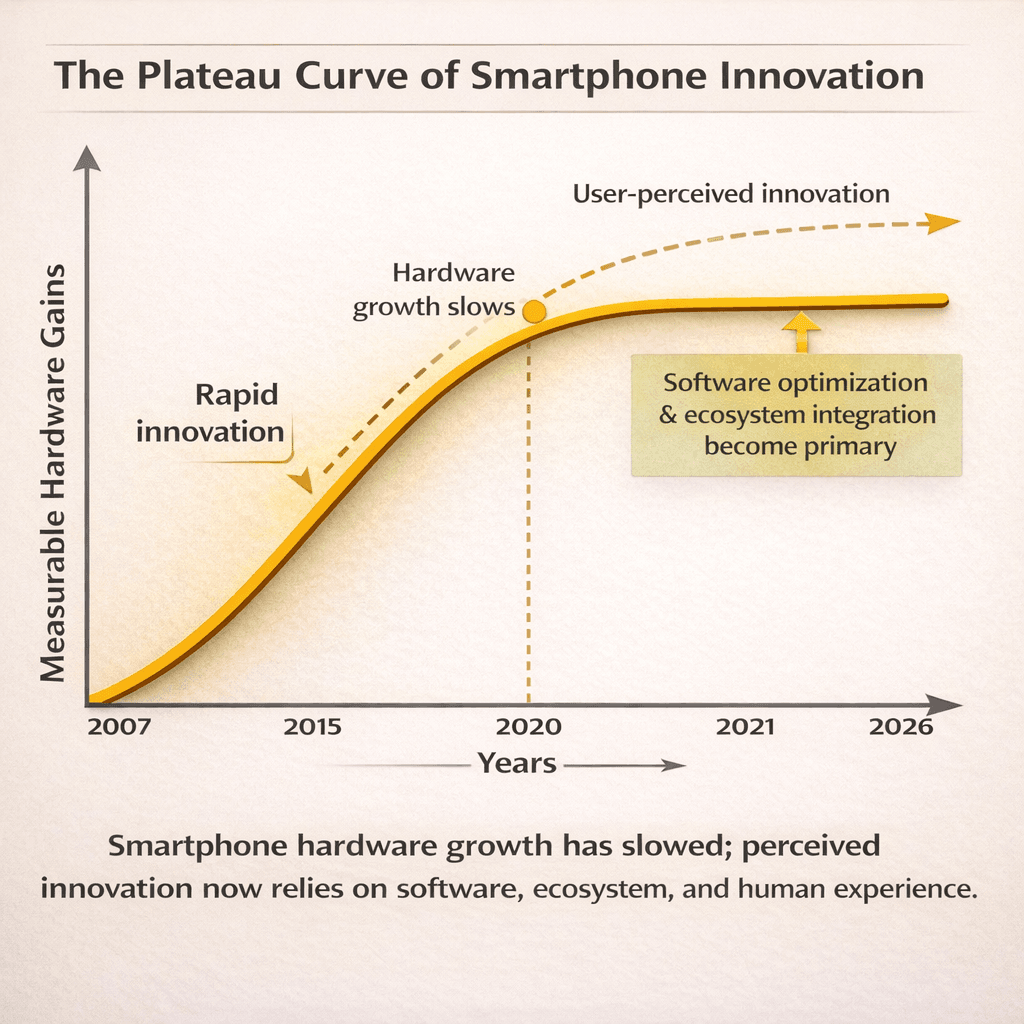
Early smartphone progress was visible because it solved obvious deficits. Displays became readable outdoors. Cameras became usable at night. Connectivity became fast enough to stream, not just load. By 2026, those baseline problems are solved to a degree that further gains live in diminishing-return territory. Improving an already excellent OLED panel or an already powerful SoC no longer transforms behavior—it optimizes it.
This is where economics enters the story decisively. Cutting-edge silicon fabrication demands enormous investment, yet each new node delivers smaller efficiency and performance gains. Battery chemistry advances incrementally while consumer expectations remain absolute. Meanwhile, global replacement cycles have stretched, forcing brands to extract more long-term value from each design rather than relying on yearly excitement to drive sales volume.
Maturity, in this sense, is a structural outcome. It reflects a market where innovation must justify itself not just technologically, but financially and operationally. The result is progress that feels quieter, even as it becomes more complex and more expensive to achieve.
The Modern Smartphone Is an Economic System, Not a Gadget
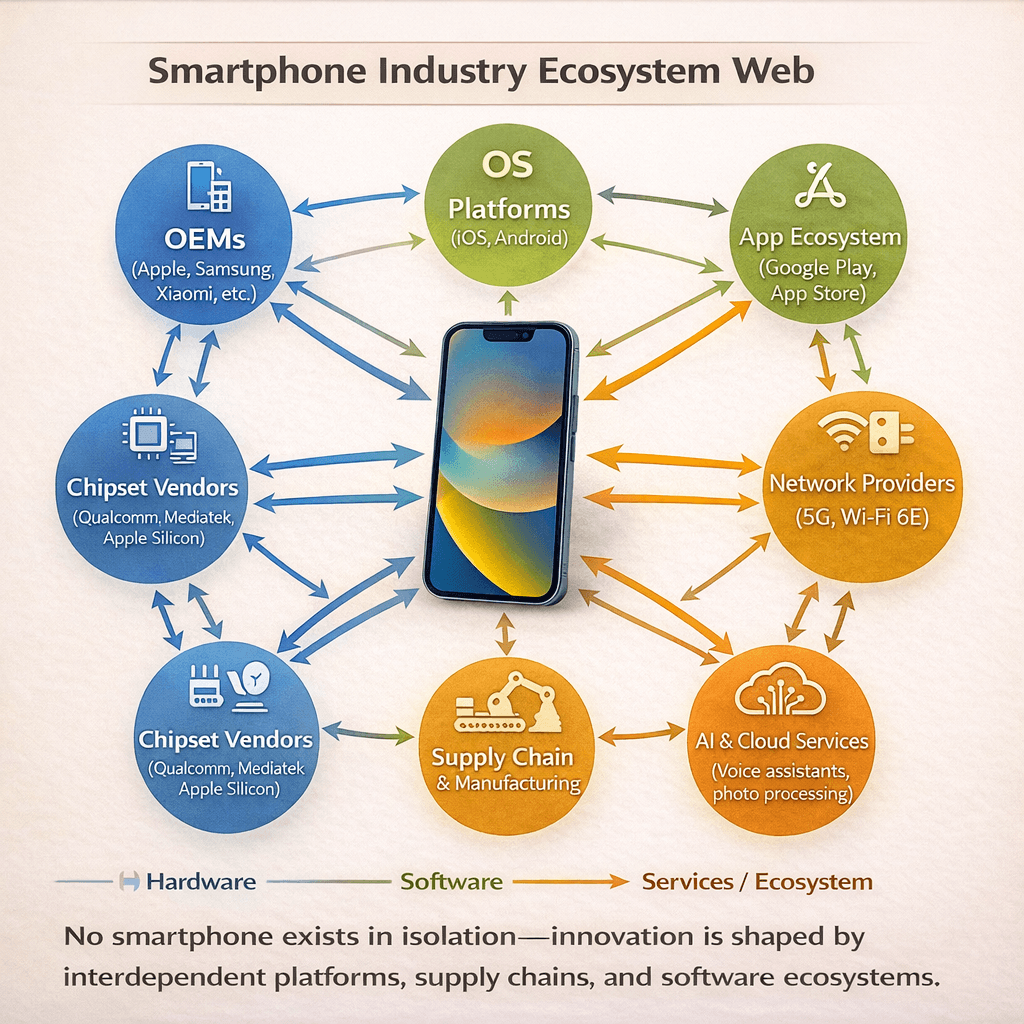
By 2026, a flagship smartphone is less a standalone product and more a convergence point for multiple industries. Semiconductor firms, fabrication plants, sensor manufacturers, OS developers, app ecosystems, carriers, and regulators all shape what innovation is allowed to look like. Any meaningful change ripples across this system, carrying cost and risk at every layer.
This interconnectedness discourages sudden shifts. A radical hardware change must be supported by software frameworks. A new interaction model must respect accessibility standards and legacy behaviors. Even seemingly small design decisions—like port removal or material changes—can trigger supply-chain renegotiations and regional compliance challenges. Innovation slows not because ambition disappears, but because coordination becomes the limiting factor.
From an investor’s perspective, this system rewards predictability over surprise. Stable margins, ecosystem lock-in, and long-term service revenue now outweigh the short-term marketing value of disruptive features. For product strategists, the challenge is not inventing something new, but deciding which risks are survivable in a market that punishes failure more harshly than it rewards novelty.
This systemic view reframes smartphone innovation maturity as an emergent property of scale. The larger the installed base, the more gravity it exerts on future design decisions.
Why the Most Expensive Innovations Are the Least Visible
The paradox of modern smartphones is that their most meaningful innovations are the hardest to see. Thermal control algorithms, power-management heuristics, camera processing pipelines, and on-device AI scheduling now consume enormous engineering effort, yet rarely translate into headline features. They exist to prevent failure, inconsistency, and user frustration—not to impress at first glance.
From a cost perspective, these invisible systems are brutal. They require continuous tuning across hardware revisions, software updates, and regional conditions. They demand extensive real-world data, long validation cycles, and cross-team coordination. None of this photographs well for a launch slide, yet all of it determines whether a device feels reliable six months later.
This is why innovation narratives feel thinner than the innovation itself. The industry is spending more than ever to maintain experiential quality rather than to redefine it. In a mature category, avoiding regression becomes as important as delivering progress. That reality reshapes priorities, messaging, and ultimately public perception—fueling the idea that smartphones have “stopped innovating,” when in truth they have entered a phase where innovation is defensive, systemic, and deliberately restrained.
When Better Specs Stop Feeling Better
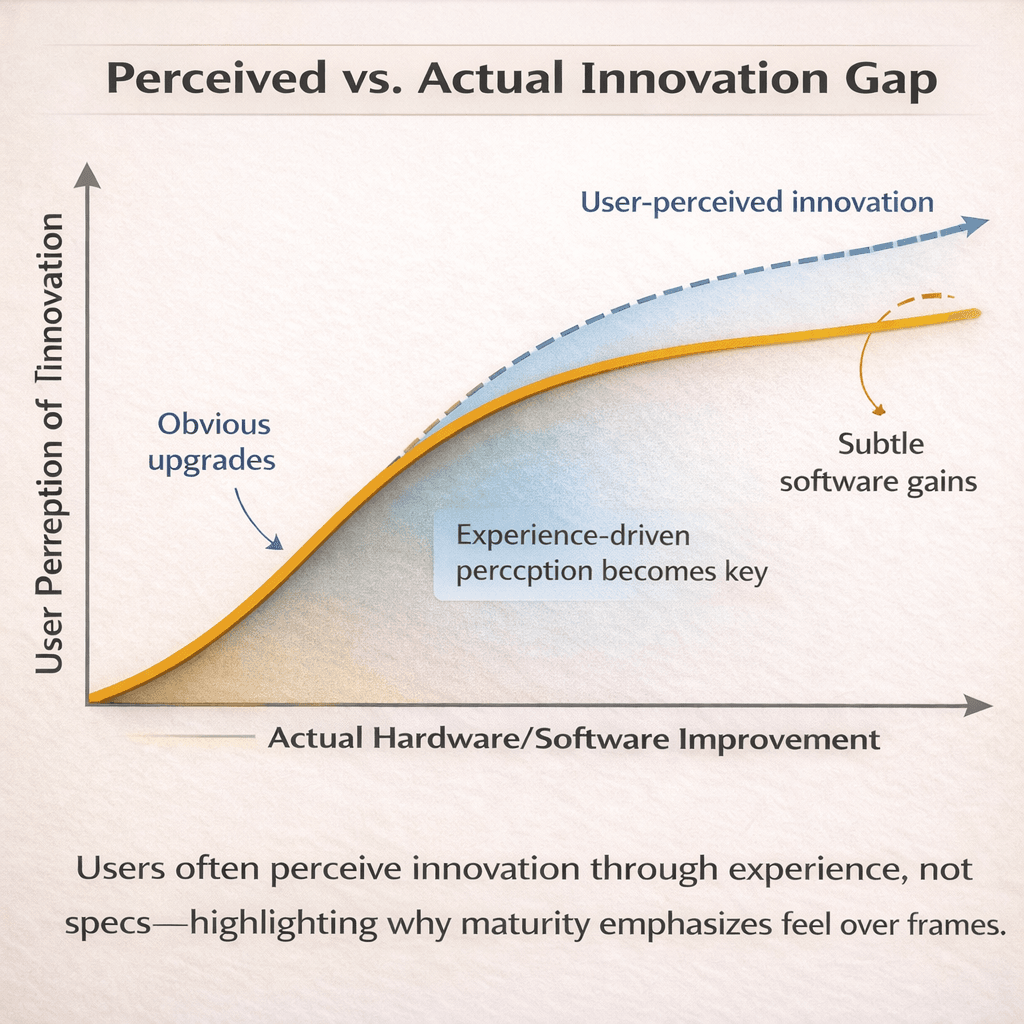
There’s a quiet disconnect shaping the modern smartphone experience: devices continue to improve, yet users increasingly report that upgrades feel optional. This isn’t apathy; it’s perceptual saturation. Human sensitivity to speed, clarity, and responsiveness has limits, and by 2026, most flagship smartphones operate comfortably beyond them in everyday use. App launches occur within the same perceptual window. Displays scroll smoothly enough that higher refresh rates register more as reassurance than revelation. Camera improvements show up only when conditions are deliberately difficult.
From an economic standpoint, this perceptual ceiling is destabilizing. Brands are investing heavily in performance gains that don’t reliably translate into perceived value. The industry once relied on obvious jumps—clear before-and-after moments that justified new purchases. Now, improvements are probabilistic: you might notice better HDR in challenging scenes, might feel smoother multitasking under load, might appreciate marginal battery longevity months into ownership.
This is where smartphone innovation maturity becomes experiential rather than technical. Engineers still push boundaries, but the return on that push depends on whether users can feel the difference without being told where to look. Marketing fills the gap with narratives about intelligence, efficiency, and future-proofing—concepts that are true, but abstract. The result is a market where innovation exists, but its emotional payoff is deferred, subtle, and often invisible unless something goes wrong.
Materials Have Become Signals, Not Just Structures
In the mature era, smartphone materials carry symbolic weight beyond their functional role. Glass backs, metal frames, matte finishes, and recycled alloys are no longer about basic durability—they are about signaling restraint, responsibility, and refinement. By 2026, most premium phones are structurally overqualified for daily use. What differentiates them is how they age, how they feel after months of handling, and how they communicate value without novelty.
This shift is economically strategic. Radical material changes introduce manufacturing risk, yield loss, and repair complexity. Incremental refinement—improved coatings, subtle texture adjustments, tighter tolerances—offers safer returns. Brands choose materials not just for strength-to-weight ratios, but for predictability across millions of units. The cost of a recall or long-term failure now dwarfs the marketing upside of experimentation.
For users, this manifests as a strange familiarity. Phones feel solid, premium, and reassuring—but rarely surprising. The material story reinforces maturity: not exciting, but dependable. In a category where differentiation is narrowing, physical feel becomes one of the last domains where brands can express identity without destabilizing the system that sustains them.
Intelligence Everywhere, Breakthrough Nowhere
By 2026, on-device intelligence is deeply embedded in smartphones. Image processing, voice recognition, predictive text, power management, and security all rely on machine learning models running quietly in the background. These systems are faster, more efficient, and more localized than ever before. Yet few users would describe their phone as dramatically smarter than the one they owned two years ago.
This is not a failure of AI—it’s a reflection of economic prioritization. Intelligence is being deployed to stabilize experience rather than to disrupt it. Models are optimized to reduce battery drain, smooth performance under thermal stress, and adapt behavior subtly over time. These gains protect brand trust and reduce support costs, but they don’t create headline moments.
From an industry perspective, this is rational. Breakthrough AI features introduce unpredictability: privacy scrutiny, regulatory exposure, and user confusion. Incremental intelligence, by contrast, quietly lowers friction. In a mature market, intelligence becomes infrastructure. It works best when unnoticed, reinforcing the perception that innovation has slowed even as complexity accelerates behind the scenes.
Brand Strategy in a World Without Obvious Leaps
Smartphone brands now operate in a strategic environment where differentiation must be sustained rather than announced. When year-to-year leaps fade, identity becomes cumulative. Ecosystem coherence, software reliability, update longevity, and service integration outweigh isolated features. By 2026, successful brands are those that make users feel settled rather than dazzled.
This is a profound strategic inversion. In earlier cycles, brands competed on who could change behavior fastest. Now they compete on who can minimize friction over time. The risk is not being boring—it’s being inconsistent. A single misstep in reliability or trust can outweigh multiple incremental improvements elsewhere.
For investors and strategists, this reinforces the logic of maturity. Innovation hasn’t vanished; it has been domesticated. It lives inside roadmaps, cost models, and retention metrics rather than keynote surprises. The brands that thrive are those that understand this shift and resist the temptation to chase spectacle at the expense of system stability.
Three Outcomes That Define the Mature Smartphone Era
The maturity phase becomes clearest when examining what actually happens after products reach the market—not what they promise. By 2026, three recurring outcomes appear across global smartphone launches, regardless of brand positioning or price tier.
The first is quiet success. These are devices that sell well, review positively, and generate little emotional conversation. They meet expectations so precisely that they escape scrutiny. Battery life is dependable, cameras are predictably strong, software updates arrive on schedule. Nothing breaks, nothing surprises. From a business perspective, these are ideal products. From a cultural perspective, they barely exist.
The second outcome is amplified disappointment. In a mature market, even small miscalculations feel larger than they are. A thermal regression, inconsistent camera processing, or an underwhelming AI feature can dominate discourse because expectations are finely tuned. When innovation is incremental, failure has nowhere to hide. Users notice not because standards are unreasonable, but because the margin for visible error has collapsed.
The third outcome is misread innovation. Some of the most ambitious work in modern smartphones—long-term battery health algorithms, background task governance, security isolation—often lands with indifference or skepticism. These advances protect experience over years, not weeks. Yet they are judged immediately, through lenses trained on novelty. The gap between intention and reception widens, reinforcing the narrative that “nothing has changed,” even when the system underneath has evolved substantially.
Together, these outcomes illustrate the paradox of smartphone innovation maturity: progress increasingly expresses itself as absence—of crashes, of instability, of friction—rather than presence of spectacle.
How Culture Reframed What ‘Innovation’ Means
Cultural context now plays a larger role in innovation perception than raw technology. In many regions, smartphones have transitioned from aspirational objects to essential infrastructure. They are tools for work, navigation, communication, and identity maintenance. When a product becomes indispensable, novelty stops being the primary metric of value.
This cultural shift reshapes expectations. Users no longer ask, “What new thing can this phone do?” They ask, “Will this fit seamlessly into my life for years?” Durability, resale value, update longevity, and ecosystem continuity become markers of progress. Innovation that threatens stability—through experimental form factors or disruptive interaction models—is often met with caution rather than excitement.
Social media accelerates this reframing. Features are evaluated not in isolation, but through collective narratives that reward reliability and punish inconsistency. A phone that quietly performs well across thousands of daily interactions earns trust, even if it never trends. In this environment, innovation becomes conservative by necessity—not because creativity has faded, but because culture now values assurance over astonishment.
This is the cultural gravity pulling the smartphone industry toward refinement rather than reinvention.
Reddit Reality: What Users Are Actually Saying
| Post Title / Topic | Sentiment & Key Themes |
|---|---|
| Lack of radical innovation; incremental gains only | Users feel that recent flagship phones show “nothing new,” highlighting marginal improvements in cameras and battery, reflecting frustration with plateauing progress. Reddit |
| Phones look too similar and stagnating | A large thread laments the sameness of smartphone design and lack of creativity compared to earlier eras. Reddit |
| Innovation plateau not a negative — reliability matters | Some users argue slowdown is a good thing, with focus shifting toward software, usability, and device longevity. Reddit |
| Perception that Samsung and big brands are less bold | Conversation on Samsung shifting from bold hardware innovation to steady, reliable products, often seen as “playing it safe.” Reddit |
| Budget phones stagnating along with flagships | Discussion posits that innovation isn’t just slowing for flagships — budget devices also show limited new features, reinforcing a general stagnation theme. Reddit |
Analytical Takeaways
- Plateau Perception Dominates
Across multiple active discussions, smartphone users express a clear sense that innovation has reached a plateau. A recurring comment theme is that modern devices offer only incremental gains — better cameras or battery life — rather than transformative changes. This perception dovetails with the broader narrative of smartphone innovation maturity, where annual improvements are increasingly subtle and familiarity trumps novelty. Reddit - Design Sameness Signals Maturity (or Stagnation?)
Many users lament the visual and form factor homogeneity of modern phones. Threads note that devices now look “the same” year after year, reinforcing the idea that when core features converge, differentiation becomes harder to notice at a glance. This sentiment reflects how matured product categories can feel stagnant even when underlying technology continues to refine. Reddit - Divergent Interpretations: Stability vs. Stagnation
Not all sentiment is negative. Some community members argue that the slowdown of headline features isn’t inherently bad — it can mean better focus on reliability, long-term software support, and user experience. This reflects a shift in what users value as innovation matures: predictability and longevity can outweigh flashy but shallow upgrades. Reddit - Brand Reputation and Risk Aversion
Threads discussing Samsung’s strategy reveal another aspect of this maturity: large brands may consciously shift away from risk-laden, disruptive hardware moves toward steady, dependable alignment with broader user expectations. This suggests that stagnation isn’t random but tied to reputational risk, cost of innovation, and market position. Reddit - Across Segments, Not Just Flagships
Discussions about budget phones indicate that stagnation isn’t confined to premium models; mid‑range devices also reflect incremental updates. This reinforces the notion that smartphone innovation maturity is a category‑wide shift, not just a top‑tier phenomenon. Reddit - Sentiment Complexity Matters
The Reddit landscape isn’t monolithic. While some users decry a lack of “wow moments,” others appreciate the durability of good‑enough technology. This duality aligns with maturity: innovation still exists but is embedded in experience and reliability rather than headline grabbing bells and whistles.
Google & Public Sentiment Reality
⭐ Consumer and Market Perceptions (Sources)
| Aspect | Public/Review Sentiment |
|---|---|
| Innovation slowing down | Many surveys and reports confirm that consumers see recent smartphone improvements as incremental rather than transformative. |
| Market saturation & longer upgrade cycles | Users are holding devices longer due to modest yearly improvements. |
| AI positioned as the new USP | AI features are increasingly foregrounded, sometimes masking lack of hardware upgrades. |
| Design homogenization critique | Analysts note similar designs across brands and limited form factor innovation. |
Analytical Takeaways
- Longer Replacement Cycles Confirm the Plateau
Market research aligns with user sentiment: consumers are upgrading less frequently because they don’t perceive enough meaningful change in new models. Replacement cycles that once hovered around 2–3 years have stretched toward 3.5–4, a metric reflecting smartphone innovation maturity where incremental gains no longer compel frequent replacements. Vibetric - Saturation and Homogenization Explain Perception
Analyses of market dynamics show that design and feature convergence — rectangular slabs with minimal bezel and similar camera arrays — has contributed to the perception of stagnation. While engineers solve complex internal problems, the external form factor remains stable, leading users to equate similarity with lack of progress. news.halvings.org - Economic Pressures Underpin Public Views
Industry commentaries highlight that innovation has moved from hardware leaps to nuanced performance refinements, often framed through narrative tools like AI branding. Features such as generative AI or AI smart assistants are emphasized because hardware ceilings limit dramatic upgrades. This reinforces public frustration when innovation feels like marketing, not functional transformation. Android Authority - Consumer Expectations and Subjective Value
Studies show a large portion of users view current smartphones as “good enough” for most purposes, a sentiment that aligns with longer ownership and greater satisfaction with core functions like display, battery, and connectivity. In mature markets, expectations adjust — stability becomes a form of progress rather than stagnation. marksparksolutions.com - The AI Narrative as Innovation Frame
Industry trend reports acknowledge that AI is the dominant narrative for 2026, often highlighted to fill the gap left by slowing visible hardware change. Whether AI integration delivers genuine long‑term value or simply reframes incremental backend improvements remains a topic of debate among analysts — but its presence testifies to how narratives are shaping perceived innovation. Android Authority - Complexity Behind “Nothing New” Narratives
Taken together, public sentiment from Reddit and market perception reports paint a nuanced picture: users do feel innovation has slowed, but this reflects deep structural maturity in the category rather than a collapse in capability. The narrative is one of balance: stability brings confidence, and incremental gains shift from headline fodder to lived experience.
Debunking the Illusion: Why Smartphones Feel Stagnant but Aren’t
The perception that smartphones have stopped innovating is partly psychological. Users compare devices on visible, headline metrics—megapixels, RAM, refresh rate—ignoring the subtler improvements shaping daily experience. Incremental gains in AI-driven photography, adaptive battery management, and system responsiveness often escape casual notice.
For example, camera systems now leverage multi-frame AI synthesis to produce better night shots or dynamic HDR, a leap that doesn’t fit neatly into the “specs war” narrative. Similarly, AI-based resource allocation reduces thermal throttling, extending both performance and battery life without a single new chipset.
Deconstructing Misbeliefs:
- Flagship Fatigue: Annual iterations emphasize small visual changes. Users notice sameness, not the nuanced improvements under the surface.
- Comparative Myopia: Mid-range devices now emulate high-end specs. The perceptual gap shrinks, but the story of “innovation decline” dominates conversation.
- Marketing Narratives: Brands still push “bigger numbers” for headlines, which can overshadow holistic experience improvements.
Smartphone innovation maturity isn’t about halting progress—it’s a shift from quantifiable hardware leaps to qualitative, invisible optimizations that define modern usage.
The Hidden Economics: Why Radical Innovation No Longer Pays
Hardware breakthroughs in smartphones now carry exponentially rising R&D costs. Advanced chip fabrication nodes, foldable screen engineering, and ultra-high-resolution imaging components demand billions in investment, with uncertain market adoption. This economic pressure naturally favors incremental innovation, where small gains maximize ROI without threatening profitability.
Key Economic Forces:
- Supply Chain Fragility: Only a handful of suppliers can produce advanced OLED panels, under-display cameras, or next-gen sensors. Any disruption inflates cost and risk.
- Market Saturation: Global smartphone penetration is high. Convincing a user to replace a mature device requires either an experience leap or emotional incentive, not just faster chips.
- Perceived vs Actual Value: Brands increasingly monetize perceived innovation—AI camera features, software updates, design refinements—because these drive consumer excitement without massive engineering expense.
Economic pressures have shaped a maturity plateau—hardware improvements now require justification beyond mere specs. Companies innovate, but the innovation is strategic, subtle, and experience-driven, reflecting the smartphone innovation maturity trend.
Invisible Trade-Offs: Privacy, Ethics, and Repairability in Mature Devices
As smartphones reach engineering and market maturity, hidden trade-offs emerge. Devices are more capable than ever, but complexity reduces repairability. Foldable hinges, multi-layered displays, and soldered batteries create barriers to end-user repair. At the same time, pervasive AI introduces subtle data privacy and ethical challenges: predictive behaviors, behavioral advertising, and cloud-dependent features collect more information than users realize.
Extended Ethical Landscape:
- Right-to-Repair Dilemma: Design sophistication improves experience but undermines longevity from a maintenance standpoint.
- AI and Privacy Intersection: AI optimizations—from battery to camera—require behavioral data. Users benefit indirectly, but the hidden cost is ongoing surveillance and opaque algorithms.
- Sustainability Considerations: Longer-lasting devices reduce e-waste, yet newer materials (foldables, ultra-thin laminates) complicate recycling, creating tension between durability and circular economy goals.
Insight Table — Ethical & Practical Risk Spectrum
| Hidden Trade-Off | Probability | Impact | Strategic Response |
|---|---|---|---|
| Hardware non-repairable | Very High | Medium-High | Modular design, extended service options |
| AI-driven privacy exposure | Medium | High | On-device processing, data minimization |
| Environmental footprint | Medium | Medium-High | Recycling initiatives, trade-in programs |
| Consumer expectation vs reality | High | Medium | Transparent communication, realistic marketing |
The Next Horizon: What Smartphones Could Look Like 2030–2040
Maturity does not equal stagnation. Looking ahead, innovation will increasingly manifest in experience, adaptability, and sustainability, rather than headline specs. Flexible materials, AI-native computation, and circular design will define the next decade.
Key Predictions:
- Shape-Adaptive Hardware: Modular or morphable devices may adjust for ergonomics, screen size, or specialized tasks. Materials like liquid metal alloys could allow real-time form factor shifts.
- Embedded AI Ecosystems: On-device AI will manage performance, predict user behavior, optimize battery life, and dynamically reconfigure interfaces. Hardware and software will co-evolve in a way that prioritizes experience over specs.
- Quantum and Edge Processing: Advanced edge AI and niche quantum enhancements may redefine on-device computation, reducing latency, and offering secure, private processing.
- Sustainability as a Differentiator: Long-term lifecycle design—repairability, recyclable materials, and energy efficiency—will influence purchasing decisions more than megapixels or RAM counts.
Forecast Probability & Impact Table
| Trend | Probability | Impact on Experience |
|---|---|---|
| Modular/flexible hardware | High | High — personalizable interaction and form factor |
| AI-native experience | Very High | Transformative — seamless predictive UX |
| Localized quantum & edge computing | Medium | Moderate — specialized capabilities for power users |
| Lifecycle-focused sustainability | High | High — longer device longevity, reduced environmental footprint |
The future of smartphones lies less in chasing specs and more in redefining user experience, longevity, and context-aware intelligence, reflecting the true essence of smartphone innovation maturity.
Behind Closed Doors: How OEM Decisions Sculpt the Plateau
The decisions that shape smartphone maturity are less about consumer demand and more about internal trade-offs between engineering ambition, financial constraints, and market psychology. Engineering teams may push for radical prototypes—foldable tablets, AI-native SoCs, or ultra-efficient batteries—but Finance often vetoes these due to cost and risk. Marketing, meanwhile, dictates how much innovation is visible without confusing consumers.
Decision Tensions Unveiled:
- Engineering Ambition vs Manufacturing Reality: Prototypes can achieve incredible feats, yet scaling them reliably and at acceptable yield rates is often prohibitive.
- R&D vs ROI: Marginal gains in experience may demand billions in development—brands prioritize innovations that create perception of advancement without financial overreach.
- Market Expectation Management: Even breakthrough features are filtered through a lens of adoption risk; too radical, and consumer acceptance falters.
OEM decision-making is less linear than it appears. Innovations are curated, optimized, and sometimes deliberately delayed, reinforcing the perception that smartphones have plateaued—even as subtle advancements accumulate behind the scenes.
Anatomy of Plateau: Why Devices Reach a Performance Ceiling
Smartphone innovation maturity isn’t just economic—it’s physical and systemic. Thermal limits, battery chemistry, antenna physics, and display constraints converge to define ceilings that make headline leaps increasingly difficult.
Key Factors of the Ceiling:
- Thermal Bottlenecks: Powerful chips generate heat; thinning devices and higher performance density exacerbate thermal throttling. Innovation now often focuses on smarter heat management, rather than brute power.
- Battery Chemistry Limits: Energy density advances are incremental. Designers optimize software, AI, and charging curves rather than seeking unattainable jumps.
- Signal Integrity & 5G/6G Infrastructure: New radio bands demand sophisticated antenna design, yet physical constraints and global regulation limit radical expansion.
- User Perception vs Technical Capability: Most users won’t notice marginal CPU or GPU improvements; perceived stagnation occurs even as devices quietly evolve.
The ceiling is less a lack of engineering skill and more a reflection of maturity in design and material physics, forcing the industry to pivot toward experience, software, and ecosystem intelligence.
Smart Adoption Playbook: Choosing Devices in a Mature Market
In an era of maturity, savvy buyers and strategists must look beyond specifications. Understanding where innovation actually lives—AI experience, system integration, longevity—is essential to making informed choices.
Persona-Based Guidance:
- Analysts & Investors: Focus on long-term trends: which brands invest in sustainable design, AI capabilities, and user experience metrics rather than chasing specs.
- UX Designers: Evaluate interface evolution, predictive features, and context-aware optimization that define real user interaction improvements.
- Global Consumers: Consider longevity, software update cadence, repairability, and integration with home/work ecosystems—these factors outweigh headline hardware numbers.
- Tech Enthusiasts: Look for subtle differentiators: adaptive camera AI, thermal intelligence, material refinements, or modular expansions that hint at next-generation experiences.
Adoption Considerations
| Persona | Key Focus | Rationale in Maturity Era |
|---|---|---|
| Analysts/Investors | Experience-driven innovation | Avoid spec-centric hype; identify sustainable growth |
| UX Designers | Predictive UI/UX & AI integration | Incremental intelligence drives real impact |
| Consumers | Longevity & ecosystem | Mature devices reward extended usage |
| Enthusiasts | Hidden hardware/software refinements | Subtle gains define high-end perception |
Strategic adoption now relies on recognizing where innovation lives quietly, rewarding those who prioritize long-term experience over short-term specs.
Credibility in a Saturated Narrative: How Experts See Maturity
Public discourse often amplifies the perception that smartphones are “stagnant.” Yet industry experts, analysts, and engineers recognize subtle but profound advancements in software intelligence, thermal management, and user-centric refinements. Credibility in this environment comes from investigative rigor and systemic observation, not click-driven metrics or marketing spin.
Analytical Dimensions:
- Evidence-Based Observation: Tracking software feature evolution, AI integration, and hardware adaptation provides insight beyond superficial comparison charts.
- Contextual Intelligence: Understanding market saturation, component economics, and regulatory constraints explains why innovation appears subtle yet consistent.
- Cross-Disciplinary Validation: Expert consensus often emerges from engineering, design, and consumer feedback convergence, revealing hidden innovation pathways invisible to casual users.
Comparison Frame — Perception vs Expert Assessment
| Public Perception | Expert Insight |
|---|---|
| “Nothing new in smartphones” | AI-driven UX, thermal optimizations, modular experiments are quietly transformative |
| “Specs are stagnant” | Hardware ceilings reached; software & integration now define differentiation |
| “Flagship fatigue” | Annual iterations prioritize polish & ecosystem cohesion over headline leaps |
Credibility now lies in the ability to read between lines, interpreting subtle engineering and experiential advances as true markers of smartphone innovation maturity.
Hidden Risk Factors: Subtle Weak Links in Mature Devices
Even as smartphones appear polished, subtle structural and systemic vulnerabilities accumulate over time. These weak links rarely make headlines but directly influence long-term user experience and brand perception.
Key Risk Dimensions:
- Thermal Fatigue: Repeated high-performance cycles strain solder joints and battery contacts, leading to subtle throttling or unexpected shutdowns after several years.
- Connector & Port Wear: USB-C, Lightning, and modular connectors degrade over repeated use; invisible tolerance drift can affect charging efficiency and data transfer speed.
- Adhesive Aging & Structural Integrity: Ultra-thin devices rely on adhesives for water resistance and rigidity; degradation over time may cause flex, creaking, or screen lift.
- Software Decay: Beyond hardware, prolonged OS updates can outpace hardware optimization, creating lag or instability, particularly in AI-intensive features.
- Component Supply Chain Variation: Even within the same model, component variance can create inconsistent behavior, especially in displays, cameras, and wireless modules.
Hidden Weak Link Map
| Weak Link | Manifestation | Impact on User Experience |
|---|---|---|
| Thermal Fatigue | Throttled performance, battery wear | Subtle lag, shorter peak usage |
| Connector Wear | Charging/data inefficiency | Frustration, potential device replacement |
| Adhesive/Structural | Device flex, screen lift | Perceived fragility, repair costs |
| Software Decay | Lag, AI underperformance | Experience stagnation despite hardware |
| Component Variance | Camera or signal inconsistencies | Uneven perception across users |
In a mature market, hidden weak links define device longevity and trustworthiness more than the flashy specs touted at launch.
Long-Term Aging Simulation: Predicting a Decade of Use
Mature smartphone designs face a complex interplay of physics, software evolution, and environmental exposure. Modeling decade-scale aging reveals where innovation truly matters and which components drive user satisfaction long-term.
Aging Dynamics:
- Battery Cycle Degradation: Lithium-ion chemistry is well-characterized; beyond 1,500–2,000 full charge cycles, capacity drops ~15–25%, impacting real-world performance.
- Thermal Stress Accumulation: Continuous AI workloads increase thermal cycles, stressing solder, glue, and chip interconnects.
- Surface & Material Wear: Aluminum, glass, and polymer composites gradually lose tactile quality, while coatings for grip or scratch resistance thin over years.
- Software-Driven Obsolescence: AI frameworks, security patches, and OS evolution may gradually outpace aging hardware, subtly reducing responsiveness or battery optimization.
5–10 Year Aging Projection
| Component | Year 5 Projection | Year 10 Projection |
|---|---|---|
| Battery | ~80% capacity, minor voltage sag | ~65–70% capacity, noticeable lag |
| Thermal Integrity | Minor throttling | Increased throttling, occasional heat spikes |
| Structural Materials | Minor scratches, slight flex | Surface wear, potential adhesive lift |
| Software | Smooth with updates | Potential AI lag, OS sluggishness |
True innovation now lies in long-term reliability, thermal management, and software synergy, rather than annualized spec jumps.
The Vibetric Verdict: A Reflective Assessment of Smartphone Innovation Maturity
After decades of rapid advancement, smartphones have entered a phase of refined consistency rather than headline disruption. This era is defined less by “what can be added” and more by what can be subtly perfected.
Core Takeaways:
- Incremental Experience Matters More: Camera algorithms, AI responsiveness, thermal intelligence, and ecosystem integration now differentiate devices.
- Hardware Ceilings Are Not a Failure: Maturity is a sign of physics limits converging with optimized design—true leaps will require new materials, architectures, or interaction paradigms.
- Innovation Shift: Expect gradual evolution rather than headline-grabbing revolutions. The next big change may come from software, AI orchestration, modularity, or cross-device ecosystems, not raw specs.
- Consumer Implication: Users benefit from reliable, cohesive experiences. The era rewards strategic adoption, ecosystem thinking, and attention to subtle feature refinement.
Smartphones are no longer racing toward raw performance; they are sculpted for predictability, integration, and long-term utility—a quiet, profound form of innovation.
Ready to See How Smartphone Innovation Will Evolve Beyond Specs?
Now that you’ve navigated the complexities of smartphone innovation maturity, you understand why the era of dramatic yearly leaps has plateaued. The future isn’t about raw performance—it’s about experience, integration, AI orchestration, and longevity.
- Follow us on Instagram@vibetric_official for deep dives into the subtle innovations shaping smartphones and their ecosystems.
- Bookmark vibetric.com— our analysis evolves as new research and breakthroughs emerge.
- Subscribe for ongoing insights delivered straight to your inbox, and gain foresight into how devices will truly define the next decade.
The journey into smartphone maturity reveals that innovation has become quieter, smarter, and experience-driven, and those who can interpret these subtle advances are poised to see the future unfold first.
FAQ: Demystifying Smartphone Innovation Maturity
Innovation has plateaued because core hardware—processors, displays, cameras—has reached near-physical limits. Gains are now measured in software optimization, user experience, and ecosystem integration rather than raw specs.
Yes, but their value is subtler. Incremental improvements in AI, battery longevity, camera processing, and ecosystem compatibility often yield a more consistent experience than raw speed benchmarks.
Software now dictates perceived innovation. Updates in AI scene recognition, power management, and OS efficiency can make a 2–3-year-old device feel modern, mitigating hardware stagnation.
Breakthroughs exist but are increasingly specialized: foldable designs, modularity, under-display optics, and advanced cooling systems. Broad, transformative leaps are limited by physics, cost, and supply chain realities.
Differentiation comes from ecosystem synergy, material quality, software features, and long-term reliability, rather than chasing GHz or megapixels. Consumer perception is now shaped by holistic experience.
Yes, but only when experienced in context. Gamers, content creators, and professionals are most sensitive to latency, consistency, and device feel, rather than headline specs.
Devices now retain value longer when they age gracefully—efficient batteries, stable software, and consistent performance mean users can resell devices without feeling obsolete.
Beyond hardware, expect AI orchestration, cross-device interoperability, augmented reality integration, and context-aware adaptive experiences to drive perceived novelty.
Yes—through refined software, adaptive AI, or ecosystem-driven experiences. Innovation is quieter but more human-centric, emphasizing reliability, predictability, and integrated functionality.
Focus on experience-driven metrics, ecosystem depth, and longevity of devices, rather than spec-for-spec comparisons. Profitability and user satisfaction now align more with subtle refinement than headline breakthroughs.
Final Reflective Closing: Coming Full Circle
The first time we glimpsed the smartphone in a hands-on moment, it promised boundless novelty: cameras, processors, and screens racing year after year. Today, that race has matured into a marathon of refinement.
Innovation no longer announces itself in numbers; it whispers through seamless AI, subtle haptics, adaptive thermal management, and ecosystem cohesion. The devices we hold are now tools of consistency and trust, built to age gracefully and integrate deeply into our lives.
As analysts, enthusiasts, and users, our attention must shift: the excitement lies not in the next spec sheet, but in how the device feels, performs, and sustains itself across time and use. Smartphone innovation has matured—but in that maturity, it reveals a richer, more human-centric narrative of progress.
What’s your take on this?
At Vibetric, the comments go way beyond quick reactions — they’re where creators, innovators, and curious minds spark conversations that push tech’s future forward.

Galaxy S26 Ultra Privacy Display: 5 Brutal Real-World Truths Nobody Tells You
Galaxy S26 Ultra Privacy Display: 5 Brutal Real-World Truths Nobody Tells You There’s a specific anxiety that comes with using a phone