
Consistency Over Speed in Gaming Hardware: Why Stability Now Wins
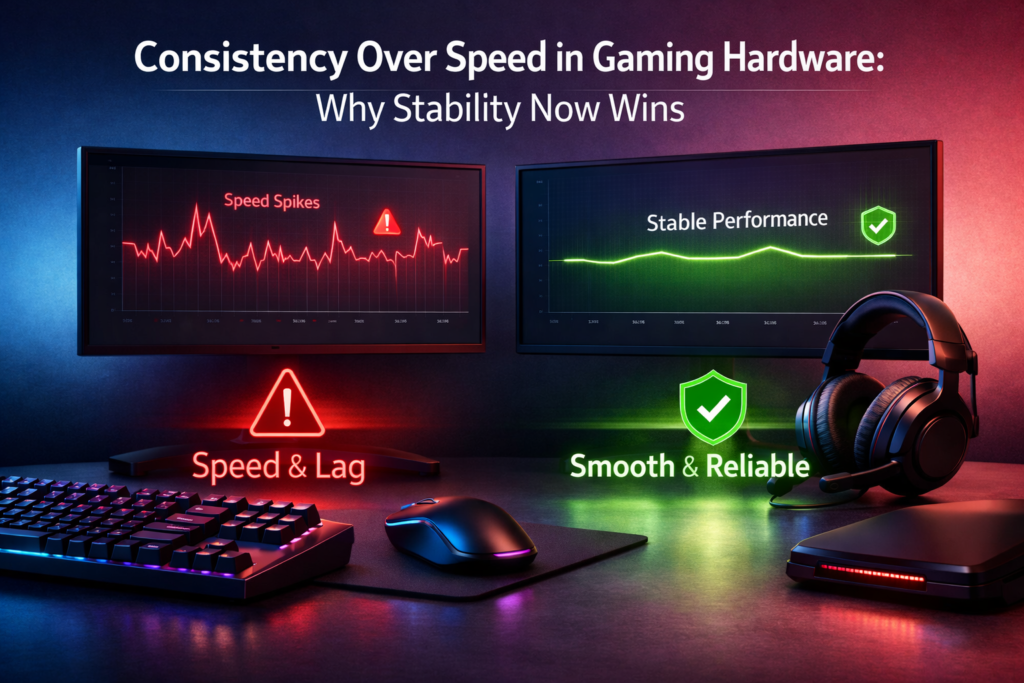
For years, gaming hardware chased a single promise: faster is better. Lower latency. Higher refresh rates. Bigger numbers meant sharper advantage. That logic still dominates marketing, but it’s losing practical relevance. As performance ceilings rise, outcomes are increasingly shaped by stability rather than speed. This is the quiet pivot toward consistency over speed in gaming hardware—a shift driven less by specs and more by how games are actually played.
Speed Won the Race—Then Ran Out of Track
Modern gaming systems are no longer fighting for basic responsiveness. Frame rates are stable, input pipelines are refined, and storage delays are largely invisible. Once these thresholds are crossed, gains compress. The difference between good and excellent speed is measurable, but rarely decisive outside elite competition.
This is where the conversation changes. Hardware that delivers peak performance inconsistently introduces friction: frame pacing spikes, thermal throttling, variable latency. These moments break immersion and disrupt muscle memory. In contrast, systems that hold steady—even if slightly slower on paper—support better execution. Consistency over speed in gaming hardware emerges not as compromise, but as optimization for real play.
The Human Factor That Specs Can’t Capture
Players don’t experience averages; they experience moments. A single stutter during a critical exchange matters more than a higher benchmark score. Human perception is sensitive to irregularity. Predictable input-response timing allows the brain to adapt and perform fluidly. Erratic performance forces constant recalibration.
This is why many experienced players describe “smoothness” as more important than raw speed. Smoothness isn’t a spec—it’s the absence of surprises. Hardware that behaves the same way every minute of a session reduces cognitive load, letting skill express itself cleanly.
Why Games and Engines Reinforce the Shift
Game engines increasingly prioritize consistency. Dynamic resolution scaling, frame pacing controls, and adaptive workloads are designed to flatten performance swings. Developers know that a stable experience retains players better than one that occasionally spikes higher.
As engines absorb complexity, they normalize hardware differences before they reach the user. The result is a narrowing of practical speed gaps and a growing emphasis on sustained behavior. In this environment, consistency over speed in gaming hardware aligns naturally with how software is evolving.
Marketing Still Sells Speed—Because It’s Easy
Speed is simple to advertise. A number can be compared, ranked, and celebrated. Consistency is harder to communicate. It reveals itself only over time, across varied scenarios. This asymmetry keeps speed-centric narratives alive even as their real-world impact diminishes.
Communities amplify the message. New releases are framed as breakthroughs, even when gains are marginal. When performance disappoints, inconsistency is often blamed on optimization rather than hardware philosophy. The myth persists because it’s familiar, not because it’s accurate.
The Contrarian Reality: Stability Is the Competitive Edge
At high levels of play, the advantage comes from predictability. Stable frame times enable tighter aim. Consistent latency supports reliable timing. Comfortable thermals and acoustics sustain focus during long sessions. These factors compound quietly.
This doesn’t mean speed is irrelevant. Poor performance still creates barriers. But once a solid baseline is reached, chasing extremes yields diminishing returns. The edge shifts from how fast a system can go to how reliably it stays there. That’s the practical meaning of consistency over speed in gaming hardware.
A Late-Stage Snapshot of What’s Changing
Placed here to avoid mid-article patterning, this snapshot clarifies the transition:
| Old Priority | Emerging Priority |
|---|---|
| Peak frame rate | Stable frame pacing |
| Lowest possible latency | Predictable input timing |
| Short-burst benchmarks | Long-session behavior |
| Spec leadership | Experience reliability |
The table highlights why buying decisions based solely on numbers increasingly miss the point.
What This Means for Players and Buyers
For players, this shift reframes improvement. Tuning settings, optimizing environments, and choosing hardware that behaves consistently often yields more benefit than upgrading for marginal speed gains. For buyers, it suggests looking beyond launch charts toward sustained performance under real conditions.
The broader implication is cultural. Gaming hardware is maturing. As with other technologies, the early race for extremes gives way to refinement. The winners aren’t the fastest—they’re the most dependable.
Milliseconds still matter. They just matter less than they used to. In modern play, outcomes are shaped by flow, trust, and rhythm. Consistency over speed in gaming hardware isn’t a downgrade of ambition—it’s an upgrade in understanding.
Keep Your Performance Expectations Calibrated
- Follow our Instagram @vibetric_official for signal beyond spec races.
- Bookmark vibetric.com to track where real gaming advantages now live.
- Stay updated as hardware design shifts from extremes to endurance.
What’s your take on this?
At Vibetric, the comments go way beyond quick reactions — they’re where creators, innovators, and curious minds spark conversations that push tech’s future forward.