
Audio Quality Differences Across Devices: Why Similar Specs Sound Unequal
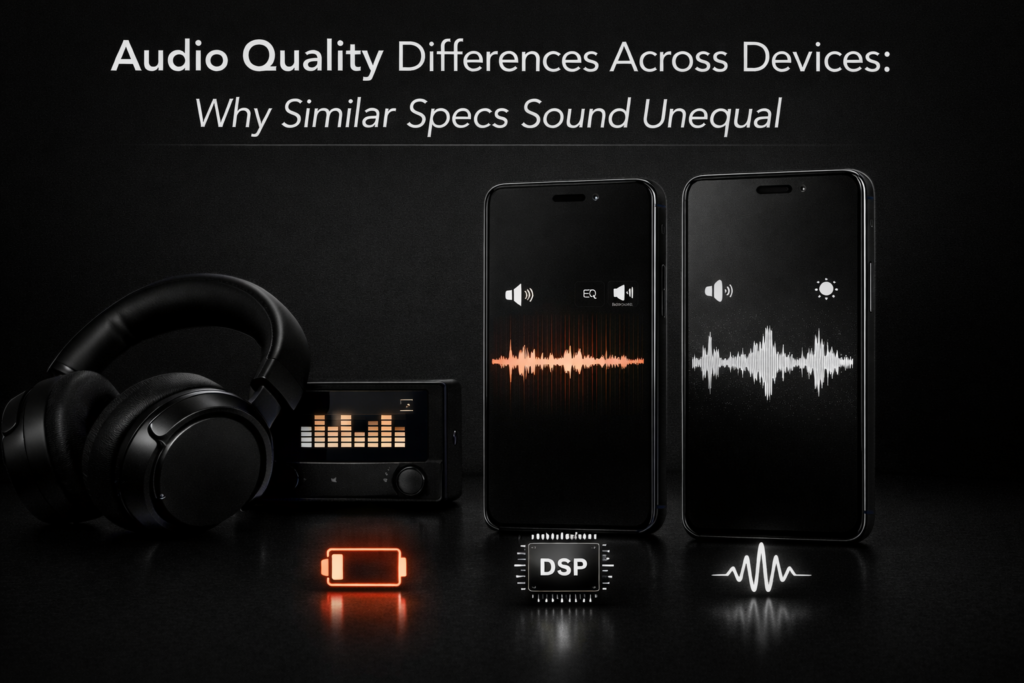
You’ve probably felt it before. Same song. Same headphones. Two devices that, on paper, should sound identical. But one feels flatter. The other has more space, more presence, more weight behind every note. Nothing is obviously “wrong,” yet something clearly isn’t the same.
This is the uncomfortable moment where spec sheets stop being reassuring—and start raising questions instead of answering them.
A Quiet Room, a Familiar Track, and an Unexpected Shift
Late at night, volume kept deliberately low, details tend to surface. The breath before a lyric. The decay of a cymbal. The sense of distance between instruments. Switch devices in that moment, and the illusion breaks. The mix collapses or opens up. Bass either holds together or fades too early.
Nothing about the file changed. Nothing about your ears changed. Yet the experience did.
That moment exposes the real story behind audio quality differences across devices.
The Mistake We Make About “Neutral” Sound
Many people assume that if two devices aim for neutrality, they should sound the same. That assumption collapses quickly in practice.
Neutrality is not a single point—it’s an interpretation. Human hearing is nonlinear, context-dependent, and heavily influenced by loudness and environment. Manufacturers compensate differently, shaping sound toward what they believe feels “right,” not what measures perfectly flat.
This is why audio quality differences across devices appear even before hardware enters the discussion.
Where software quietly shapes emotional response
Software experience isn’t just about features; it’s about emotional load. Consider a normal day:
- How many notifications demand attention versus provide value
- Whether the interface behaves the same way every time
- How quickly the phone recovers from mistakes or overload
- Whether updates improve stability or introduce friction
These moments accumulate. Over weeks, they form an emotional impression: calm or chaotic, helpful or intrusive. Hardware can’t correct that. Only software design decisions can.
This is why smartphone software experience differentiation has become deeply psychological, not merely technical.
Why Your Brain Notices Differences Before the Hardware Does
Perception often leads engineering, not the other way around.
The brain is extremely sensitive to changes in spatial cues, midrange balance, and dynamic contrast. Slight shifts in these areas register instantly—even if frequency response graphs look nearly identical.
Expectation plays a role, but it doesn’t explain everything. When listeners consistently describe one device as “more open” or “more fatiguing,” they’re responding to real design choices, not imagination.
What Happens to Audio Before You Ever Hear It
Long before sound reaches a speaker or headphone driver, it’s already been shaped.
Tuning Decisions That Never Make the Spec Sheet
Every device applies a chain of digital processing:
- Loudness management to prevent distortion
- Dynamic compression to stabilize volume
- EQ curves tuned for perceived clarity or warmth
- Protection algorithms that activate at specific levels
These choices differ wildly between manufacturers—and even between product tiers from the same brand. Two devices with the same DAC can diverge dramatically here, making DSP one of the most underestimated sources of audio quality differences across devices.
When “Same DAC” Is a Misleading Comfort
Component parity is easy to advertise. Execution is not.
A DAC’s real-world performance depends on what surrounds it: power regulation, filtering, grounding, and analog output design. Poor isolation raises noise floors. Weak power delivery limits dynamic swings. Filter choices affect transient sharpness and stereo separation.
This is why identical chips can yield noticeably different listening experiences—and why teardown lists rarely tell the whole story.
Power Limits: The Invisible Ceiling on Sound
Audio reproduction is physical. Moving air requires energy.
Portable devices live under constant constraints: battery size, heat dissipation, and efficiency targets. When power budgets tighten, something has to give. Often it’s bass control, dynamic range, or high-volume stability.
This is one of the clearest contributors to audio quality differences across devices, especially with demanding headphones or at sustained listening levels.
The Part Speakers Play—Even When You Don’t Use Them
Internal speakers quietly influence everything.
Many manufacturers tune a single sound profile to serve both internal speakers and headphone output. If those speakers are small and forward-sounding, the overall tuning may emphasize clarity over body—even through wired or wireless headphones.
Your external listening experience is often shaped by hardware you never intended to involve.
Real-World Moments Where Differences Become Obvious
The gaps don’t reveal themselves evenly. They surface in specific situations:
- Low-volume listening: Compression and EQ decisions dominate
- Podcasts and voice: Midrange tuning becomes obvious
- Movies and games: Spatial processing defines immersion
- High-impedance headphones: Power delivery limitations surface quickly
These moments explain why audio quality differences across devices feel inconsistent—sometimes dramatic, sometimes subtle.
A Snapshot of Why Specs Don’t Translate Cleanly
| On Paper | In Practice |
|---|---|
| Same DAC model | Different analog execution |
| Similar output ratings | Divergent power limits |
| Identical codec support | Varying encoder quality |
| Flat frequency response | Psychoacoustic tuning |
| High bit depth | Noise floor and headroom |
What the Measurements Actually Suggest
Across lab testing and industry analysis, certain patterns repeat:
- Conservative DSP preserves dynamics but sounds quieter
- Aggressive loudness tuning increases impact but flattens depth
- Better power isolation improves transient clarity
- Listeners prefer coherence over raw resolution
These trends don’t crown a single “best” approach—but they explain why audio quality differences across devices persist even as hardware converges.
Choosing Based on How You Actually Listen
Rather than chasing specs, matching design priorities to habits matters more.
Everyday Listeners
Consistency and comfort matter more than maximum detail.
Creators and Professionals
Minimal processing and stable power delivery take priority.
Gamers and Media Consumers
Spatial accuracy often outweighs tonal purity.
Long-Term Buyers
Software tuning support can matter as much as hardware.
When the Differences Genuinely Don’t Matter
There are cases where this entire discussion becomes irrelevant—and that’s worth acknowledging.
- Background listening
- Highly compressed streams
- Noisy environments
- Entry-level earbuds
Here, the bottleneck isn’t the device. It’s the context. Pretending otherwise oversells the importance of marginal gains.
What Everyday Users Actually Report
| Common Reaction | Likely Cause |
|---|---|
| “Louder but less detailed” | Dynamic compression |
| “More space, less punch” | Conservative DSP |
| “Bass falls apart at volume” | Power limits |
| “Voices sound clearer” | Midrange emphasis |
| “Gets tiring over time” | High-frequency boost |
| “Sounds thin at night” | Low-volume tuning |
| “Better with movies than music” | Spatial processing bias |
| “Great wired, worse wireless” | Codec implementation |
These reactions map cleanly to engineering tradeoffs—not placebo.
Where Device Audio Is Headed Next
The future isn’t about chasing higher specs. It’s about responsiveness.
- Context-aware DSP that adapts to content
- Smarter power scaling without dynamic loss
- Personalized tuning profiles
- Greater transparency in audio pipelines
As these mature, audio quality differences across devices may become less accidental—and more intentional.
Returning to That First Late-Night Listen
That moment of doubt—the feeling that something changed—wasn’t a failure of your ears or the specs. It was a glimpse into how much interpretation happens between a file and your perception.
Sound isn’t delivered. It’s decided.
Vibetric Ending
Audio quality lives in the choices manufacturers make quietly, long before marketing gets involved. Once you hear those decisions, you stop asking which device is “better”—and start asking which one listens the way you do.
What Really Shapes the Sound You Hear From Modern Devices?
- Follow vibetric_official on Instagram for ongoing insights into audio engineering and device design.
- Bookmark Vibetric.com we refine our analysis as tuning strategies and platforms evolve.
Subscribe to receive deep-dive breakdowns on how technology shapes listening experiences.
Questions That Reveal Where Device Audio Really Diverges
Because tuning, power delivery, and analog design vary beyond what specs reveal.
No. Implementation matters more than the component itself.
DSP intervention increases to preserve clarity and prevent distortion.
They contribute, but encoder quality and stability matter just as much.
Dynamic compression boosts loudness at the expense of depth.
EQ helps tonal balance but can’t overcome power or hardware limits.
Yes. Tuning changes can noticeably alter audio behavior.
Flat measurements don’t always align with human perception.
Midrange emphasis and vocal-focused DSP.
Unlikely. Differentiation will shift toward personalization, not uniformity.
What’s your take on this?
At Vibetric, the comments go way beyond quick reactions — they’re where creators, innovators, and curious minds spark conversations that push tech’s future forward.