
Smartphone Software Experience Differentiation: Why It Matters More Now
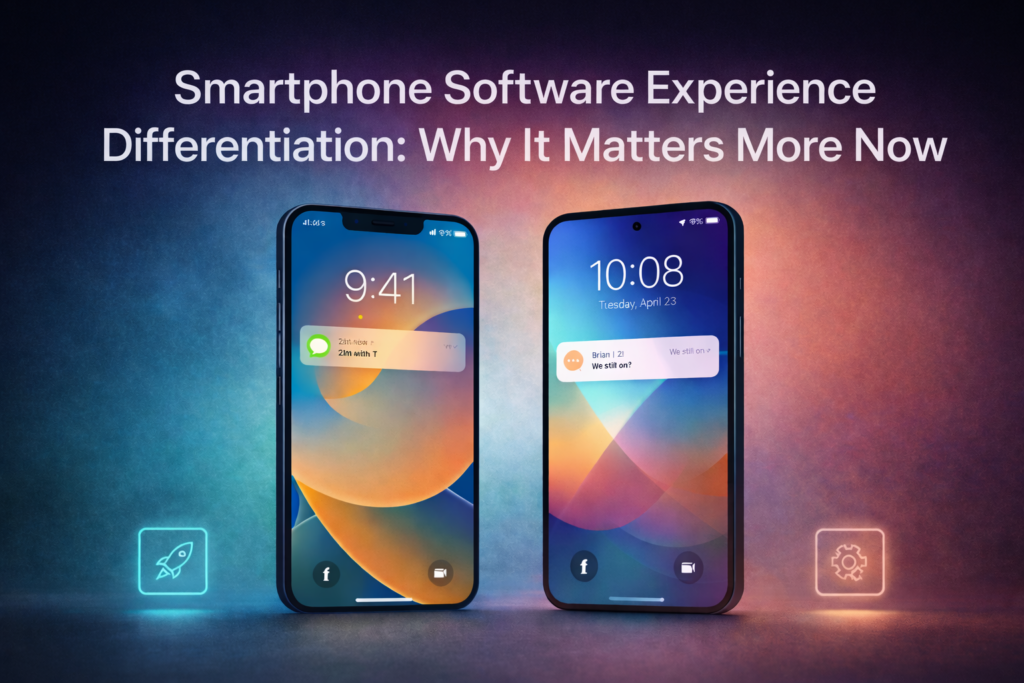
Camera counts creeping upward. On paper, they look wildly different. In the hand—and in daily life—they feel strangely interchangeable. Yet some phones feel calmer, faster, more “yours,” while others quietly exhaust you. That gap isn’t about megapixels or chip names anymore. It’s about something harder to quantify, and far harder to copy. The real battle has shifted beneath the surface.
When Hardware Became Adequate, Experience Took Control
There was a time when a faster processor or a sharper display immediately changed how a phone felt. That era is mostly over. Current-generation chips are powerful beyond what most apps demand. Displays have hit perceptual limits for brightness and smoothness. Even camera improvements are increasingly incremental.
What’s changed is user expectation. People now live inside their phones: managing work, relationships, creativity, and identity. As hardware gains flattened, the day-to-day experience became the differentiator—and that experience is almost entirely shaped by software.
This is where smartphone software experience differentiation begins to matter more than any spec sheet ever could.
What users praise—and complain about—has quietly shifted
Listen to how people talk about their phones now. Rarely do they mention clock speeds or RAM. Instead, you hear phrases like:
- “It just feels smoother.”
- “The notifications drive me crazy.”
- “This phone actually understands how I use it.”
- “Updates made it worse, not better.”
These are software judgments. They’re about responsiveness, consistency, predictability, and trust. A phone that technically benchmarks well can still feel frustrating if its software interrupts, nags, or behaves inconsistently.
The modern user judges a phone the way they judge an operating system or a service—not a gadget shaped by raw hardware specs.
Where software quietly shapes emotional response
Software experience isn’t just about features; it’s about emotional load. Consider a normal day:
- How many notifications demand attention versus provide value
- Whether the interface behaves the same way every time
- How quickly the phone recovers from mistakes or overload
- Whether updates improve stability or introduce friction
These moments accumulate. Over weeks, they form an emotional impression: calm or chaotic, helpful or intrusive. Hardware can’t correct that. Only software design decisions can.
This is why smartphone software experience differentiation has become deeply psychological, not merely technical.
The misconception: “All Androids are the same now”
One of the most persistent myths in the smartphone market is that modern platforms have converged so much that differences are cosmetic. This couldn’t be more wrong.
Underneath similar app grids, software philosophies diverge sharply:
- Some prioritize aggressive background control to save battery.
- Others allow looser multitasking for responsiveness.
- Some push AI-driven suggestions constantly.
- Others favor manual control and predictability.
These choices affect everything from battery anxiety to perceived speed. Two phones with identical hardware can feel dramatically different depending on how the OS manages processes, memory, animations, and user intent.
A quick snapshot of what actually varies beneath the surface
| Software Layer | Why It Changes Daily Experience |
|---|---|
| Notification system | Determines interruption vs focus balance |
| Background task control | Affects speed vs battery trade-offs |
| Update cadence | Builds or erodes long-term trust |
| UI consistency | Reduces cognitive load over time |
| System intelligence | Can feel helpful—or invasive |
This is where smartphone software experience differentiation stops being abstract and starts shaping real behavior.
Real-world scenarios where software decides loyalty
Consider three everyday users:
The remote professional
They rely on reliable notifications, fast app switching, and stable updates. A phone that delays messages or breaks workflows after updates feels unprofessional—even if the hardware is excellent.
The creator
They value color consistency, file handling, and app optimization. Software tuning determines whether creative tools feel fluid or constrained.
The average user
They care about battery confidence, intuitive gestures, and minimal friction. Complex menus or unpredictable behavior feel like failure, not “power features.”
In all three cases, hardware differences fade quickly. Software behavior stays visible every hour.
The industry’s quiet pivot toward experience engineering
Manufacturers know this shift is happening. That’s why more resources now go into:
- Custom UI layers
- Long-term update promises
- On-device intelligence
- Ecosystem integration
Interestingly, this has less to do with adding features and more to do with refining flow. Companies are competing over how naturally users move between tasks, devices, and moments.
This is strategic. Hardware can be matched in one generation. Smartphone software experience differentiation compounds over years, shaping loyalty long after launch.
Why updates now matter more than launch features
At launch, most phones look good. Over time, software reveals priorities. Does the phone get timely security updates? Do major OS updates improve performance or introduce bugs? Are older devices respected or quietly neglected?
Users remember this. A brand’s reputation increasingly rests on post-purchase behavior, not launch-day marketing.
This is another reason smartphone software experience differentiation has become a long-term loyalty engine rather than a one-time selling point.
A simplified look at how perception diverges from reality
What users think:
“New features make my phone better.”
What actually matters:
Consistency, stability, and restraint make a phone feel better.
Feature-heavy software often feels impressive in demos but exhausting in daily use. The most satisfying experiences usually come from what doesn’t happen: no stutters, no surprise changes, no unnecessary prompts.
Reddit and user forums reveal the pattern clearly
Spend time in long-term user threads and a pattern emerges. Praise and frustration rarely center on raw performance.
| Common User Comment | What It Really Signals |
|---|---|
| “Battery got worse after update” | Background management changes |
| “Feels laggy lately” | Animation tuning or memory policy |
| “Too many notifications now” | UX prioritization failure |
| “Still smooth after years” | Strong software maintenance |
| “Regret switching brands” | Workflow disruption |
These are lived software experiences, not spec debates.
The human cost of bad software decisions
Poor software design doesn’t just annoy—it drains attention. Constant alerts increase stress. Inconsistent gestures slow muscle memory. Unreliable updates reduce trust.
Over time, users adapt by checking phones compulsively or avoiding features entirely. That’s not engagement; it’s friction.
The best software experiences reduce mental overhead. They disappear into the background, letting people focus on what matters.
A practical framework for choosing based on software
When evaluating phones today, different users should prioritize different aspects of software experience—especially when viewed through smartphone software experience differentiation, not raw specs.
Everyday users
- Notification control
- Battery behavior consistency
- UI clarity
Professionals
- Update reliability
- App stability under load
- Multitasking behavior
Enthusiasts
- Customization depth
- Performance tuning options
- Transparency of system behavior
Future-focused buyers
- Length and quality of software support
- Track record of improvements over time
This mindset makes smartphone software experience differentiation actionable, not theoretical.
When software differentiation matters less
There are exceptions. If a phone is used primarily for basic communication or as a secondary device, differences shrink. Similarly, users deeply embedded in one ecosystem may tolerate weaker software in exchange for compatibility.
But for primary, daily devices, software experience eventually dominates satisfaction—even if users don’t articulate it clearly.
Looking ahead: the next phase of differentiation
As on-device AI, adaptive interfaces, and context-aware systems mature, software experience will become even more central. The risk isn’t insufficient intelligence—it’s overreach.
Phones that respect user intent, minimize intrusion, and learn quietly will stand out. Those that push constant suggestions or opaque automation may alienate users, regardless of technical capability.
The future isn’t louder software. It’s calmer, more invisible software.
Returning to that feeling in the store
Back in that smartphone aisle, the reason devices feel similar is because hardware differences no longer translate directly into lived experience. The real differentiator only reveals itself after weeks of use—through trust, flow, and emotional comfort.
That’s why smartphone software experience differentiation now decides which phones feel like tools—and which feel like burdens.
Vibetric Ending
The smartphone has matured as a machine. What’s evolving now is its relationship with the human holding it. In that relationship, software is no longer the supporting actor—it’s the script, the pacing, and the tone.
Why Software Experience Will Decide the Next Smartphone Era
- Follow vibetric_official on Instagram to keep up with the latest trends and insights into smartphone technology and user experience.
- Bookmark Vibetric.com we continuously update our analysis as new developments emerge in mobile software and design.
Subscribe for updates and receive ongoing, in-depth breakdowns and expert opinions on the future of smartphones.
The Practical Questions Users Ask Once Specs Stop Mattering
It includes UI design, notification handling, system stability, update quality, background management, and how intelligently the phone responds to user behavior.
Because modern hardware is powerful enough for most tasks, while software determines how smoothly and predictably that power is used.
Sometimes, but it’s often clearer after weeks of daily use when patterns of friction or comfort emerge.
Yes. Consistent, stable updates build trust, while problematic updates erode confidence—even if hardware remains strong.
Not necessarily. Excessive features can increase cognitive load and reduce overall satisfaction.
By reading long-term user feedback, focusing on update history, and testing notification and gesture behavior in-store.
For some users, yes. For others, simplicity and predictability matter more than options.
It depends on implementation. Subtle, respectful AI can improve experience; intrusive AI can damage it.
Yes. As hardware matures further, software experience will only grow in importance.
Prioritizing feature count over consistency, restraint, and long-term user trust.
What’s your take on this?
At Vibetric, the comments go way beyond quick reactions — they’re where creators, innovators, and curious minds spark conversations that push tech’s future forward.
OnePlus 15 Review 2026: Intelligent Performance in the AI Era
OnePlus 15 Review 2026: Intelligent Performance in the AI Era Performance used to be theatrical. Manufacturers showcased peak clock speeds, explosive benchmark
Smartphone Stagnation 2026: The Hidden Shift Behind Slower Upgrade Cycles
Smartphone Stagnation 2026: The Hidden Shift Behind Slower Upgrade Cycles The review unit arrived on schedule, exactly as expected — sealed packaging,