
Modern Laptops — How They’re Quietly Redefining Everyday Computing
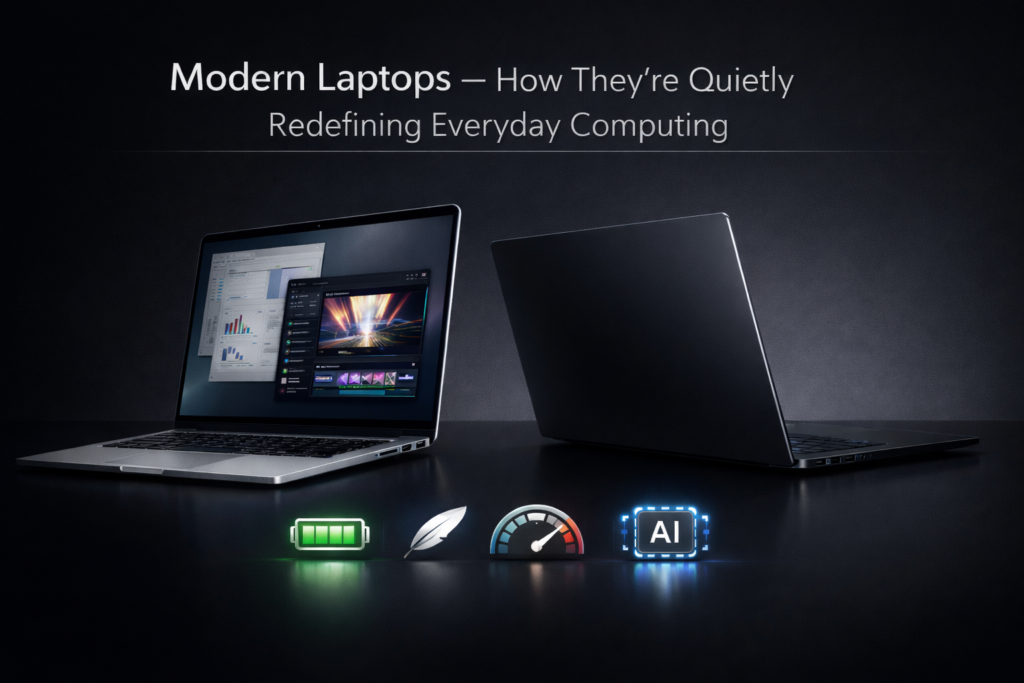
Walk into a classroom in Nairobi, a café in Berlin, or a boardroom in Singapore, and you’ll notice something subtle but consistent. The laptops people rely on no longer look, feel, or behave like the machines of even five years ago. They boot faster. They last longer unplugged. They blur the line between work device, creative tool, and personal hub.
What’s changing isn’t just hardware—it’s the role laptops play in everyday life. And the implications reach far beyond spec sheets or product launches.
A Front-Row View of a Global Transition
A student taps open a thin aluminum laptop, finishing an assignment offline before syncing to the cloud. Across town, a consultant edits a presentation mid-flight without hunting for a power outlet. Later that night, a freelancer switches the same machine from spreadsheets to photo editing to streaming—without a second thought.
These moments are ordinary now. That’s the point.
Modern laptops have quietly become adaptive companions, designed less around peak performance bragging rights and more around how people actually live and work across regions, income levels, and professions.
The Real Transformation We Often Miss
Everyone talks about faster processors and slimmer designs. The deeper truth is more structural.
The real revolution in modern laptops is that they’re no longer built for a single environment. They’re designed to move fluidly between learning, working, creating, and communicating—often within the same day, on the same device.
This shift has changed expectations worldwide. A laptop is no longer “good enough for school” or “powerful enough for work.” It’s expected to do both—and more—reliably.
The Myth of Raw Power as the Only Metric
For years, consumers were taught to chase clock speeds, core counts, and graphics numbers. While performance still matters, it’s no longer the defining factor for everyday computing.
What many people miss is that most daily tasks—documents, video calls, browsing, light editing—don’t need extreme horsepower. They need consistency, responsiveness, and efficiency.
This realization has reshaped laptop engineering from the inside out.
Efficiency-First Engineering Takes Over
One of the defining traits of modern laptops is their focus on performance per watt rather than raw output.
Key engineering shifts include:
- Energy-efficient CPUs optimized for sustained workloads
- Integrated graphics tuned for common creative tasks
- Smarter thermal designs that avoid aggressive fan noise
- Batteries engineered for real-world usage, not lab conditions
This is why a mid-range laptop today often feels faster and more reliable than a high-end machine from a few years ago.
Micro Snapshot: Old Priorities vs New Realities
| Design Focus (Then) | Design Focus (Now) |
|---|---|
| Peak benchmark scores | All-day usability |
| Maximum fan cooling | Silent thermal balance |
| Desktop replacement mindset | Mobile-first computing |
| Short battery cycles | Longevity and health |
Why Brands Changed Course
Laptop makers didn’t suddenly become altruistic. User behavior forced the shift.
Remote work, hybrid education, and cloud-based tools exposed a flaw in traditional laptop design: machines optimized for desks struggled in flexible environments. Heat, battery drain, and weight became daily frustrations.
Brands that adapted—by rethinking processors, displays, webcams, keyboards, and wireless performance—gained trust across global markets. Those that didn’t quickly felt irrelevant.
Where This Trajectory Is Heading
The next phase of modern laptops is about contextual intelligence.
Expect systems that:
- Dynamically adjust performance based on task type
- Learn user behavior to optimize battery and responsiveness
- Integrate AI locally for privacy-sensitive tasks
- Reduce dependency on constant internet access
This isn’t science fiction. It’s a natural extension of the efficiency-first philosophy already shaping today’s devices.
Real-World Scenarios That Define the Shift
Consider how different users now rely on the same class of laptop:
- Students attend virtual classes, take notes, code, and collaborate globally on affordable, lightweight machines.
- Professionals move between home, office, and travel without changing devices or workflows.
- Creators sketch, edit, and publish content without needing specialized hardware for every task.
- Small businesses deploy laptops as primary workstations instead of desktops.
Quick Snapshot: Everyday Laptop Use Cases
| User Scenario | Key Requirement | Laptop Response |
|---|---|---|
| Online classes | Stability & battery | Optimized efficiency |
| Hybrid work | Portability | Thin, durable builds |
| Freelance creation | Balanced performance | Integrated acceleration |
| Travel productivity | Connectivity | Strong Wi-Fi & webcams |
| Home computing | Versatility | Multi-role capability |
This adaptability explains why modern laptops are becoming the default computing device worldwide, not just in affluent markets.
What the Data (and Design Logic) Tells Us
Without relying on flashy statistics, the pattern is clear: usage time per device has increased, while the need for multiple specialized machines has declined.
Engineering teams now design around:
- Sustained performance over hours, not minutes
- Consistent user experience across workloads
- Reduced maintenance and longer device lifespans
In practical terms, this means fewer slowdowns, fewer thermal surprises, and less anxiety about whether a device can handle “one more task.”
How This Shift Affects Human Productivity
The most overlooked impact of modern laptops is psychological.
When a device is predictable, people stop thinking about it. That mental relief matters.
Users report:
- Less stress during long work sessions
- Greater willingness to experiment creatively
- Fewer interruptions caused by heat, lag, or battery anxiety
The laptop fades into the background—and that’s a sign of good design.
Choosing the Right Laptop for Your Reality
Everyday Users
Best served by balanced systems with strong battery life, comfortable keyboards, and reliable displays. Extreme specs add little value here.
Creators & Professionals
Look for laptops with efficient performance cores, color-accurate screens, and sustained thermal performance rather than peak benchmarks.
Gamers & Enthusiasts
Dedicated hardware still matters, but even here, modern thermal and power management significantly improve long-term usability.
Future-Proof Buyers
Prioritize build quality, software support, and efficiency. These traits age better than raw performance.
Pros & Cons Snapshot Across Modern Laptop Designs
| Strengths | Trade-Offs |
|---|---|
| Excellent battery life | Fewer upgrade options |
| Quiet operation | Limited peak power |
| Lightweight builds | Integrated components |
| Versatile usage | Higher initial cost |
When the Old Model Still Makes Sense
There’s a counterpoint worth acknowledging.
Not everyone benefits equally from this shift. Users running specialized software—high-end 3D rendering, scientific simulations, or niche legacy tools—may still prefer traditional high-power systems or desktops.
For them, efficiency is secondary to raw capability. The good news is that modern design philosophies haven’t eliminated these options; they’ve simply stopped treating them as the default.
What Real Users Are Saying Online
Across forums and community discussions, a consistent narrative emerges.
| User Type | Feedback Summary | Relevance |
|---|---|---|
| Students | “Battery lasts all day” | High |
| Remote workers | “No fan noise on calls” | High |
| Freelancers | “One device for everything” | Medium |
| IT admins | “Lower failure rates” | High |
| Power users | “Miss upgradeability” | Medium |
| Casual users | “Just works” | High |
| Travelers | “Finally reliable unplugged” | High |
The consensus isn’t that modern laptops are perfect—it’s that they align better with real-world expectations.
The Next Five Years of Everyday Computing
Looking ahead, modern laptops will likely become:
- More modular internally, even if sealed externally
- More AI-assisted without sacrificing privacy
- More durable as sustainability pressures increase
- More standardized in performance consistency
The gap between “budget” and “premium” will narrow in daily experience, even if materials and branding still differ.
Coming Full Circle
That student in the classroom and the executive in the boardroom are no longer using fundamentally different tools. They’re using variations of the same idea: a computer designed to adapt, not dictate.
This is the quiet success of modern laptop design. It doesn’t demand attention. It earns trust through consistency.
And once you experience that, it’s hard to go back.
Vibetric Ending
When technology disappears into everyday life, that’s when it’s doing its job best.
What’s Behind the Magic of Modern Laptops?
- Follow vibetric_official on Instagram to keep up with the latest trends and insights into laptops and everyday computing.
- Bookmark Vibetric.com we continuously update our analysis as new developments emerge in laptop technology.
Subscribe for updates and receive ongoing, in-depth breakdowns and expert opinions on modern computing devices.
FAQs: Upcoming Gaming Gear in 2025
Efficiency, versatility, and sustained performance matter more than peak specs.
Yes, for most workflows including design, development, and media editing.
Better processors, smarter power management, and optimized software integration.
For many users, yes—but desktops still dominate extreme workloads.
Absolutely. Portability and reliability make them ideal learning tools.
It’s reduced, but compensated by longer usable lifespans.
Five years of comfortable use is increasingly realistic.
Remote and hybrid work accelerated trends already underway.
What’s your take on this?
At Vibetric, the comments go way beyond quick reactions — they’re where creators, innovators, and curious minds spark conversations that push tech’s future forward.