
Open-Ear vs In-Ear — Which Is Better for Daily Use?
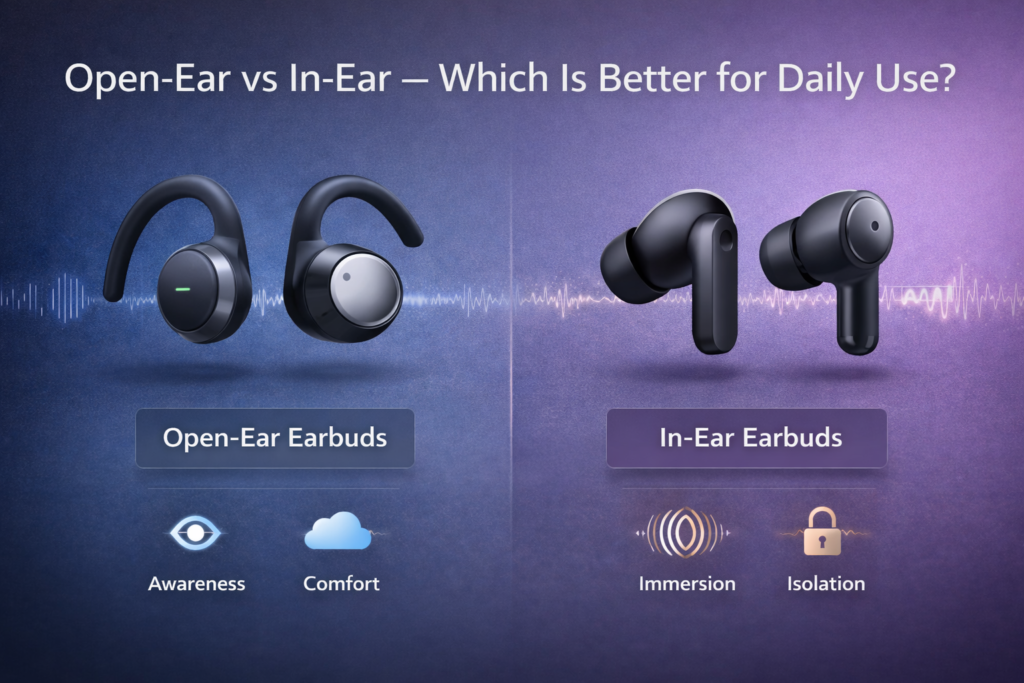
The conversation around open-ear vs in-ear earbuds is no longer a simple matter of comfort or style. As more people use earbuds throughout the day — at work, during commutes, while exercising, or even during calls — the fundamental question has shifted from sound quality to daily usability. The rise of open-ear designs shows just how much listening habits are evolving in 2025. To understand which format fits into everyday life better, you need more than a quick comparison; you need a breakdown of how each technology shapes behavior, awareness, fatigue, and long-term comfort.
The Engineering Difference That Shapes the Experience
Open-ear and in-ear earbuds differ in more than just fit. Their entire acoustic design dictates how listeners perceive sound, interact with the environment, and experience comfort over long sessions.
Open-ear earbuds use air conduction or directional drivers that sit outside the ear canal. They project audio toward the ear while keeping the canal open.
- Pros: zero pressure, full environmental awareness, airy soundstage
- Trade-offs: weaker bass, sound leakage, lower isolation
In-ear earbuds, on the other hand, rely on silicone tips sealing the canal. This seal creates stable bass, controlled frequency response, and consistent isolation.
- Pros: stronger bass, better detail, passive noise isolation
- Trade-offs: ear fatigue, pressure buildup, reduced awareness
These mechanical differences explain why preferences for open-ear vs in-ear earbuds vary dramatically depending on use-case. One prioritizes natural comfort, the other prioritizes acoustic accuracy.
Comfort vs Immersion — The Real Everyday Conflict
Most people think sound quality is the biggest deciding factor, but daily use tells a different story. The real challenge is how long you can wear them without irritation.
Why open-ear wins at long sessions
With nothing inside the canal, open-ear designs eliminate the two biggest causes of fatigue: tip pressure and trapped heat. This makes them ideal for:
- office use
- walking, commuting
- long calls
- people sensitive to in-ear pressure
Listeners who often remove and reinsert earbuds also find open-ear far more convenient.
Why in-ear dominates immersive tasks
Tasks that demand isolation naturally favor in-ear earbuds:
- flights
- gaming
- focused work
- noisy public transport
The seal creates immersive sound without increasing volume, which also helps reduce ear strain.
The conflict here isn’t which is “better” — it’s whether your daily routine leans toward awareness or immersion.
When Sound Quality Tells a Different Story
If the decision were based purely on audio performance, in-ear earbuds would win instantly. The seal they create allows:
- deeper bass extension
- more stable midrange
- better passive noise isolation
- richer detail at lower volumes
But daily use isn’t a studio session. Many people realize that realistic “good-enough” audio with comfort is more valuable than perfect frequency response. This is exactly where open-ear earbuds have gained traction — not by competing on raw fidelity but by matching daily behavior.
But there’s a twist
Open-ear tech in 2025 has improved dramatically. Modern directional drivers reduce sound leakage and produce cleaner mids, making them better for podcasts, calls, and casual music than older bone-conduction designs. They still can’t match in-ear bass physics, but they aren’t just “compromised alternatives” anymore.
A Practical Lens: What Each Design Does Best
To simplify the daily decision-making, here’s a quick practical snapshot:
| Daily Use Case | Best Option | Why |
|---|---|---|
| Office work & meetings | Open-ear | Comfort + awareness |
| Gym workouts | In-ear | Stability + bass |
| Outdoor running/walking | Open-ear | Safety + awareness |
| Commuting (bus/train) | In-ear | Noise isolation |
| Long study sessions | Open-ear | No fatigue |
| Airplane travel | In-ear | Maximum isolation |
| Mixed casual use | Depends on environment | Both formats have advantages |
This is where open-ear vs in-ear earbuds show clear specialization. Each format thrives in different environments.
Misconceptions That Confuse Buyers
The debate around these two designs is filled with myths. Three stand out:
Myth 1: Open-ear earbuds have terrible sound
Reality: Modern directional drivers offer solid clarity for daily listening. They only fall behind in sub-bass and isolation.
Myth 2: In-ear earbuds damage ears faster
Reality: Earbuds only cause harm when volume levels exceed safe thresholds. In-ears can actually keep volume lower because of their isolation.
Myth 3: Open-ear earbuds are only for athletes
Reality: Their comfort-first design has made them popular for office workers, remote employees, and commuters.
Understanding the engineering context clears away these misconceptions.
How Daily Patterns Should Guide Your Choice
The best way to decide isn’t by comparing specs or marketing claims — it’s by analyzing your daily rhythm.
Choose open-ear if your day includes:
- continuous wear for 4–8 hours
- frequent calls
- safe outdoor movement
- discomfort with in-ear pressure
Choose in-ear if your environment:
- is constantly noisy
- demands immersive sound
- includes travel
- requires strong mic isolation in calls
What matters most is whether your routine requires awareness or isolation, not which design is newer or more advanced.
Closing Insight
The conversation around open-ear vs in-ear earbuds captures a shift in how people think about everyday audio. Comfort is becoming as important as fidelity, and awareness is becoming as valuable as immersion. Instead of choosing based on specs, the smarter approach is to match the design to your daily rhythms. The right pair feels invisible, supports your environment rather than fighting it, and integrates naturally into your habits. Earbuds have become wearables — and the best wearable is the one you forget you’re wearing.
Stay Tuned for More Daily-Use Audio Insights
- Follow our Instagram @vibetric_official for nuanced takes on everyday audio gear.
- Bookmark vibetric.com to keep up with upcoming earbuds, wearables, and sound tech explainers.
- Check back soon — more breakdowns on design, comfort, and listening science are on the way.
What’s your take on this?
At Vibetric, the comments go way beyond quick reactions — they’re where creators, innovators, and curious minds spark conversations that push tech’s future forward.

Galaxy S26 Ultra Privacy Display: 5 Brutal Real-World Truths Nobody Tells You
Galaxy S26 Ultra Privacy Display: 5 Brutal Real-World Truths Nobody Tells You There’s a specific anxiety that comes with using a phone