
How Battery Health Affects Earbud Sound Over Time
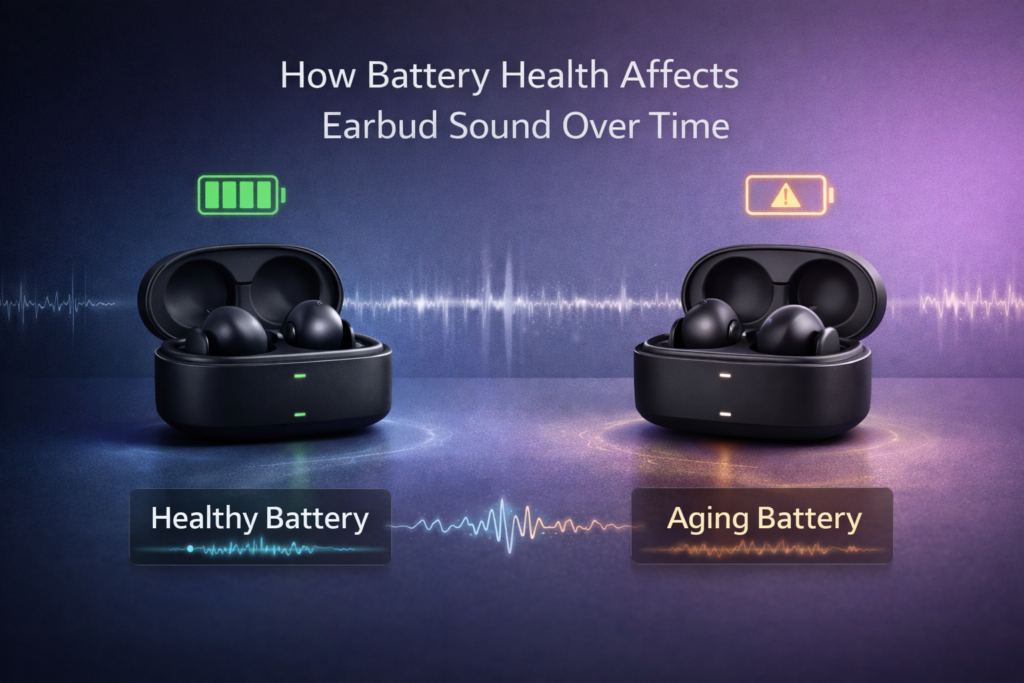
Wireless earbuds have evolved into everyday essentials, but most users overlook one crucial fact: the sound you hear isn’t just shaped by drivers or tuning—it’s shaped by the battery powering everything inside. As earbud battery health declines, so does audio performance, sometimes in subtle ways you don’t notice until months later. Understanding how battery wear affects sound helps you protect both clarity and longevity.
Why Earbuds Depend So Heavily on Battery Stability
Unlike headphones, earbuds operate with tiny cells that balance amplification, wireless transmission, and DSP processing inside a shell no bigger than a coin. Their sound quality is tied directly to stable voltage delivery. When earbud battery health weakens, voltage drop becomes more common, and the audio chain begins to shift—sometimes only during loud peaks, sometimes across the entire frequency curve.
Earbud tuning is designed around the assumption of a consistent power supply. When that assumption breaks, sound begins to drift.
What Actually Happens as Battery Health Declines
- Lower Maximum Volume
A degraded battery cannot sustain the same voltage peaks. Earbuds compensate by reducing amplifier output, leading to a lower perceived max loudness—even though the drivers haven’t changed at all.
- Bass Weakening
Low frequencies require more energy to reproduce cleanly. When voltage sags:
- bass loses punch
- sub-bass rolls off sooner
- dynamic drivers struggle during heavy beats
This is one of the earliest audible signs of poor earbud battery health.
- Distortion at High Volumes
As batteries age, earbuds hit their power ceiling earlier. DSP tries to prevent clipping by compressing or limiting audio more aggressively. The result:
- treble becomes harsher
- midrange loses clarity
- transients sound “squeezed”
- Bluetooth Instability
Weak battery health affects transmission quality too. You may hear:
- micro-stutters
- codec downgrades (LDAC → AAC, or AAC → SBC)
- increased latency during calls and games
The sound worsens not because the codec is bad—but because the battery can’t sustain its power requirements.
Technical Breakdown: Why Battery Wear Impacts Audio
Earbuds rely on lithium-ion or lithium-polymer cells. Over time, cycles and heat trigger:
- increased internal resistance
- reduced voltage stability
- lower usable capacity
Internal resistance is the silent killer. Higher resistance means the battery struggles to deliver current on demand, especially during bass-heavy tracks.
Engineers design earbuds with protection circuits that throttle output when voltage dips below safe thresholds. The listener hears this as reduced volume, less bass, and slight compression during dynamic tracks.
How Listening Habits Affect Longevity
High Volume = Faster Wear
Pushing earbuds near max volume repeatedly forces the amplifier and battery into peak current draw. Over time, this accelerates degradation.
Always Using ANC
Active Noise Cancellation increases battery load by powering microphones and processing. This doesn’t harm the battery directly, but more cycles mean faster long-term wear.
Long Gaming or Call Sessions
Continuous microphone usage and high transmission duty cycles increase heat, which slowly reduces earbud battery health.
Myth vs Reality: What Users Often Misunderstand
MYTH: “My earbuds started sounding worse because the drivers are degrading.”
REALITY: Drivers rarely degrade. It’s almost always the battery.
MYTH: “Only cheap earbuds lose sound quality over time.”
REALITY: Even premium models show changes as battery health drops—though better tuning and protection circuits delay it.
MYTH: “If battery life is still okay, sound quality should be fine.”
REALITY: Sound quality declines before
total playtime does. Voltage stability deteriorates earlier than capacity.
Quick Comparison: Healthy vs Aging Earbud Battery
| Aspect | Healthy Battery | Aging Battery |
|---|---|---|
| Max Volume | Strong & consistent | Noticeably lower |
| Bass Output | Full and controlled | Weaker, muddier |
| Bluetooth Codec | Stable high-bitrate | More dropouts, fallback to lower codecs |
| Distortion | Minimal | More frequent at peaks |
| ANC Performance | Strong cancellation | Less effective, more hiss |
2025 Example: How It Shows in Real Models
- Apple AirPods Pro 2: After ~2 years of heavy use, many users report softer bass and shorter ANC time—classic battery wear symptoms.
- Sony WF-1000XM5: DSP compensates better than most, but high-volume listeners may hear treble harshness as battery resistance increases.
- Nothing Ear (2): Their tight tuning makes voltage drops more noticeable; soundstage narrows slightly as batteries age.
These examples show the same pattern: even premium earbuds can’t escape chemical aging.
How to Slow Down Earbud Battery Degradation
- Keep volume under 70–80% for most listening.
- Avoid leaving earbuds in hot environments, including cars and pockets during summer.
- Let the case cool after charging; heat accelerates wear.
- Don’t leave earbuds fully charged 24/7—periodically cycle them.
- Use ANC only when needed to reduce daily cycles.
Closing Insight
Earbud sound quality is not a fixed attribute—it evolves with the battery powering the system. As earbud battery health shifts, the entire sonic character moves with it, from bass output to distortion control to wireless stability. Recognizing this relationship helps listeners understand subtle changes and extend the lifespan of their audio gear. With mindful habits, your earbuds can stay closer to their original tuning for years instead of months.
Stay Ahead of Your Audio Gear’s Lifespan
- Follow our Instagram @vibetric_official for breakdowns on longevity, tuning science, and real-world wear tests.
- Bookmark vibetric.com to track durability insights across earbuds and headphones.
- Check in for upcoming deep dives into battery chemistry and long-term audio behavior.
What’s your take on this?
At Vibetric, the comments go way beyond quick reactions — they’re where creators, innovators, and curious minds spark conversations that push tech’s future forward.

Galaxy S26 Ultra Privacy Display: 5 Brutal Real-World Truths Nobody Tells You
Galaxy S26 Ultra Privacy Display: 5 Brutal Real-World Truths Nobody Tells You There’s a specific anxiety that comes with using a phone