
Top Gaming Keyboards & Mice for Competitive Play — 2025 International Guide
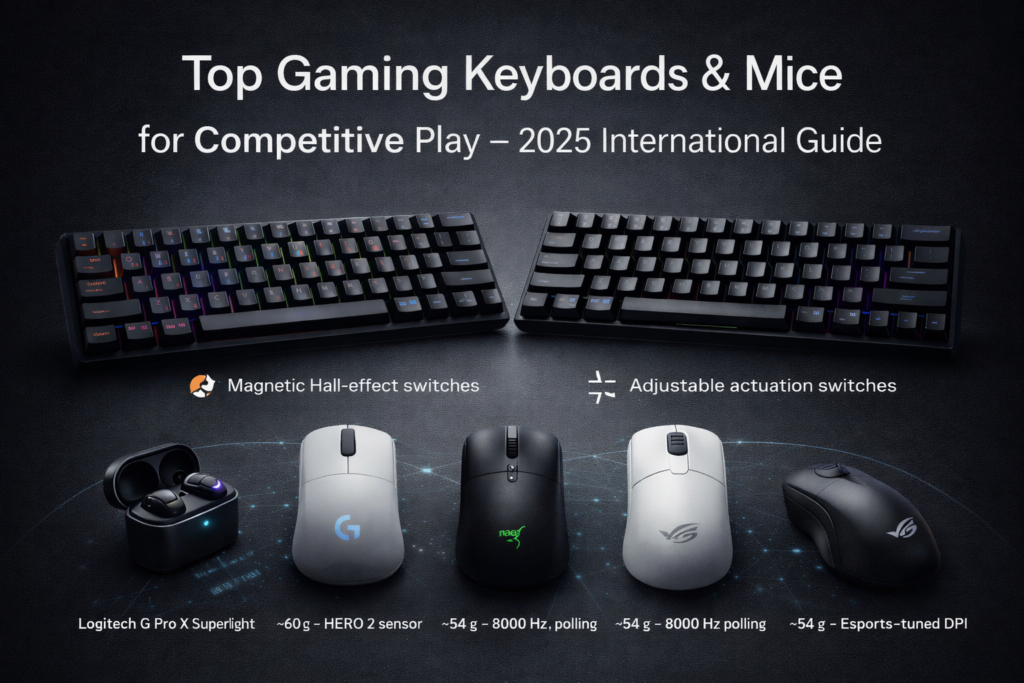
You’ve warmed up. Crosshair lined up perfectly. You know that shot should hit. But it doesn’t. You shrug it off once, twice. Then it starts happening consistently—only in the clutch moments. At high competitive tiers, performance isn’t just skill and strategy. It’s the unseen latency, physical feedback, and ergonomic harmony between your hands and your kit. And in 2025, that invisible margin has never been more critical—or more refined. So what really separates casual gear from performance-driven peripherals? And more importantly, what are the best gaming keyboards and mice right now that make that difference felt in actual gameplay?
A Desk Where Precision Becomes Reality
The setup you game on is more than the sum of parts. It’s the interface between intention and execution. Whether you’re flicking a mouse in Valorant, weaving abilities in an MMO, or queueing up a 360-no-scope in CS2, the peripherals you choose fundamentally shape your competitive experience. Today’s best gaming keyboards and mice aren’t defined by RGB or gimmicks. They’re defined by reliable sensors, refined actuation, and consistent hardware behavior under load.
The Deep Truth Behind Top Competitive Gear
Everyone knows that lighter mice and mechanical keyboards can feel better. But the deeper reality is why these choices matter: they reduce cognitive load and physical noise—allowing players to repeat optimal inputs without hesitation.
Common Assumptions Players Hold
Many players think:
- Higher DPI equals better aim
- Larger keyboards are more functional
- RGB indicates quality
These beliefs linger because early gaming hardware pushed flashy metrics over fundamental responsiveness.
What the Hardware Reality Shows
In 2025, the focus has shifted:
- Polling stability beats raw polling numbers
- Sensor consistency matters more than peak DPI
- Switch reliability eclipses key travel length
Elite peripherals now emphasize predictable feedback, consistent tracking, and ergonomic balance—meaning muscle memory becomes sharper and more dependable in clutch moments.
Industry Behavior and Priorities
Brands are reacting. Wireless technology has matured to the point where 2.4 GHz and proprietary high-polling protocols offer negligible latency differences compared to wired counterparts. Compact, TKL, and 60% layouts continue gaining traction because they prioritize functional desk space for larger mouse arcs—a subtle ergonomic advantage pro gamers rely on.
2025+ Outlook
Expect peripherals to lean into:
- Adaptive firmware that learns user behavior
- Actuation tuning tailored to game genre
- Longer switch lifespans under competitive stress
Competition hardware is becoming less about bells and whistles and more about quiet confidence.
Real-World Competitive Examples
The best gaming keyboards and mice aren’t just well-reviewed—they show up in actual tournament settings and ranked ladders.
FPS Play (e.g., CS2, Valorant):
Players often favor lightweight mice with precision tracking and compact keyboards that maximize desk space for wide mouse movement.
MMO / MOBA (e.g., League of Legends):
Keyboards with consistent switch behavior and macro capabilities are favored, while mice with multiple programmable buttons help manage complex command inputs.
Balanced Competitive Play:
Hybrid gamers seek peripherals that combine low-latency performance with ergonomic comfort for long multi-hour sessions.
Quick Scenario Table — Competitive Priorities
| Playstyle | Keyboard Focus | Mouse Focus | Competitive Benefit |
|---|---|---|---|
| FPS Precision | Compact TKL or 60% | Ultra-light, accurate sensor | Flick accuracy & control |
| MOBA / RTS | Macro-friendly keys | Multi-button layout | Command efficiency |
| Hybrid | Balanced comfort | Responsive tracking | All-purpose performance |
| Long Sessions | Ergonomic design | Comfortable grip | Reduced fatigue |
The Best Gaming Mice of 2025
| Mouse | Key Feature | Why It Matters |
|---|---|---|
| Razer Viper V3 Pro | ~54 g, 8000 Hz HyperPolling | Ultra-low latency & pro responsiveness, top pick for shooters. |
| Logitech G Pro X Superlight 2 | ~60 g, HERO 2 sensor | Trusted by esports players for consistency. |
| Asus ROG Harpe Ace Mini | 8000 Hz polling | Tailored for esports with fast tracking. |
| Razer DeathAdder V4 Pro | Premium ergonomic shape | Excellent comfort + high-end sensor. |
| Keychron M3 Mini 8K | Wireless 8K polling | Competitive latency at great value. |
| HyperX Pulsefire Haste 2 | Light, agile design | Solid balance of speed and price. |
The current competitive mouse landscape emphasizes lightweight bodies, stable tracking, and smooth sensor performance, which are foundational for micro-adjustments in high-pressure gameplay.
The Best Gaming Keyboards of 2025
| Keyboard | Strength | Competitive Advantage |
|---|---|---|
| Corsair Vanguard Pro 96 | Magnetic Hall-effect switches | Rapid, clean input with premium feel. |
| SteelSeries Apex Pro TKL | Adjustable actuation | Customize key sensitivity for playstyle. |
| Logitech G Pro X TKL | Compact & hot-swappable | TKL space optimization + customization. |
| Razer BlackWidow V4 Pro | Full-feature esports-ready | Macro control + fast polling. |
| Asus ROG Falcata | Magnetic switches + wireless | Premium flexibility and speed. |
Competitive boards are prioritizing compact layouts, adjustable or Hall-effect switches, and wireless performance that feels wired, creating a new generation of peripherals built for intensity rather than decoration.
Patterns That Define Competitive Gear
Several clear patterns emerge among the best gaming keyboards and mice of 2025:
- Wireless Lag ≈ Wired: Advanced wireless solutions now rival strict wired performance.
- Shape & Feel > Extra Features: Ergonomics and tactile behavior trump RGB or gimmicks.
- Polling & Stability Over Raw Numbers: Consistency beats headline specs.
These aren’t just trends—they reflect the real demands of competition, where minute performance edges matter.
Human Impact — Beyond Stats & Specs
The difference between a good and great peripheral shows up in player mindset as much as physical performance:
- Confidence Under Pressure: Reliable hardware allows players to commit without second-guessing.
- Reduced Fatigue: Comfortable grips and switch feel sustain focus across marathon sessions.
- Predictable Inputs: Less hardware variability means stronger muscle memory.
As many competitive players point out, the peripherals that “feel right” tend to perform right—a lived truth backed by wide community feedback.
Structured Buyer Guide — Who Should Choose What
Everyday Competitive Players
- Keyboard: Logitech G Pro X TKL
- Mouse: HyperX Pulsefire Haste 2
Why: Balanced performance without extreme investment.
FPS-Focused Gamers
- Keyboard: SteelSeries Apex Pro TKL
- Mouse: Razer Viper V3 Pro
Why: Micro-tuned inputs and ultra-light responsiveness.
Macro & MOBA Players
- Keyboard: Corsair Vanguard Pro 96
- Mouse: Asus ROG Harpe Ace Mini
Why: Actuation control + fast tracking.
Pro & Future-Proof Buyers
- Keyboard: Asus ROG Falcata
- Mouse: Logitech G Pro X Superlight 2
Why: Top-tier stability, customization, and premium build.
Pros & Cons Comparison
| Peripheral | Pros | Cons |
|---|---|---|
| Razer Viper V3 Pro | Ultra-responsive, pro-oriented | Premium price |
| Logitech G Pro X Superlight 2 | Reliable esports performance | Fewer extra buttons |
| Corsair Vanguard Pro 96 | Fast magnetic actuation | Full layout may not suit all |
| SteelSeries Apex Pro TKL | Adjustable actuation | Slight learning curve |
| Keychron M3 Mini 8K | Strong value wireless | Limited macro options |
When Competitive Gear Isn’t Necessary
Competitive peripherals shine at high intensity, but not everyone needs elite models. For casual or mixed use, mid-range keyboards and mice offer excellent performance with broader comfort and features—especially if you prioritize aesthetics and general functionality over minimal input variability.
Reddit / User Reality Section
Here’s what real players are saying about keyboards and mice in 2025:
| User Type | Feedback Summary | Relevance |
|---|---|---|
| FPS Main | Lightweight mice + TKL boards increase control | High |
| Budget Gamer | Affordable setups still compete well | Medium |
| Peripheral Enthusiast | Customization > raw performance | Medium |
| Wireless Skeptic | 2.4 GHz preferred for minimal lag | High |
| Shape-First Player | Ergonomics beat specs | High |
Community insight underscores a universal idea: performance isn’t defined by price alone—fit and feel matter as much, if not more.
2026+ — What’s Next for Competitive Peripherals
Looking ahead:
- Adaptive actuation via firmware personalization
- AI-assisted sensitivity tuning
- Longevity-focused switch technologies
- More wireless innovations with consistent latency
Incremental performance improvements will persist, but the real evolution lies in personalization and predictability—the core attributes of the best gaming keyboards and mice.
Closing Narrative — The Quiet Truth
You have the aim, the knowledge, the strategy. But without peripherals that act like extensions of your intentions, victory remains elusive. In 2025, the best gaming keyboards and mice don’t shout—they sync. They transform milliseconds into confidence, and inputs into outcomes you can trust.
In competition, that calm precision is more powerful than raw specs.
Vibetric Ending
Precision doesn’t announce itself. It performs.
Which Competitive Peripheral Setup Fits You Best?
- Follow vibetric_official on Instagram for trend insights into gaming peripherals.
- Bookmark Vibetric.com we update it as new competitive gear emerges.
Subscribe for ongoing expert breakdowns and performance comparisons in gaming tech.
FAQs — Best Gaming Keyboards and Mice
- Do wireless peripherals lag in competitive play?
Modern 2.4 GHz wireless tech now rivals wired latency, making wireless a viable competitive choice. - What layout is best for competitive keyboards?
Tenkeyless (TKL) and compact 60% layouts free up space for mouse movement and ergonomic positioning. - Is a lighter mouse always better?
Not always—balance and shape are equally important for precise flicks and control. - Should I prioritize polling rate?
Polling stability is more meaningful than peak numbers—consistent reporting beats big specs. - Are Hall-effect switches worth it?
For competitive players who value fine control and durability, yes. - Can cheaper peripherals compete?
Absolutely—mid-range gear can still deliver solid performance for many competitive gamers. - Do RGB and lights affect performance?
No—these are aesthetic. Performance comes from hardware behavior, not lighting effects. - What’s the biggest mistake gamers make when buying gear?
Choosing based solely on brand and specs rather than fit, feel, and personal playstyle. - How often should I upgrade my peripherals?
Only when you feel your current gear limiting performance; hardware doesn’t age like software. - Do pro players care about extra buttons?
Only for specialized games—most competitive players focus on consistency and shape.
What’s your take on this?
At Vibetric, the comments go way beyond quick reactions — they’re where creators, innovators, and curious minds spark conversations that push tech’s future forward.

Galaxy S26 Ultra Privacy Display: 5 Brutal Real-World Truths Nobody Tells You
Galaxy S26 Ultra Privacy Display: 5 Brutal Real-World Truths Nobody Tells You There’s a specific anxiety that comes with using a phone