
Why Controllers Are Becoming More Like Keyboards
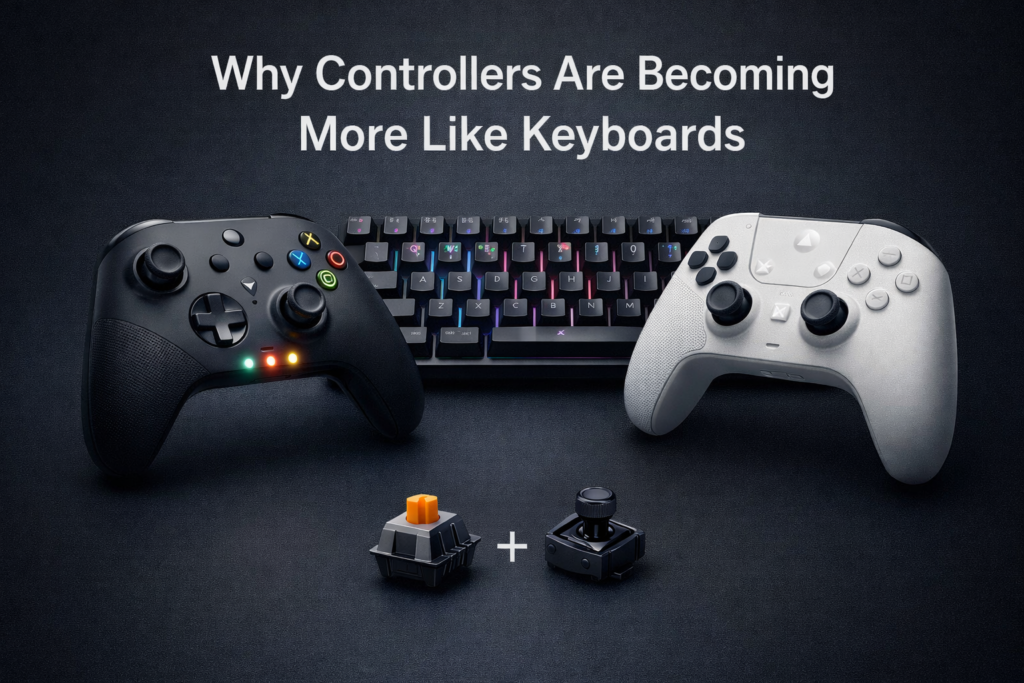
Gamers once described controllers and keyboards as two completely different worlds — one built for comfort and analog nuance, the other engineered for precision and raw input speed. But in 2025, the debate around controller vs keyboard design is no longer binary. Modern controllers are quietly adopting ideas that originated from mechanical keyboards, and the shift isn’t cosmetic. It reflects a deeper change in how game design, input latency, and player expectations are evolving across platforms.
Where the Convergence Really Started
The shift in controller vs keyboard design began when competitive console titles started demanding the same reaction time and consistency that PC shooters had relied on for years. Traditional membrane buttons on controllers were soft, mushy, and inconsistent across units. Keyboard manufacturers had already solved these problems with mechanical switches offering tighter actuation points, clearer tactile feedback, and consistent input registration.
Controller manufacturers took notice.
- Short-travel microswitches replaced rubber domes
- Face buttons gained sharper actuation profiles closer to mechanical keys
- Triggers adopted magnetic sensors and Hall-effect designs inspired by linear keyboard switch accuracy
The design goal became clear: deliver PC-grade responsiveness without abandoning handheld ergonomics — a direct response to the modern controller vs keyboard design debate.
The Engineering Shift Behind the Trend
This evolution isn’t about aesthetics or marketing language. The convergence between controller and keyboard design is driven by engineering limits.
Keyboards excel in three measurable areas:
- Actuation precision
- Input consistency over millions of presses
- Predictable force curves
Controllers historically lagged because rubber domes degrade faster, introduce uneven resistance, and create latency variance. That was acceptable in casual games — but not in competitive shooters, action RPGs, or esports-focused titles.
To close this gap, controller makers borrowed proven keyboard principles:
- Clicky face buttons → Inspired by low-profile mechanical switches
• Trigger stops → Mimic short-actuation mods common in competitive keyboard setups
• Hall-effect joysticks → Apply frictionless magnetic sensing concepts found in premium keyboard switches
In the modern controller vs keyboard design landscape, predictability matters more than comfort alone.
What Players Think They’re Getting vs What Actually Matters
Many gamers assume these changes exist purely for “better feel,” but the real advantage is repeatability.
Mini Comparison: Mechanical Keyboard Influence on Modern Controllers
| Category | Mechanical Keyboards | Modern Controllers |
|---|---|---|
| Input Style | Discrete, precise switches | Hybrid digital-analog layouts |
| Advantage Borrowed | Tactility, consistency | Faster, sharper actuation |
| Ideal Use Case | Competitive precision | Quick-trigger shooters & action titles |
In the controller vs keyboard design conversation, feel is secondary. Competitive players value consistency — the controller behaving the same on day one and day three hundred.
Why Modern Games Forced This Evolution
The real catalyst behind the shift wasn’t hardware ambition — it was game design convergence.
Genres once considered PC-exclusive are now console staples:
- Arena shooters
- High-speed extraction games
- Cross-platform esports
- Animation-cancel-heavy action titles
These games exposed the limits of traditional controller hardware. A single millisecond delay could decide a parry, a trade, or a headshot. Developers tuned mechanics around fast, consistent inputs, forcing controllers to evolve — and the controller vs keyboard design gap narrowed rapidly as a result.
Keyboard engineering provided the blueprint.
Contrarian Angle — Are Controllers Losing Their Identity?
Not everyone sees this convergence as progress. Critics argue that as controller design moves closer to keyboards, it risks losing what made controllers unique.
- Ultra-short triggers reduce analog expressiveness
- Microswitch buttons remove pressure modulation
- Keyboard-like layouts push controllers toward digital uniformity
Ironically, in trying to match keyboard precision, controllers may sacrifice versatility. The controller vs keyboard design debate now includes a deeper question: should controllers evolve into hybrids, or preserve their analog-first identity?
Closing Insight
The growing overlap between controllers and keyboards isn’t a trend — it’s a structural shift driven by modern games, competitive expectations, and cross-platform parity. The real challenge in controller vs keyboard design is no longer speed or latency. It’s balance.
How far can controllers borrow from keyboards before they stop being controllers at all? The next few years will define whether input devices converge, specialize, or reinvent themselves entirely.
Stay Connected for More Input-Tech Deep Dives
- Follow our Instagram @vibetric_official for hardware teardowns and input-tech insights.
- Bookmark vibetric.com for upcoming controller and switch analyses.
- Check back weekly for design-focused perspectives you won’t find in spec-sheet reviews
What’s your take on this?
At Vibetric, the comments go way beyond quick reactions — they’re where creators, innovators, and curious minds spark conversations that push tech’s future forward.

Galaxy S26 Ultra Privacy Display: 5 Brutal Real-World Truths Nobody Tells You
Galaxy S26 Ultra Privacy Display: 5 Brutal Real-World Truths Nobody Tells You There’s a specific anxiety that comes with using a phone