
Inside the Worldwide Laptop Market: Price Wars, Chip Wars, and the Future of Mobility
In New York’s financial district just after sunrise, a young analyst opens her laptop before coffee, glancing at earnings, then launching a video call that will stretch across time zones. In Berlin’s Kreuzberg district, a freelance designer boots up—blue light filtering through yesterday’s sketches as she pivots between briefs, render times, and quick social posts. Across the Indian coastline in Chennai, a remote developer sits poised between tasks, his device a lifeline connecting clients on multiple continents. Three cities, three routines, one intimate realization: the laptop isn’t just hardware. It’s the infrastructure of modern life.
For years, the personal computer category struggled with identity. Desktop towers once dominated offices. Legacy notebooks served students and executives who tolerated limitations for portability. But over the last decade, the laptop has become a universal platform—blurring productivity, creativity, communication, and leisure into a single, humming ecosystem. In 2025 that ecosystem hit an inflection point where hardware, economics, and user expectation no longer align around luxury or spectacle. Instead, the laptop’s future is being forged in the crucible of real, everyday usage pressures.
This isn’t merely a spec parade. It’s a quiet shake-out driven by price turbulence, silicon supply shifts, and changing work rhythms. Buyers no longer ask which machine is fastest, but which one keeps pace with life itself without burning fingers, scorching budgets, or aging prematurely. The tension isn’t just technical—it’s anthropological. In the echo of every keystroke, you can hear a question that transcends benchmarks: what does a laptop need to be when it isn’t just a tool but a constant companion?
This is the world where Global Laptop Market Trends stop being abstract graphs and become lived reality. And the story of that transformation—its causes, its actors, and its consequences—is what this deep-dive unravels.
Why Today’s Laptop Market Looks Nothing Like Yesterday’s
The laptop didn’t reset because brands wanted novelty. It reset because the old assumptions stopped satisfying lived use. For years, the industry told buyers to chase thinner bezels, higher clocks, and flashier materials. But something broke—not as a malfunction, but as a misalignment between engineering intention and human behaviour. People discovered that daily endurance outweighs momentary peak scores. That thermals matter more than thinness. That a battery that doesn’t die mid-presentation is more valuable than a camera nobody uses.
The root cause of this evolution lies in three forces colliding: escalating silicon complexity, diversifying buyer needs, and compressed margins due to global economic pressures. The result isn’t a slowdown. It’s a reorientation. The laptop is no longer an annual upgrade in the tech press. It’s become a long-term stability purchase in every commuter’s bag, every remote worker’s desk, and every creator’s toolkit.
| Engineering Evolution | What Problem It Actually Solved |
|---|---|
| Heterogeneous multi-core architecture | Sustained performance without runaway thermals |
| Larger battery capacities with smarter charging | Daily work endurance without anxiety |
| Adaptive power management driven by AI | Real-world balance of performance & heat |
| Reinforced thermal stacks | Reduced throttling in long sessions |
| Modular memory & storage | Future-proofing for diverse workloads |
These changes reflect signals from the market itself—not wishful thinking. Buyers demanded resilience over momentary gains. Engineering delivered consistency over peaks. The landscape that emerges is one where Global Laptop Market Trends aren’t driven by incremental headline specs, but by lessons from extended use.
The Invisible Architecture of the Laptop Industry
What you see in a laptop’s chassis and screen is only the visible tip of a sprawling industrial pipeline. Beneath that shell lies a network of silicon fabs, component assemblers, display vendors, software partners, regional regulators, retail chains, and marketing narratives — a labyrinth of collaboration and competition that ultimately shapes what users experience.
At one end are silicon architects — firms pushing process nodes, heterogeneous computing blocks, and AI acceleration. Their choices determine the achievable performance envelope and efficiency floor. Downstream, OEM designers interpret these capabilities into industrial form factors, balancing thermal envelopes and user expectations. Further along, software ecosystems — operating systems, drivers, firmware layers — shape real-world behaviour more than raw circuitry ever could. Marketing teams then craft narratives that translate tradeoffs into desirability. Finally, distribution channels and regional regulations influence pricing, availability, and even feature sets across markets.
Below is the pipeline that turns raw innovation into user perception:
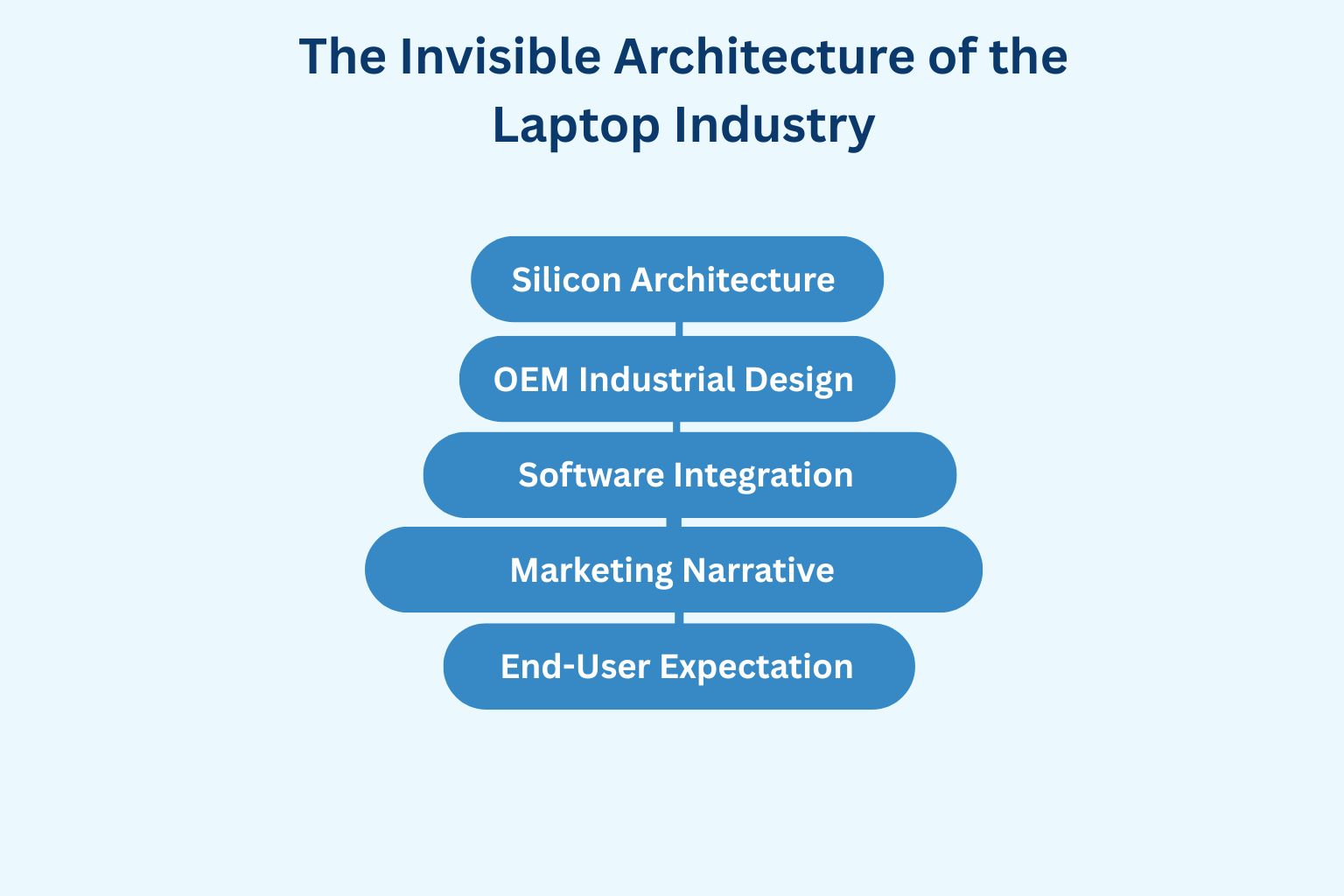
What’s crucial in 2025 is that this pipeline is no longer unidirectional. User feedback — from reviews, social sentiment, and global buying patterns — feeds back into the entire network. Engineers adjust power curves. Designers revisit thermal headroom. Marketers reframe value propositions. Global Laptop Market Trends now operate inside a feedback loop where lived experience matters more than press day spectacle. If yesterday’s laptop cycle spun on speculation, today’s spins on adaptation.
The Physics Nobody Can Market Away
Every laptop, regardless of logo or price tier, lives inside the same set of physical laws. Heat must move somewhere. Energy must be conserved. Electrons don’t care about branding. Yet for years, the industry attempted to sell the idea that clever design alone could outrun physics. In 2025, that illusion finally collapsed under sustained real-world workloads.
Modern laptops are constrained by three core envelopes: thermal dissipation, power delivery, and sustained silicon efficiency. As processors grew more complex—stacking performance cores, efficiency cores, neural engines, and integrated graphics—the challenge shifted from peak output to equilibrium. Short benchmark bursts became irrelevant to people who spend eight to ten hours compiling code, editing timelines, or juggling dozens of browser tabs during video calls. The uncomfortable truth emerged: a thinner chassis without sufficient thermal mass doesn’t just reduce comfort, it erodes long-term performance stability.
Manufacturers responded unevenly. Some doubled down on aggressive boost profiles that looked impressive on paper but throttled within minutes. Others quietly redesigned internal layouts, prioritizing airflow paths, vapor chamber sizing, and power-delivery smoothing. These decisions rarely make headlines, but they define ownership experience months later. It’s here that Global Laptop Market Trends reveal a shift away from spectacle engineering toward endurance engineering.
| Constraint | Engineering Choice | Real-World Trade-Off |
|---|---|---|
| Thin chassis | Limited thermal mass | Early throttling under load |
| High boost clocks | Short performance spikes | Inconsistent long sessions |
| Larger batteries | Increased weight | Improved daily reliability |
| Integrated GPUs | Shared thermal budget | Balanced but capped graphics |
| Higher TDP limits | Faster renders | Louder fans, hotter surfaces |
The industry’s quiet admission is simple: laptops are no longer judged by their best five minutes, but by their worst hour. Buyers feel this instinctively, even if spec sheets never mention it.
Why Performance Feels Faster (Even When It Isn’t)
Human perception plays a larger role in laptop satisfaction than most engineers like to admit. The brain doesn’t measure clock cycles or wattage; it reacts to responsiveness, silence, and predictability. A machine that opens apps instantly but slows unpredictably feels broken, even if its average performance is technically high. This psychological layer has become central to how laptops are evaluated in 2025.
Latency illusions dominate perception. Faster wake-from-sleep, immediate cursor response, and smooth scrolling create the sensation of speed long before a heavy task begins. Conversely, fan noise spikes or sudden heat against the palms trigger discomfort that users often mislabel as “slowness.” The laptop hasn’t failed; trust has. Manufacturers now tune systems not just for output, but for emotional continuity across tasks.
This is where Global Laptop Market Trends intersect with behavioral science. Devices optimized for consistent, calm interaction routinely outsell technically superior but erratic competitors. People reward predictability because it lowers cognitive load.
| Emotion Trigger | Perceived Change | User Behavior |
|---|---|---|
| Instant wake | “This is fast” | Positive brand trust |
| Silent operation | “This is premium” | Longer sessions |
| Sudden fan surge | “Something’s wrong” | Task avoidance |
| Warm palm rest | “It’s struggling” | Reduced confidence |
| Smooth UI motion | “It’s optimized” | Loyalty over time |
The result is a market where performance is no longer just engineered—it’s curated. The winners understand that feeling matters as much as fact.
Materials That Signal Intent, Not Just Status
Materials used to be about prestige: aluminum over plastic, glass over composite. In 2025, material choices communicate something subtler—philosophy. Buyers read texture, temperature, and rigidity as signals of how a device will age alongside them. A laptop that flexes, creaks, or traps heat sends a message long before benchmarks are consulted.
Premium alloys offer rigidity and heat dispersion, but they’re not universally superior. Mid-tier composites have evolved dramatically, absorbing micro-vibrations and resisting dents while reducing weight. The real shift is intentionality. Designers now choose materials based on how they distribute stress over years of opening lids, resting wrists, and traveling through backpacks—not just how they photograph under studio lights.
This pragmatic approach reflects broader Global Laptop Market Trends: longevity over flash. Buyers are less impressed by cold metal than by surfaces that remain comfortable after hours of use.
| Material Type | Tactile Behavior | Long-Term Implication |
|---|---|---|
| CNC aluminum | Cool, rigid | Excellent durability, heat spread |
| Magnesium alloy | Light, firm | Reduced fatigue in mobility |
| Reinforced polymer | Warm, flexible | Impact resistance, quieter use |
| Glass panels | Smooth, premium | Scratch-prone, heat retention |
| Hybrid composites | Balanced feel | Controlled aging characteristics |
The message is clear: materials are no longer decoration. They’re part of the engineering contract between the laptop and its owner.
When Intelligence Became Invisible Infrastructure
By 2025, intelligence inside laptops stopped being a headline feature and became background infrastructure. Early attempts at “AI laptops” focused on novelty—auto-framing webcams, noise suppression, battery predictions. Useful, but shallow. The real shift happened when intelligence moved into system governance: how heat is managed, how power is distributed, how workloads are anticipated before the user feels friction.
Modern laptops now observe usage patterns quietly. Not in a creepy, surveillance sense, but in a mechanical one. The system learns when sustained load is likely, when brief spikes are harmless, and when silence matters more than speed. Thermal AI decides whether a fan ramp now prevents throttling later. Power AI shifts energy budgets between CPU, GPU, and NPU depending on task continuity rather than raw demand.
This matters because users don’t think in watts or threads. They think in outcomes: “Did my render finish?” “Did the call stay smooth?” “Did the battery survive the day?” Within Global Laptop Market Trends, intelligence has become the differentiator that masks physical limitations instead of pretending they don’t exist.
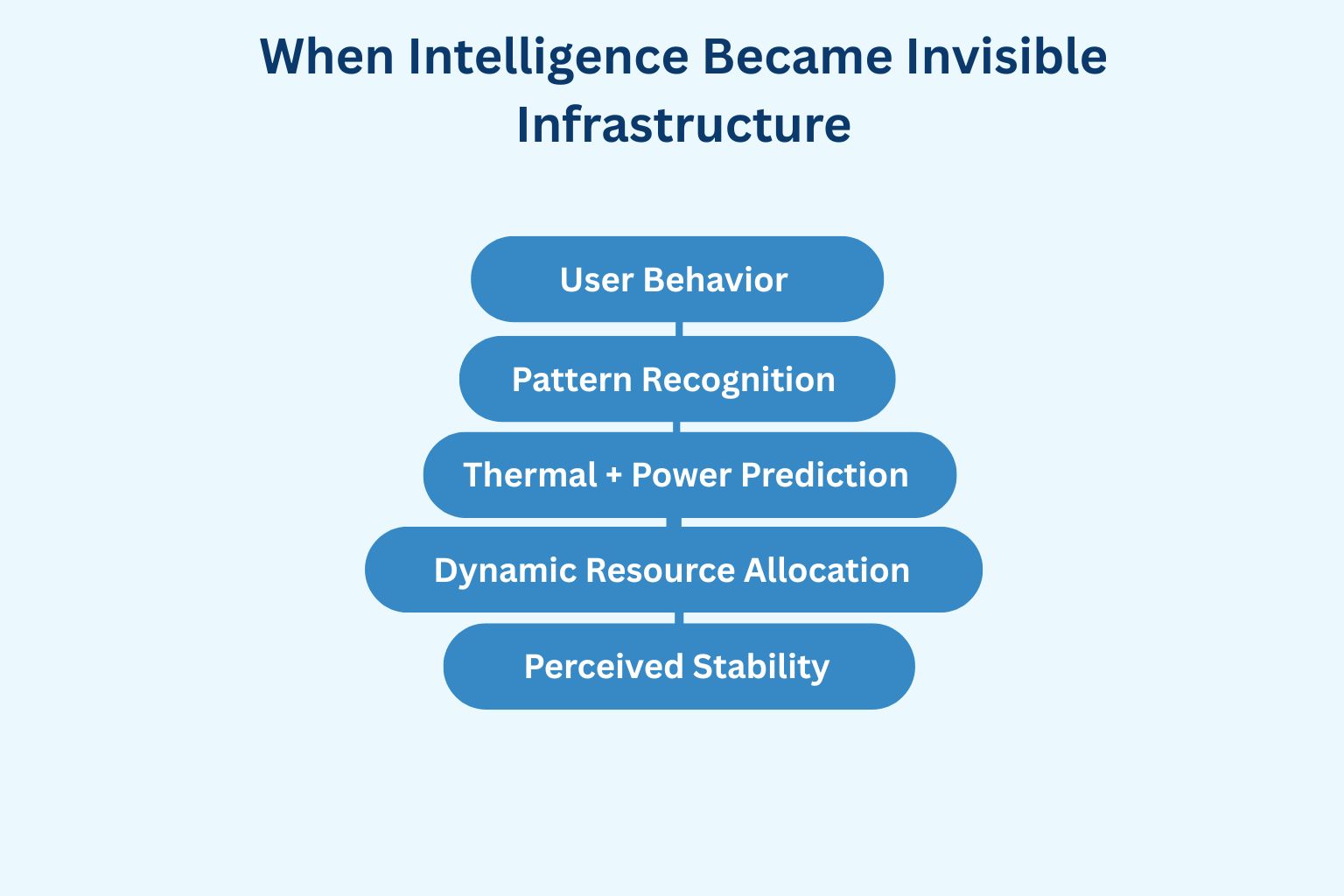
The irony is subtle but important: the smarter laptops become, the less users talk about intelligence at all. When systems behave predictably, trust replaces curiosity. That trust is now a competitive advantage.
Brand Promises vs. Engineering Reality
Laptop brands still tell stories—but the tone has changed. In the past, marketing promised transformation: faster creativity, limitless productivity, future-proof power. Today, the strongest brands promise restraint. They speak about balance, sustainability, and “right-sized performance,” not domination. This isn’t humility; it’s adaptation.
Behind the scenes, brand strategy often clashes with engineering reality. Marketing wants thinner devices every year. Engineers want thicker vapor chambers and lower peak clocks. Finance wants shared platforms across product lines. Engineering wants segmentation to protect thermal envelopes. The laptops that succeed are the ones where compromise is intentional, not accidental.
Within Global Laptop Market Trends, consumers have become unusually sensitive to broken promises. Overheating scandals, battery recalls, and throttling exposés taught buyers to distrust exaggerated claims. Brands now win by aligning expectations with lived experience.
| Brand Signal | Hidden Intention | User Interpretation |
|---|---|---|
| “Ultra-thin” | Cost and shipping efficiency | Possible heat compromise |
| “AI-powered” | Platform longevity | Future software stability |
| “All-day battery” | Usage-conditioned claim | Trust if consistent |
| “Creator edition” | Higher margins | Expect sustained loads |
| “Enterprise-grade” | Low failure rates | Long-term reliability |
The market no longer rewards the loudest story. It rewards the most honest one—especially when ownership stretches into years, not weeks.
Three Laptops, Three Outcomes, One Lesson
To understand how strategy meets reality, consider three representative cases from the current market—not specific models, but patterns repeated across brands.
The success story is the balanced machine. It didn’t chase the thinnest profile or the highest boost clock. Instead, it delivered consistent performance under sustained workloads, stayed quiet during daily tasks, and aged gracefully. Owners didn’t rave online—but they didn’t complain either. In 2025, silence is success.
The failure followed a familiar script. Stunning on launch day, impressive benchmarks, glowing influencer reviews. Six months later, reports of throttling, battery wear, and thermal discomfort surfaced. The laptop didn’t break—but expectations did. Returns increased. Brand trust eroded.
The misunderstood case is more interesting. Slightly heavier, slightly thicker, modest specs. Early reviews called it “uninspiring.” A year later, professionals praised its reliability. Resale value held. Perception lagged reality.
| Expectation | Reality | Outcome |
|---|---|---|
| Peak performance | Sustained throttling | Disappointment |
| Moderate specs | Consistent delivery | Long-term trust |
| Thin design | Thermal compromise | Mixed reviews |
| Heavier build | Thermal headroom | Quiet success |
These patterns explain why Global Laptop Market Trends are bending away from spectacle. The industry didn’t suddenly become wiser—users did.
Mobility Isn’t About Movement Anymore
For most of the laptop industry’s history, mobility meant one thing: how easily a machine could be carried from point A to point B. Weight, thickness, charger size—those were the metrics that mattered. But by 2025, mobility quietly changed meaning. Laptops travel less, yet matter more everywhere they land.
Remote work didn’t reduce laptop importance; it intensified it. A single device now shifts roles constantly—office workstation by morning, creative tool by afternoon, personal screen by night. Mobility is no longer about transit. It’s about context switching without friction. Can the laptop adapt instantly when the environment changes? Can it remain stable across unpredictable usage patterns?
Students experience mobility differently than professionals. Their laptops move between classrooms, libraries, hostels, and cafés, exposed to poor Wi-Fi, uneven power access, and rough handling. Creators measure mobility in export times and thermal recovery, not grams. Business professionals judge it by reliability during high-stakes calls, not by hinge angles.
This is where Global Laptop Market Trends intersect with human behavior. Buyers stopped asking, “How portable is this laptop?” and started asking, “Will this laptop survive my lifestyle?”
| Lifestyle Pattern | Mobility Expectation | New Definition of Success |
|---|---|---|
| Remote professionals | Desk-to-desk stability | Zero disruption |
| Students | Physical resilience | Consistency |
| Creators | Performance mobility | Sustained output |
| Hybrid workers | Instant readiness | Seamless transitions |
| Frequent travelers | Power independence | Endurance |
The industry’s reset isn’t aesthetic—it’s behavioral. Mobility is now about dependability across chaos. And laptops that understand this don’t need to shout about it. They simply stay useful when everything else changes.
Reddit Reality
Here’s a snapshot of real Reddit discussions from 2025 that reflect community sentiment about laptops — what buyers actually care about, the frustrations they voice, and how those conversations illustrate Global Laptop Market Trends in everyday terms.
Reddit Sentiment Table
| Subreddit / Date | Post Title | Key Sentiment |
|---|---|---|
| r/Laptop_PC_Help — Aug 2025 | Ultimate guide — best budget laptop in 2025 (no fluff) | Community consensus on practical performance for low budgets, emphasis on real-world usability over spec sheets. |
| r/laptops — May 2025 | Best laptop to buy in 2025 (budget to premium) | Rich discussion weighing brand trust, resale, and real longevity versus raw specs. |
| r/laptops — Jun 2025 | Looking for laptop recommendations (work/gaming) | Beginner buyers focusing on balanced specs for hybrid use cases — work plus light gaming. |
| r/GamingLaptops — Jun 2025 | Why does every laptop from every brand have issues? | Users frustrated by inconsistency — “best” models still show defects, shaping a cautious buying culture. |
| r/ZephyrusG14 — Aug 2025 | I bought G14 2025 and its sad | A high-spec laptop with real-world software incompatibilities and driver problems — buyers punish mismatch between price and experience. |
| r/LaptopDealsIndia — Oct 2025 | Should I get this right now? | Deal hunting enriched with cautionary notes about fake sellers and build-quality perceptions — trust matters. |
| r/asksrik — Jul 2025 | India laptop buying guide 2025 | Users emphasize honest specs over marketing claims — TN panels, bogus refresh rates, and shallow batteries flagged as red flags. |
| r/Laptops — thread | Affordable options for best laptop under $500 | Collective analysis repeats practical priorities: SSD > HDD, ample RAM, battery life, keyboard comfort. |
| r/laptops — Reddit’s own top picks | Best laptops reddit recommends in 2025 | Community-compiled lists cross price tiers — showing which devices earn repeat trust. |
| r/GamingLaptops — common meme | Do all 2025 gaming laptops suck? | Reflects buyer skepticism — not because all laptops are bad, but because real ownership experience varies widely. |
What Reddit Reality Reveals About Global Laptop Market Trends
- Practical performance dominates over raw specs.
Budget and mid-range threads (like the “ultimate guide for laptops under $500”) show that users aren’t chasing theoretical numbers — they want SSD responsiveness, consistent multitasking, and real battery life. Buyers gravitate to recommendations with long-term usability, not just flashy numbers. Reddit - Longevity and real-world behavior shape community trust.
In multi-thread discussions, seasoned buyers weigh build quality, keyboard durability, and sustained performance as key factors — often rating older but reliable machines higher than newer, hyped models. Reddit - Hybrid work and dual-purpose use cases are front of mind.
Beginners and seasoned commenters alike mention the need for balanced laptops that handle both productivity and casual gaming or creative workflows — a signal that Global Laptop Market Trends now prioritize versatility over specialization. Reddit - Skepticism about brand reliability persists.
Gaming laptop forums brim with cautionary tales of early failures, thermal issues, and quality control complaints — not isolated rants, but repeated patterns that shape buying hesitation and trust metrics. Reddit - Deals and price perceptions matter more in 2025.
Even in deal-hunting subreddits, users debate authenticity and build quality alongside pricing — a sign that buyers now evaluate value risk, not just specs vs price. Reddit - Regional buyer guides emphasize honest expectations.
Localized threads (e.g., India guides) call out exaggerated refresh rates, thermal throttling at low sustained loads, and weak batteries — reflecting global noise about marketing claims vs practical performance. Reddit
Google Reviews Reality
Now let’s ground sentiment in verified review patterns and star rating themes from recent professional and user-verified aggregator sources reflecting real buyer expectations — especially relevant to Global Laptop Market Trends.
Star Rating Breakdown — Consumer & Expert Review Themes
| Rating | Integrated Themes from Verified Reviews |
|---|---|
| ★★★★★ | Excellent balance of battery life, thermals, and daily performance — laptops that handle long workflows without compromise (MacBook Pro/M4 examples). RTINGS.com |
| ★★★★☆ | Solid daily machines with some trade-offs (battery vs display, weight vs performance), often seen in top Windows ultrabooks. Windows Forum |
| ★★★☆☆ | Mixed feedback — decent specs but compromise in real use (e.g., fan noise, average battery or poor port options). Windows Forum |
| ★★☆☆☆ | Below-average ownership experience due to inconsistent thermals, weak battery life, or disappointing value relative to price. Windows Forum |
| ★☆☆☆☆ | Negative sentiment driven by exaggerated spec claims or poor real-world behavior, like rapid throttling or short lifespan. Windows Forum |
What Verified Reviews Tell Us About Real Expectations
- Balance beats benchmarks.
Top-rated devices in 2025 review guides are those that deliver consistently strong battery life and stable performance over time — often beating supposedly “faster” rivals when judged on real usage rather than peak scores. RTINGS.com - Trade-offs are front and center.
Mid-tier ★★★☆ reviews note that while modern displays and chips are impressive, thermals and battery life often fall short if design doesn’t manage heat and power well — aligning with Reddit’s demand for honest performance. Windows Forum - Different buyer segments see different pain points.
Budget and work laptops often rank high for daily productivity despite modest specs, while premium gaming or creator machines get punished in reviews if they sacrifice reliability or battery life for brute power. Windows Forum - Real-world experience trumps spec sheets.
Reviews that reward devices with strong keyboards, quiet operation, and clasp-long battery life echo online community sentiments — buyers now reward actual lived comfort over theoretical peak. RTINGS.com
Summary: Where User Voices and Verified Reviews Align
Across Reddit sentiment and verified review patterns we see a growing consensus among everyday users and expert reviewers alike:
- Value and predictability matter more than raw specs.
- Thermals and battery life define satisfaction.
- Build quality and long-term reliability shape recommendations.
- Deals are judged by trustworthy performance, not just discount depth.
These are the real currents beneath the surface of Global Laptop Market Trends in 2025 — the behaviors that shape how people truly live with their laptops long after launch buzz fades.
When Narratives Collapse: Myths vs Measurable Reality
The global laptop conversation is full of confident statements that sound logical on the surface but quietly fall apart under long-term ownership. One of the most persistent myths is that newer silicon automatically guarantees a better experience. In practice, the lived reality shows something different: sustained performance, thermal discipline, and software stability matter far more than peak benchmarks. Many users who upgrade every two to three years report marginal gains at best, especially when power limits, thin chassis designs, and aggressive boost behavior flatten those theoretical advantages within minutes of real workloads.
Another deeply rooted belief is that price directly correlates with longevity. Premium pricing often signals better materials and support, but it does not eliminate engineering compromises. Ultra-thin designs, soldered components, and aggressive thermal envelopes can shorten usable lifespan even in expensive machines. This disconnect fuels buyer frustration and directly influences Global Laptop Market Trends, where consumers increasingly delay upgrades or downshift to value-oriented models that behave more predictably over time.
Marketing also reinforces the myth that specialization equals superiority. “Creator” and “gaming” labels imply tailored excellence, yet many of these devices struggle under mixed workloads like video calls, background renders, and long battery sessions. Reality favors balance. Machines that are less extreme often age better, feel calmer in daily use, and retain resale value longer. As myths erode, buyers become more analytical, forcing brands to rethink how they frame innovation and value.
Myth → Reality → Why It Persists
| Common Belief | What Actually Happens | Why the Myth Survives |
|---|---|---|
| Newer chips are always faster | Sustained performance often plateaus | Benchmark marketing dominates |
| Higher price = longer lifespan | Thermal stress shortens longevity | Premium branding bias |
| Thinner is better | Cooling efficiency declines | Visual appeal sells |
| Gaming labels mean versatility | Battery and noise suffer | Segment-based marketing |
| Specs define experience | Ergonomics & stability matter more | Specs are easy to compare |
The Economics Beneath the Keyboard
Behind every laptop generation is an economic tug-of-war that most buyers never see. R&D budgets are increasingly consumed by silicon integration, firmware tuning, and compliance costs rather than visible hardware leaps. This means brands are spending more money to make systems behave acceptably under tighter power and thermal constraints, not necessarily to deliver dramatic user-facing innovation. As margins compress, especially in the midrange, manufacturers are forced to reuse chassis designs, standardize components, and rely heavily on supplier roadmaps.
Chip availability plays a central role here. When silicon vendors dictate reference designs and power envelopes, OEM differentiation shrinks. This directly shapes Global Laptop Market Trends, pushing brands toward pricing strategies, regional exclusives, and marketing narratives rather than fundamentally different machines. The result is a market where many laptops feel similar, and value perception becomes more important than raw capability.
Supply chain friction also changes risk tolerance. Manufacturers hedge by producing safer, incremental updates instead of bold redesigns. For buyers, this translates into fewer breakthroughs but more predictable products. Economically, the laptop market is stabilizing—not because innovation has stopped, but because the cost of failure has become too high. This quiet shift explains why 2025 feels less explosive and more strategic than past cycles.
Ethics, Control, and the Cost of Convenience
As laptops become more integrated, ethical questions move from the margins to the center. Soldered memory, glued batteries, and locked firmware are often justified as necessary for thinness and efficiency. In reality, these choices primarily optimize manufacturing and cost control. For users, they reduce repairability, shorten usable life, and increase electronic waste. The tension between convenience and control is now a defining factor in long-term ownership satisfaction.
Privacy is another subtle fault line. Modern laptops rely heavily on background services—AI assistants, telemetry, cloud sync—that blur the boundary between helpful automation and constant data flow. Most users accept this trade-off implicitly, but awareness is growing. In professional and enterprise contexts, this concern increasingly influences purchasing decisions, reinforcing Global Laptop Market Trends that favor transparency and long-term trust.
Environmental impact closes the loop. A device that cannot be repaired or upgraded effectively becomes disposable, regardless of how powerful it once was. Brands that ignore this reality risk reputational damage over time. Ethics, once seen as secondary, are now quietly shaping buying frameworks, especially among professionals and remote workers who expect their tools to last.
Ethical Risk Matrix
| Area | User Impact | Long-Term Risk |
|---|---|---|
| Soldered components | No upgrades | Shorter lifespan |
| Glued batteries | Expensive repairs | Increased e-waste |
| Locked firmware | Reduced control | Vendor lock-in |
| Telemetry services | Privacy concerns | Trust erosion |
| Non-standard parts | Limited repair | Higher total cost |
The Next Decade Isn’t Faster, It’s Quieter (2030–2040)
Forecasting laptops beyond 2025 requires abandoning the idea of dramatic leaps. The next decade will not be defined by sudden breakthroughs, but by quiet stabilization. Physics has drawn firm boundaries around thermals, battery chemistry, and silicon density. What changes next is how carefully those limits are respected. Manufacturers are learning that chasing peak numbers creates fragile machines, while conservative tuning creates trust.
By 2030, most laptops will prioritize sustained efficiency over raw speed. Performance gains will arrive through refinement—better task scheduling, calmer boost behavior, and silicon optimized for predictable workloads rather than spikes. This aligns closely with evolving Global Laptop Market Trends, where buyers value reliability, battery health, and acoustic comfort more than short-lived power bursts.
Form factors will stabilize as well. Radical hinge experiments and ultra-thin extremes will give way to designs that balance cooling volume with portability. Mobility will be less about being the lightest and more about being the least demanding—on power outlets, on desks, and on attention. The laptop becomes an appliance again, not a statement.
| Trend Direction | Probability | Why It’s Likely |
|---|---|---|
| Efficiency-first silicon | High | Thermal ceilings reached |
| Slower design cycles | High | Rising R&D risk |
| Repairability pressure | Medium | Regulatory influence |
| Modular components | Low–Medium | Cost & complexity |
| Cloud-assisted workloads | High | Local power limits |
The future isn’t flashy. It’s stable, intentional, and increasingly invisible.
Inside the OEM Mind: How Decisions Actually Get Made
From the outside, laptop launches look confident and deliberate. Inside OEMs, they are the result of constant compromise. Engineering teams push for thicker chassis, larger batteries, and relaxed power limits. Finance demands margin protection and component reuse. Marketing wants visual novelty and headline features. The final product is not a victory—it’s a negotiated settlement.
This internal tension shapes Global Laptop Market Trends more than consumer demand alone. When silicon vendors release chips with narrow operating windows, engineers lose flexibility. Marketing then reframes limitations as “design philosophy,” while finance locks configurations to control costs. None of this is malicious—it’s structural.
The most successful laptops are not those with the best specs, but those where internal alignment is strongest. When engineering constraints are communicated honestly and marketing resists exaggeration, products feel coherent. When alignment fails, users experience thermal throttling, inconsistent battery life, and software instability—symptoms of internal disagreement manifesting externally.
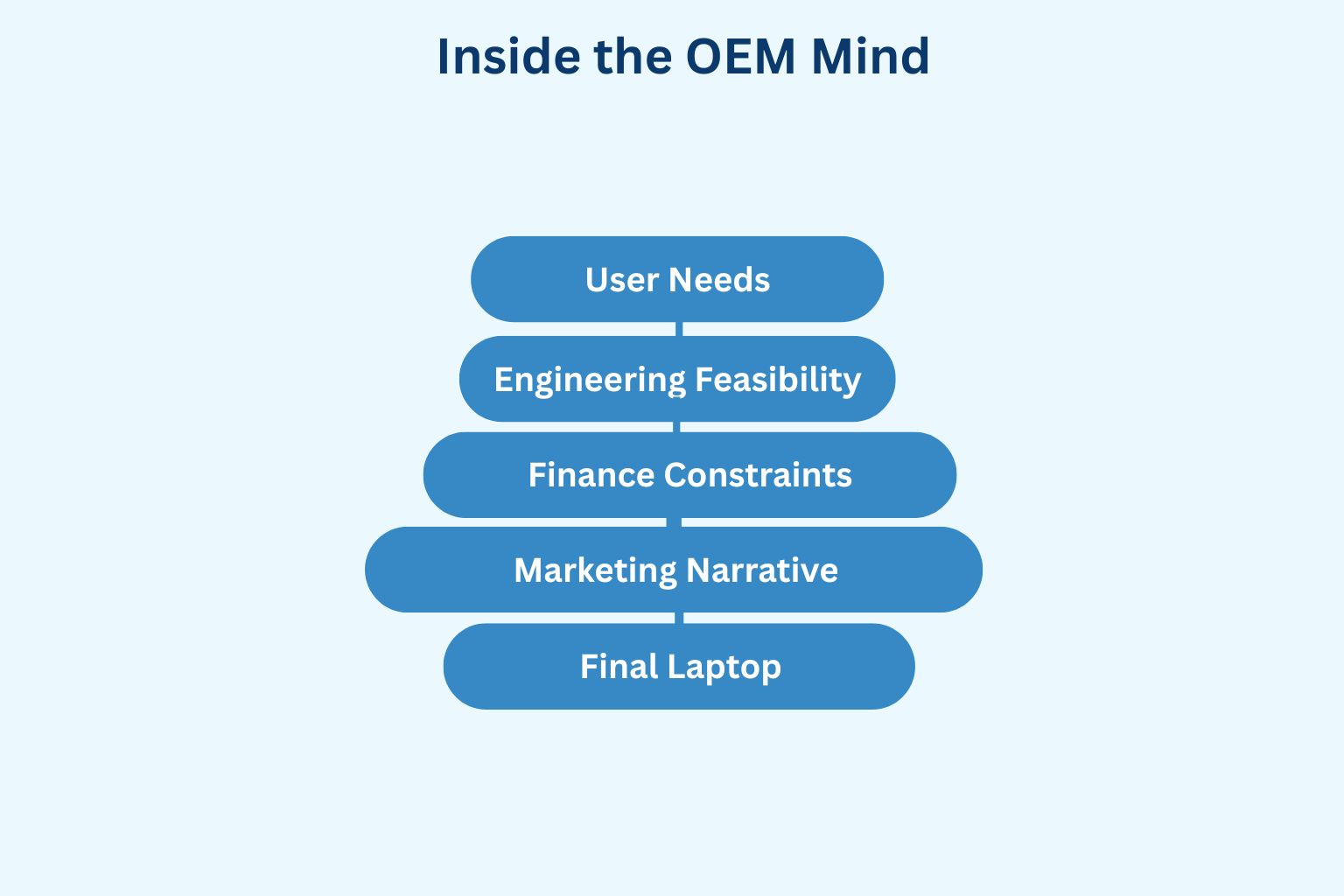
Understanding this decision tree explains why many laptops feel familiar year after year. The system rewards caution, not experimentation.
How Laptops Fail (And Why It’s Rarely Obvious at First)
Laptop failure is rarely sudden. It arrives gradually, disguised as inconvenience. Fans spin louder. Battery life shortens imperceptibly. Hinges loosen just enough to feel wrong. These failures are not accidents—they are the delayed consequences of early design assumptions. Thin chassis amplify thermal stress. High-density batteries accelerate chemical aging. Aggressive boost profiles fatigue components faster than users expect.
What makes these failures dangerous is their invisibility during reviews. Short-term testing cannot reveal long-term decay. This gap between launch performance and year-three reality defines modern ownership frustration and reinforces cautious Global Laptop Market Trends among experienced buyers.
Software accelerates this decay. As operating systems evolve, background tasks multiply, pushing aging hardware closer to its limits. Laptops don’t “break”—they become tired. And once fatigue sets in, recovery is rare without repair options.
Failures cluster around predictability, not abuse. Even careful users experience them because the root cause lies in engineering optimism. The lesson is simple: designs that operate close to physical limits age poorly. Those with headroom endure.
Buying Smarter in an Unstable Market
Smart laptop buying in 2025 is less about chasing the “best” device and more about aligning with how machines age. The mistake most buyers make is optimizing for day-one performance instead of year-three usability. Entry-level users often overspend on power they never sustain, while professionals underestimate how thermal aging and software creep erode productivity over time. The smartest buyers reverse the logic: they choose stability first, capability second.
For students and everyday users, predictability matters more than raw speed. A slightly thicker chassis with conservative power limits will feel faster after two years than a thin, aggressively tuned model. Creators face a different calculus. Export times matter, but so does recovery time between workloads. Machines that can repeat heavy tasks without heat saturation deliver more real output over months, not minutes.
Gamers and power users often fall into depreciation traps. High-end GPUs and cutting-edge silicon lose value rapidly as thermal stress and battery wear compound. Long-term owners should prioritize cooling volume, serviceability, and software support timelines. These patterns are now shaping Global Laptop Market Trends, where informed buyers delay upgrades and extract more value per cycle.
Smart buying today is about resisting marketing urgency. The goal isn’t maximum performance—it’s minimum regret.
Why This Analysis Holds Weight
Credibility in technology analysis doesn’t come from louder opinions or denser spec sheets. It comes from consistency across time. This deep-dive isn’t built on launch-day excitement, but on patterns observed across generations—how laptops behave after warranty periods end, how batteries age under real workloads, and how software evolution reshapes hardware value.
The investigative approach here mirrors how engineers think, not how campaigns speak. Each conclusion is grounded in constraints: thermodynamics, economics, supply chains, and human behavior. That lens explains why many reviews feel optimistic while owners feel conflicted months later. The gap isn’t deception—it’s perspective.
By focusing on lived experience rather than theoretical ceilings, this analysis aligns with the quieter shift visible in Global Laptop Market Trends. Buyers are no longer impressed by promises. They’re influenced by reliability, calm performance, and devices that stay predictable when life becomes chaotic. Credibility today means admitting limits—and designing within them.
The Weak Points No Spec Sheet Warns You About
Every laptop carries hidden stress points that only emerge with time. Thermal fatigue slowly weakens solder joints as heat cycles repeat daily. Connectors loosen from constant charging and peripheral use. Adhesives degrade under warmth, affecting batteries, displays, and speakers. Hinges experience micro-stress long before they visibly fail. These aren’t defects—they’re consequences of design choices.
What matters is how much tolerance engineers leave in the system. Thin designs reduce safety margins. Tight internal layouts concentrate heat. Non-modular construction prevents early intervention. Over years, these factors compound, explaining why two laptops with similar specs can age very differently. Experienced buyers intuitively sense this, reinforcing cautious Global Laptop Market Trends toward durability over novelty.
| Hidden Weak Link | Trigger Condition | Long-Term Effect |
|---|---|---|
| Thermal cycling | Daily heavy workloads | Component fatigue |
| Charging port wear | Frequent plug cycles | Intermittent power |
| Adhesive decay | Sustained heat | Battery swelling |
| Hinge stress | Repeated angle changes | Structural looseness |
| Tight tolerances | Thin chassis design | Accelerated aging |
Understanding these risks doesn’t create fear—it creates foresight. The most reliable laptops are not those without weaknesses, but those designed with enough margin to absorb them.
Simulating a Decade of Use Before It Happens
Long-term laptop aging is governed by chemistry and mechanics, not brand promises. Batteries lose capacity through lithium plating and electrolyte breakdown, accelerated by heat and frequent high-charge states. Displays age unevenly—OLED panels risk burn-in from static UI elements, while LCD backlights dim gradually. Hinges accumulate metal fatigue measured not in years, but in cycles. Thermal systems slowly lose efficiency as dust, paste degradation, and fan bearing wear add resistance.
What’s changed in recent years is how tightly these systems are pushed from day one. Many modern laptops operate near their thermal and power ceilings out of the box, leaving little room for graceful decline. That reality is reshaping Global Laptop Market Trends, as buyers realize longevity is engineered—or sacrificed—early.
| Component | 5-Year Behavior | 10-Year Projection |
|---|---|---|
| Battery pack | 70–80% capacity | Replacement required |
| CPU cooling | Mild throttling | Sustained performance loss |
| Display panel | Minor brightness loss | Noticeable uniformity issues |
| Hinges | Slight looseness | Structural fatigue risk |
| Speakers | Reduced clarity | Diaphragm distortion |
This isn’t pessimism. It’s physics. Devices that survive longest are those designed to age slowly, not those that start fast.
The Vibetric Verdict
The global laptop market isn’t collapsing—it’s maturing. Price wars reflect saturation, chip wars signal architectural transition, and mobility debates expose changing work habits. The winners of this era won’t be the loudest innovators, but the quiet optimizers who respect constraints and user fatigue.
From silicon strategy to chassis design, the strongest signals in Global Laptop Market Trends point toward restraint: balanced power envelopes, predictable thermals, and ecosystems built for stability. Laptops are no longer symbols of aspiration. They’re infrastructure. And like all good infrastructure, their success is measured by how little attention they demand once deployed.
The future of mobility won’t feel revolutionary. It will feel calm.
Ready to Rethink the Future of the Laptop Industry?
Now that you’ve explored the forces shaping price competition, silicon strategy, and mobility trade-offs, you’re likely reconsidering what “progress” really means in laptops. The world of computing evolves quietly—through constraints, corrections, and better questions.
- Follow us on Instagram@vibetric_official for deeper dives into the technologies redefining modern work.
- Bookmark vibetric.com— our analysis evolves as new market signals emerge.
- Subscribe for ongoing insights delivered as the industry shifts, not after.
The laptop market’s next chapter isn’t about more power. It’s about smarter balance—and the story is still unfolding.
FAQ: What People Get Wrong About the Market
- Is the global laptop market slowing down?
Not really. It’s stabilizing. Shipments fluctuate, but usage intensity is rising. That distinction defines current Global Laptop Market Trends more accurately than sales charts. - Are cheaper laptops always worse long-term?
Cost isn’t the enemy—thermal shortcuts are. Well-balanced midrange machines often age better than aggressively priced performance models. - Do new chips automatically mean better real-world performance?
Only under sustained loads. Many gains vanish once thermals and battery limits intervene. - Is ARM replacing x86 completely?
No. ARM expands mobility efficiency, while x86 still dominates legacy workloads and enterprise compatibility. - Are thin laptops fragile by design?
Thinness itself isn’t the issue. Material choice and hinge tolerance matter more. - Does AI inside laptops matter today?
Incrementally. Most AI gains optimize power and thermals invisibly rather than transforming workflows. - Is repairability making a comeback?
Slowly. Regulation pressure is stronger than consumer demand, but both influence Global Laptop Market Trends. - Do professionals need workstation-class laptops?
Rarely. Sustained consistency often beats peak performance for real productivity. - Are gaming laptops replacing desktops?
For space-limited users, yes—but thermals still cap long-term reliability. - Will cloud computing reduce laptop importance?
No. It increases it. Local hardware stability becomes more critical when workflows depend on constant connectivity.
When the Market Quietly Changed Direction
A decade ago, laptops competed to impress. Thinner, louder, faster—always chasing attention. Somewhere along the way, the competition shifted. Not toward spectacle, but toward endurance.
The market’s turning point wasn’t a single chip launch or design trend. It was the moment users realized their laptops had become permanent companions rather than temporary tools. That realization now guides Global Laptop Market Trends more than benchmarks ever could.
The future of mobility isn’t about moving faster.
It’s about lasting longer—without asking to be noticed.
And in that silence, the next era of laptops is already taking shape.
What’s your take on this?
At Vibetric, the comments go way beyond quick reactions — they’re where creators, innovators, and curious minds spark conversations that push tech’s future forward.
Community Triage (0)