
How Laptop Weight Affects Real Productivity
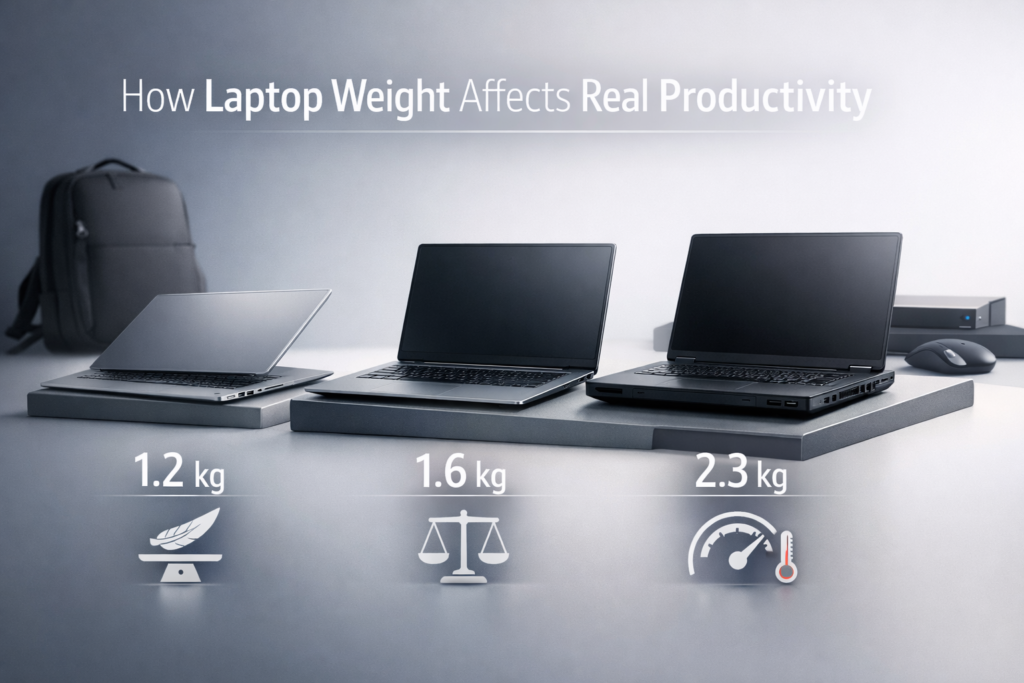
In 2025, laptops are faster, thinner, and more powerful than ever, yet one factor continues to shape user experience: weight. While benchmarks, display specs, and storage capacity dominate discussions, the role of laptop weight in productivity is often underestimated. Carrying a device that’s even half a kilogram heavier than necessary can subtly influence focus, mobility, and work efficiency over a day—or a week—of usage.
The Mechanics of Mobility
Laptop weight is not just a matter of comfort; it has real physiological and workflow implications. Heavy devices increase physical strain, particularly for professionals who carry their laptops across offices, campuses, or airports. Even minor increases in muscle fatigue can cumulatively reduce concentration and output.
Consider a standard 15-inch laptop at 2 kg versus a premium ultrabook at 1.2 kg. Over a single commute, the difference might feel negligible, but repeated daily use over months translates into noticeable fatigue, slower setup, and reduced willingness to work on the go. Laptop weight productivity isn’t about extreme differences—it’s about small, consistent advantages that compound over time.
Effect on Work Posture and Comfort
Heavier laptops often require sturdier setups, which can affect ergonomics. Users might adopt suboptimal postures to accommodate weight, increasing strain on wrists and shoulders. Lighter laptops allow for greater flexibility:
- Working from a lap, café table, or shared desk is easier.
- Frequent repositioning or switching between workspaces is less disruptive.
- Peripheral setups (mouse, keyboard, docking stations) become simpler to manage.
Engineering designers in 2025 consider weight a critical factor for hybrid work, recognizing that productivity depends not just on speed but on how effortlessly a user can deploy their device anywhere.
Battery and Thermal Trade-Offs
Weight is often a proxy for other components: larger batteries or advanced cooling solutions. A slightly heavier laptop might support longer battery life, high-end cooling, or additional ports. Users must balance portability with endurance:
- Ultra-light laptops (~1–1.3 kg) excel in mobility but may have smaller batteries or throttled performance under load.
- Mid-weight laptops (~1.5–2 kg) provide a balance of productivity and portability.
- Heavyworkstations (>2 kg) deliver sustained performance but sacrifice on-the-go convenience.
Understanding these trade-offs allows users to optimize their laptop weight productivity equation: what matters more—ease of carry or uninterrupted high performance?
Cognitive Effects of Device Weight
Studies in ergonomics suggest that heavier devices subtly influence perceived effort and cognitive load. Lighter laptops reduce the mental friction of mobility, encouraging spontaneous usage and extended work sessions outside traditional workspaces. Users often report that lighter devices feel “less like work” and encourage creativity, multitasking, and faster problem-solving in real-world conditions.
Mini Comparison: Weight vs Productivity Factors
| Laptop Category | Typical Weight | Key Productivity Advantage | Trade-Off |
|---|---|---|---|
| Premium Ultrabook | 1–1.3 kg | Extreme portability, flexible work locations | Slightly smaller battery, fewer ports |
| Mid-Range Productivity Laptop | 1.5–2 kg | Balanced performance and portability | Less agile for travel |
| High-Performance Workstation | 2+ kg | Maximum power, sustained multitasking | Heavy, cumbersome for commuting |
This snapshot emphasizes that laptop weight productivity isn’t linear—it’s about context-specific trade-offs.
Practical Guidelines for Users
- Choose a laptop weight that aligns with your typical mobility: daily commuting vs stationary desk use.
- Test devices in real-world carry scenarios, not just on a table.
- Consider hybrid solutions: docking stations at home or office to offset light laptops’ smaller battery constraints.
- Factor ergonomics into purchase decisions; a lighter device can reduce fatigue even for short durations.
Closing Insight
In 2025, productivity is as much about how seamlessly a device integrates into daily routines as its raw specs. Laptop weight affects setup time, posture, mobility, and cognitive load, creating ripple effects across hours of work. By consciously considering weight alongside performance and battery life, users can choose devices that enhance efficiency and comfort, rather than compromise them. Laptop weight productivity is less about numbers on a scale and more about how effortlessly your laptop supports sustained focus and output.
Optimize Your Daily Workflow
- Follow our Instagram @vibetric_official for in-depth explorations of ergonomics and tech efficiency.
- Bookmark vibetric.com for guides that evaluate laptops beyond specs—considering weight, battery, and real-world usability.
- Stay updated on hybrid work trends and device innovations that enhance productivity without compromising comfort.
What’s your take on this?
At Vibetric, the comments go way beyond quick reactions — they’re where creators, innovators, and curious minds spark conversations that push tech’s future forward.

Galaxy S26 Ultra Privacy Display: 5 Brutal Real-World Truths Nobody Tells You
Galaxy S26 Ultra Privacy Display: 5 Brutal Real-World Truths Nobody Tells You There’s a specific anxiety that comes with using a phone