
Do You Really Need 16GB RAM for Daily Work?
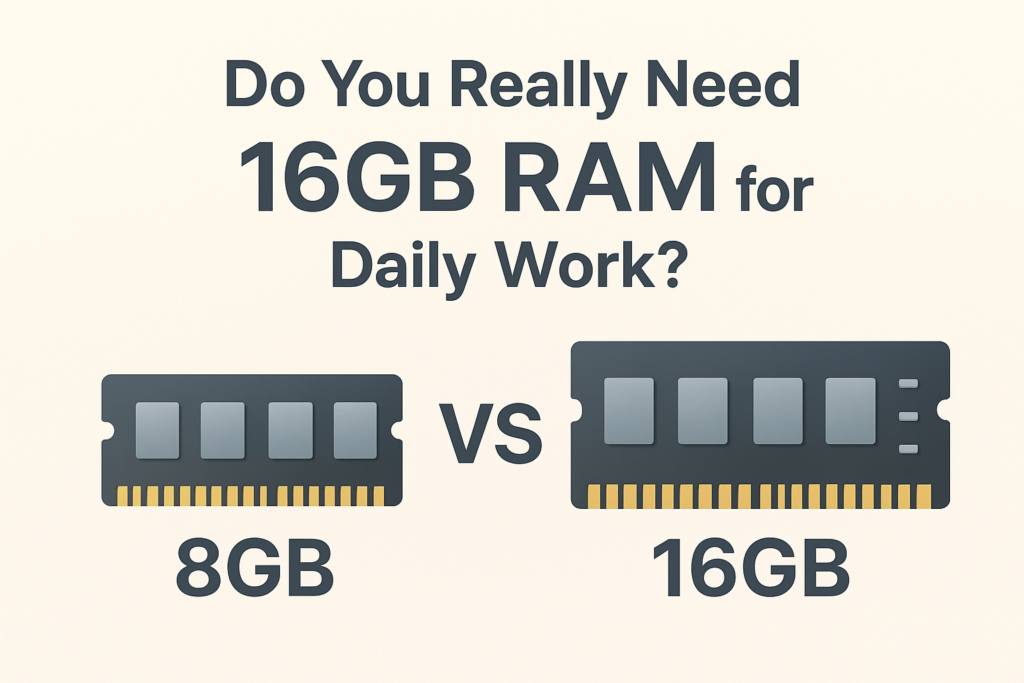
For years, the mantra “more RAM equals better performance” has guided PC buyers. In 2025, this conversation has evolved. With operating systems, browsers, and productivity apps becoming more efficient, the question arises: do you truly need 16GB RAM for routine work, or is it overkill for most users? Understanding this requires looking at real-world usage patterns rather than benchmark numbers.
How RAM Impacts Daily Tasks
RAM acts as your computer’s short-term workspace, storing data apps need instantly. Daily tasks—web browsing, emails, video calls, spreadsheets, and document editing—typically do not demand extreme memory. Modern operating systems optimize memory management, compressing idle data and offloading background tasks.
For most users, 8GB RAM handles these tasks comfortably. Moving to 16GB may provide smoother multitasking or better headroom when switching between apps, but the improvement is often subtle unless workloads are consistently heavy.
Browser Usage: The Silent Memory Consumer
Web browsers are now among the top consumers of memory. With complex web apps, cloud-based productivity tools, and multiple extensions, browsers can push memory usage significantly.
For users juggling 15–20 tabs with Google Docs, email, messaging apps, and multimedia content, 8GB RAM might occasionally cause delays in tab switching. 16GB RAM allows smoother transitions and reduces reliance on slower virtual memory. However, casual users with fewer tabs often see minimal benefit from the extra memory.
Operating System Evolution in 2025
Operating systems today—Windows 12, macOS 14, and optimized Linux distributions—are memory-aware. They prioritize active apps, compress background data, and use intelligent caching.
For most standard users, these improvements mean that 8GB RAM delivers responsive performance for everyday work. 16GB provides additional comfort, especially for users prone to heavy multitasking or running multiple virtual environments simultaneously. It’s as much about future-proofing as immediate speed gains.
Creative, Technical, and Multitasking Workloads
Where 16GB RAM shows tangible benefits is in creative or memory-intensive work: video editing, 3D rendering, large image files, and running virtual machines. These tasks exceed the capacity of smaller memory configurations, leading to storage swapping and stutter.
Even casual creators who occasionally edit video or work with layered graphics will notice smoother performance with 16GB. It minimizes reliance on slower storage-based memory and ensures that intensive tasks do not slow down the rest of the system.
Cost vs Practical Gains
Despite the benefits, 16GB RAM is often marketed as essential for everyone, which can be misleading. Efficient software, cloud solutions, and optimized OS features reduce the necessity for large memory allocations for standard productivity. For many users, investing in a faster SSD or better CPU may offer more tangible improvements in daily responsiveness than simply increasing RAM.
A Contrarian Angle: Why Less Can Be Enough
Marketing pushes the perception that 16GB RAM is mandatory, but for typical workflows—emails, spreadsheets, messaging, browsing—it is rarely fully utilized. Users who are aware of multitasking habits, browser tab management, and app efficiency may find that 8GB RAM is sufficient for years, allowing them to allocate budget to other upgrades that improve overall experience.
Closing Insight
16GB RAM provides flexibility, future-proofing, and smoother operation under multitasking or creative workloads. Yet for standard daily activities—document editing, web browsing, email, and video calls—its advantages over 8GB are limited. Choosing the right memory configuration should consider both present use and potential future demands. Understanding RAM in the context of software, multitasking needs, and system architecture ensures smarter decisions and avoids unnecessary overspending.
Stay Updated with Vibetric
- Follow our Instagram @vibetric_official for practical insights into memory, system performance, and optimization.
- Bookmark vibetric.com to compare hardware requirements across real-world use cases.
Stay informed on reviews and guides that separate marketing claims from practical performance.
What’s your take on this?
At Vibetric, the comments go way beyond quick reactions — they’re where creators, innovators, and curious minds spark conversations that push tech’s future forward.

Galaxy S26 Ultra Privacy Display: 5 Brutal Real-World Truths Nobody Tells You
Galaxy S26 Ultra Privacy Display: 5 Brutal Real-World Truths Nobody Tells You There’s a specific anxiety that comes with using a phone