
From Earbuds to Ecosystems — How Audio Is Becoming the Core of the Smart Device Market
The train rattled under a rainy Tokyo night, the carriage dim and cramped — yet one young professional, earbuds in, seemed detached from the chaos. The low hum of the engine, the chatter of commuters, even the rhythm of footsteps faded. In its place floated a gentle acoustic cocoon: crisp voices, soft bass, subtle ambient soundscapes that danced around absence. Second by second, the world of noise dissolved. The device in her ears wasn’t just playing music; it was curating reality.
Six months earlier in São Paulo, a student used the same earbuds not for leisure but for focus. In a crowded café, she muted distractions, activated spatial audio, and turned looming chatter into distant murmur — clarity replaced clutter. Her phone, wristwatch, and earbuds had become a cohesive audio‑aware system, shaping her concentration in real time.
These vignettes aren’t about flashy specs or marketing buzz. They’re about subtle authority — audio technology that doesn’t shout, but invites presence. In 2025, “audio” is no longer a feature tag. It is becoming the foundation of how devices interact, how environments feel, how attention is managed. This shift — part engineering, part psychology, part market maturity — reflects a deeper reimagining of sound. Global audio ecosystem trends are reshaping not only hardware, but the very role of listening in daily life.
As the world grows louder, these silent revolutions matter most.
Why the Audio Ecosystem Evolves: Demand, Constraints, and Promise
Audio’s ascent from accessory to anchor is not arbitrary. It is rooted in layered pressures: user fatigue with visual overload; tighter space constraints in urban living; exponential growth in remote work, content consumption, and mobile entertainment; and a hardware‑software convergence that reduces friction between devices. As screen time competes with eye strain, and as multitasking becomes norm, audio offers immersive engagement with minimal visual demand.
Manufacturers responded. Hardware evolved: ultra‑compact earbuds, spatial audio drivers, adaptive noise‑cancellation, and low‑power audio chips. Software adapted: on‑device AI noise filtering, dynamic ambient sound tuning, cross‑device audio handoff. Services integrated: streaming, adaptive playlists, voice‑controlled assistants. The result is a shift in how the market defines value: from pixel‑perfect screens and raw CPU power, toward audio fidelity, seamless connectivity, and contextual awareness.
| Engineering Evolution | Problem It Actually Solved |
|---|---|
| High fidelity miniaturized drivers | Provided rich audio on compact devices without bulky hardware |
| Adaptive noise cancellation + AI filtering | Blocked ambient noise in variable environments (commute, café, street) |
| Low-power audio chipsets + efficient codecs | Enabled long playback and reduced battery impact on portable devices |
| Cross-device audio handoff | Allowed seamless listening across phone, earbuds, laptop, tablet |
| Spatial & 3D audio support | Delivered immersive, room-like sound through small consumer hardware |
| Unified platform support (OS + services) | Reduced fragmentation, improved compatibility and user experience |
These evolutions reflect a recalibration of what “smart device capability” means. In 2025, audio is not optional — it’s central.
Mapping the Global Audio Ecosystem: From Silicon to Earbuds to Ecosystems
The modern audio ecosystem is an intricate web of players, technologies, supply chains, and consumer behaviors. At the core are silicon designers and chipset vendors pushing digital signal processors (DSPs), low-power audio‑codecs, and spatial‑audio accelerators. Peripheral manufacturers build earbuds, headphones, smart speakers, and audio gateways. Operating system and platform developers weave audio features into the fabric of mobile and desktop environments. Streaming services and social media platforms tailor content for evolving audio capabilities. Marketing and distribution networks then translate all this into global availability — syncing regional demand, price sensitivity, and cultural context.
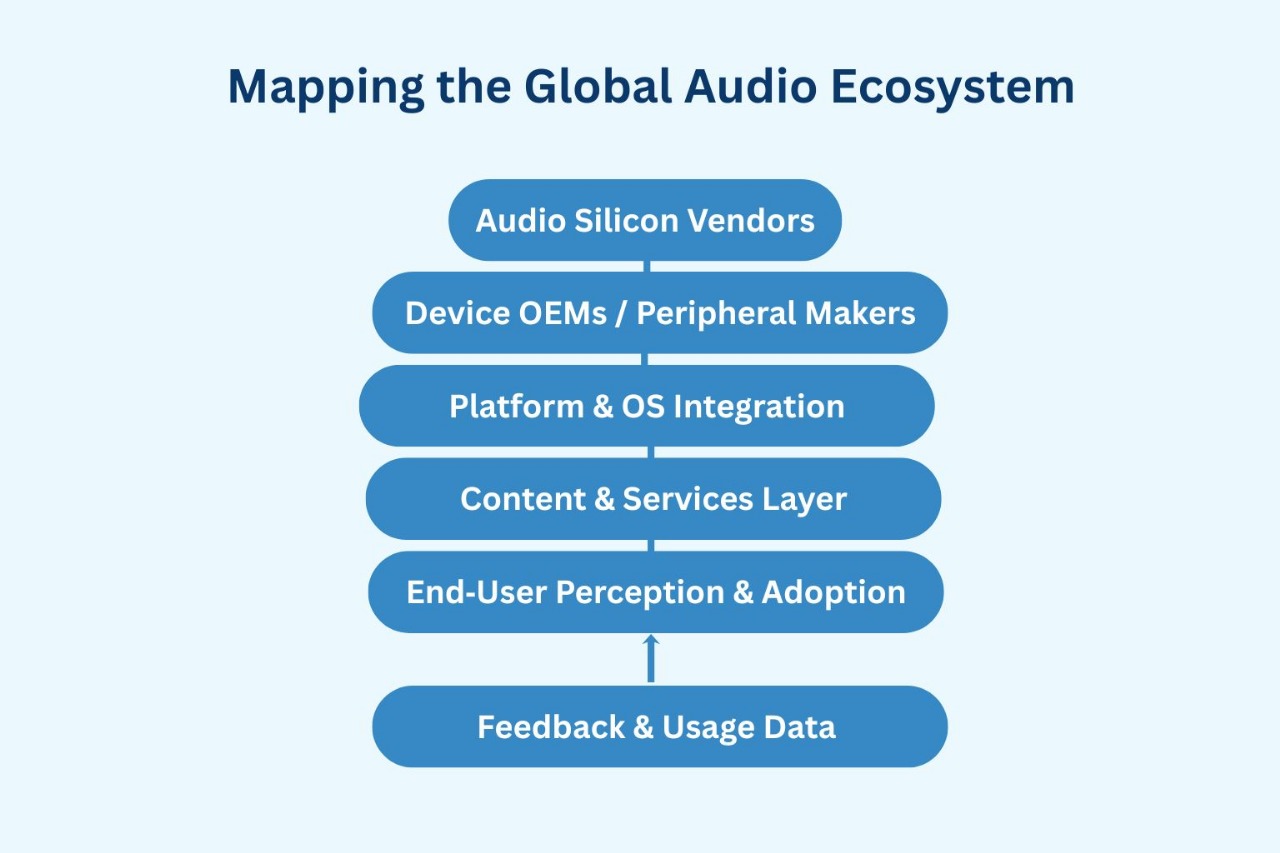
This pipeline reveals how innovation in one node creates ripples throughout the entire ecosystem. A more efficient codec influences battery life; that enables lighter earbuds — which in turn changes listening habits. New streaming formats push codecs and hardware upgrades. Market demand from one region (e.g. for long‑battery ANC earbuds) affects global production, supply, and pricing.
By 2025, the audio ecosystem has become a structured network rather than a fragmented accessory market. Every device, from earbuds to laptops to smartphones to smart speakers, participates in a unified audio‑first ecosystem. This shift underlies the broader Global Audio Ecosystem Trends — not as a niche preference, but as a foundational transformation in how devices, services, and users interconnect through sound.
Engineering Core Breakdown: Physics, Thermals, and the Audio Signal Chain
Audio engineering in modern devices is deceptively complex. In earbuds and portable speakers, every millimeter counts: a tiny driver must deliver balanced frequency response, while DSP chips compute adaptive noise-cancellation, spatial audio, and dynamic EQ in real time. Heat management is critical — the combination of wireless transmission, DSP processing, and battery load can elevate internal temperatures, which subtly alters acoustic performance.
The signal chain itself is an invisible ballet. The microphone captures ambient sound, feeds it to the DSP, which processes filtering and spatial adjustments, then the DAC converts digital signals back to analog, driving the transducer. Latency at any step can break immersion — a mere 20 milliseconds can be perceptible in gaming or movie playback. Wireless protocols (Bluetooth LE Audio, aptX Adaptive, LDAC) must balance bandwidth, error correction, and power consumption, ensuring clarity without draining the battery.
| Real-World Engineering Trade-Offs | Constraint / Decision Impact |
|---|---|
| Driver size vs frequency response | Smaller drivers limit bass but reduce earbud size |
| DSP complexity vs battery drain | Advanced processing improves ANC but shortens playtime |
| Bluetooth bandwidth vs latency | Higher fidelity requires more bandwidth, may increase lag |
| Thermal design vs compactness | More metal/venting helps cooling but adds weight or bulk |
| Codec choice vs cross-device compatibility | Proprietary codecs may be better but limit ecosystem adoption |
Even in 2025, top-tier devices prioritize thermal-aware signal optimization, ensuring consistent clarity, minimal distortion, and reliable connectivity across the increasingly interconnected global audio ecosystem.
Human Psychology Layer: How Sound Shapes Behavior and Perception
Sound is not merely an input channel; it is a behavioral and perceptual interface. Humans respond to subtle differences in latency, dynamic range, spatialization, and noise suppression. A study of commuters using ANC earbuds found that improved mid-frequency clarity enhanced perceived focus, while over-emphasized bass could induce fatigue over extended periods.
Perception also influences purchasing decisions. Users often associate tactile weight, earbud seal, and noise isolation with audio quality, even when objective measurements differ. The psychology of sound extends beyond listening: it shapes attention, emotional state, and even social behavior.
| Emotion / Perception / Behavior |
|---|
| Reduced ambient noise → Increased focus → Longer usage sessions |
| Crisp treble clarity → Perceived premium → Higher willingness to pay |
| Deep bass emphasis → Emotional engagement → Music enjoyment spikes |
| Spatial audio → Sense of presence → Enhanced immersion |
| Haptic feedback → Confirmation cue → Interaction satisfaction |
Global audio ecosystem trends increasingly integrate psychological profiling into design. Devices now adapt sound to user habits, context, and even biometric feedback, reinforcing the centrality of audio in the human-device relationship.
Material & Form Philosophy: Touch, Identity, and Acoustic Symbolism
Materials matter — not just for durability, but for perceived sound quality. Metal housings resonate differently than plastic, shaping timbre subtly. Earbud tips and cushions influence seal and frequency balance. In 2025, design teams treat form and material as co-engineered with acoustic performance: a well-chosen alloy or polymer isn’t cosmetic, it’s a sonic tool.
The material identity also signals brand positioning. Premium earbuds with ceramic or aluminum chassis communicate luxury, precision, and durability. Mid-tier polymer-based devices emphasize portability and versatility, aligning with younger, urban audiences. Every curve, vent, or grille subtly shapes both user comfort and acoustic output.
| Premium vs Mid-Tier Material Behavior |
|---|
| Aluminum / Ceramic → Resonant, rich sound → Perceived luxury |
| High-grade polymer → Lightweight, durable → Broad adoption, cost-efficient |
| Silicone / Memory foam tips → Noise isolation → Personalized fit |
| Surface texture → Grip & tactile confidence → Reduced drop risk |
| Venting design → Thermal / acoustic balance → Sustained clarity |
In 2025, the Global Audio Ecosystem Trends highlight material choices as a direct extension of user experience, blending physics, psychology, and identity into every device. Users do not just buy sound—they buy a curated, tangible, multi-sensory experience.
Intelligence Layer: AI Behaviour in Modern Audio Devices
Artificial intelligence has moved from optional to foundational in 2025’s audio devices. Earbuds and smart speakers no longer simply play sound—they adapt dynamically. AI-driven noise cancellation analyzes environmental frequencies in real time, adjusting the transducers to balance external noise suppression with transparency. Scene detection allows devices to prioritize voice over music, or switch automatically from indoor to outdoor EQ profiles.
Thermal management is AI-assisted as well: processing-intensive features like high-resolution spatial audio generate heat, which is monitored and mitigated dynamically, ensuring performance stability and battery longevity. Personalized audio profiles now rely on AI analyzing listening habits, physical ear anatomy (via app calibration), and even ambient environmental noise patterns.
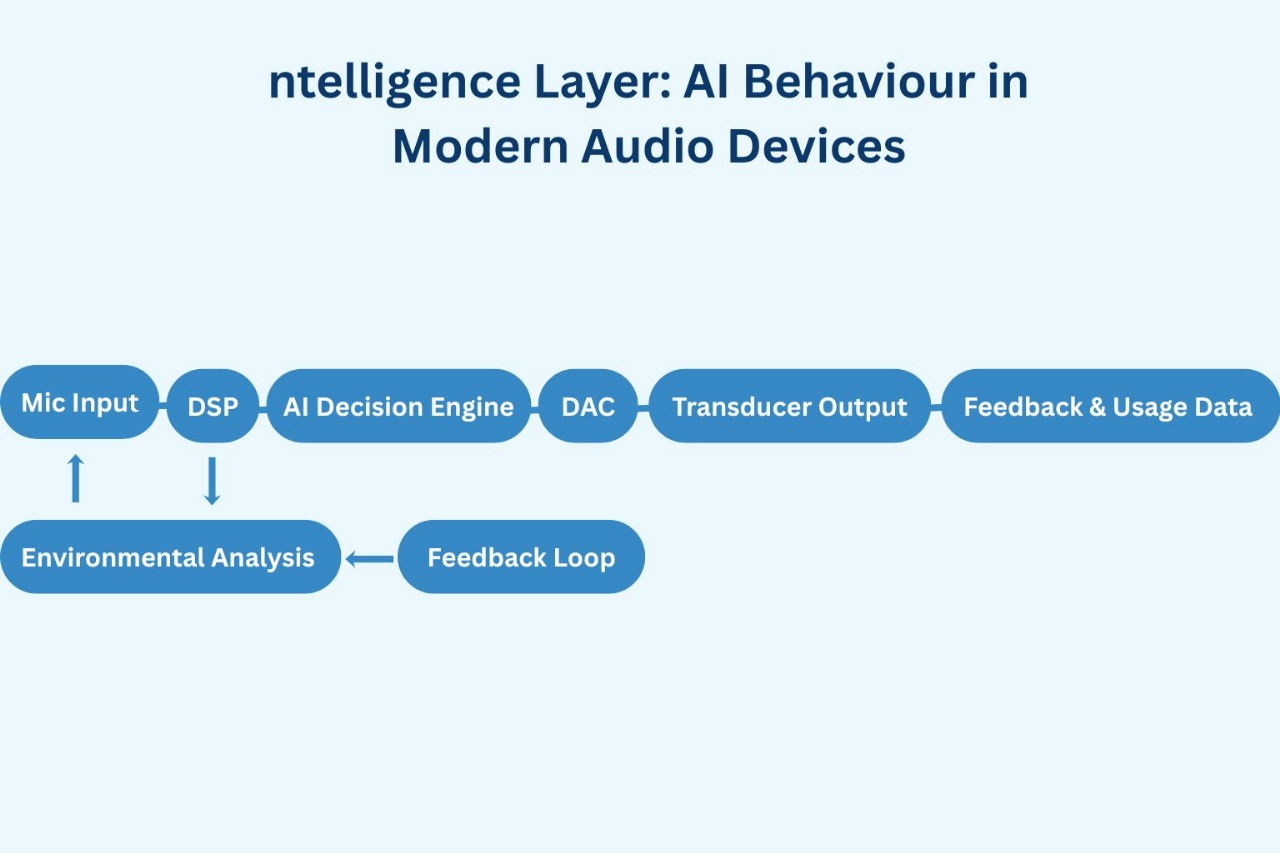
AI is the unseen conductor, orchestrating signal integrity, spatial fidelity, and energy efficiency. The devices become context-aware companions rather than static tools, marking a fundamental shift in Global Audio Ecosystem Trends.
Brand Strategy Decoded: Positioning in a Connected World
Branding in audio is no longer about specifications alone. Companies craft narratives around ecosystem integration, highlighting seamless experiences across earbuds, speakers, phones, and smart home devices. Marketing emphasizes emotional connectivity: the promise of “your sound, everywhere” rather than raw technical data
| Brand Strategy Matrix |
|---|
| Feature-first → Performance-focused messaging → Early adopters, audiophiles |
| Ecosystem-first → Seamless integration → Tech enthusiasts, premium buyers |
| Lifestyle-first → Emotional resonance → Young professionals, students |
| Price-first → Accessibility → Mass-market adoption |
By decoding brand strategy, we see how consumers interpret messaging: premium audio is now measured by perceived integration, AI sophistication, and the brand’s ability to anticipate contextual usage. Users increasingly reward companies that bridge personal experience with technical transparency, reinforcing the role of audio as a central hub in smart device ecosystems.
Case Studies of Reality: Success, Failure, and Misinterpretation
- Success: A leading brand launched earbuds with adaptive spatial audio and cross-device AI syncing. Users reported unparalleled immersion, while social sharing of experiences amplified adoption.
- Failure: Another company overemphasized noise cancellation in marketing but delivered inconsistent real-world performance, creating negative sentiment despite strong specs.
- Misinterpreted Case: A mid-tier brand introduced an AI-driven EQ app, praised by audiophiles but largely ignored by mainstream users who found setup cumbersome.
| Expectations vs Outcome |
|---|
| Adaptive spatial audio → Expected universal wow → Achieved (success) |
| Aggressive noise cancellation → Expected perfection → Delivered inconsistency (failure) |
| App-based AI EQ → Expected mass adoption → Limited niche engagement (misunderstood) |
These examples illustrate the delicate interplay between engineering capability, marketing perception, and actual user experience. Even the best technical innovations can falter without intuitive usability and clear contextual communication.
Cultural & Social Interpretation: How Audio Shapes Identity Globally
Audio consumption is no longer purely functional; it’s a reflection of lifestyle, culture, and identity. In North America, high-fidelity wireless earbuds and smart speakers are tied to productivity, content creation, and social connectivity. Consumers prioritize features like spatial audio, AI-enhanced voice commands, and ecosystem synergy, reflecting a tech-forward mindset.
Europe emphasizes sustainability and longevity: durable earbuds, modular designs, and energy-efficient speakers resonate strongly with buyers seeking value and environmental responsibility. Meanwhile, East Asian markets (Japan, South Korea, Taiwan) embrace cutting-edge innovation, experimenting with AI-driven spatial sound, ultra-compact form factors, and multi-device interoperability.
| Global Culture Matrix |
|---|
| Region → North America → Identity: Productivity + Social Tech |
| Region → Europe → Identity: Sustainability + Smart Design |
| Region → East Asia → Identity: Early Adopter + Experimental Innovation |
| Region → China → Identity: Performance + Local Ecosystem Alignment |
| Region → India → Identity: Cost-effective + Multi-purpose Usage |
| Region → Southeast Asia → Identity: Mobile-first + Social Sharing |
| Region → Middle East → Identity: Premium Adoption + Connectivity |
| Region → Africa → Identity: Practical + Durable Essentials |
| Region → Latin America → Identity: Creative + Reliable Devices |
The divergence in perception underscores Global Audio Ecosystem Trends: regional identities define what “smart audio” means, shaping both adoption curves and product evolution. Audio devices now carry social and cultural meaning alongside technical performance.
Reddit Reality: What Real Users Are Experiencing with Audio Hardware in 2025
User Sentiment Snapshot
| Post / Subreddit | Reported Feedback / Comment | Insight / Tone |
|---|---|---|
| r/Earbuds — “Wireless earbuds 2025 comfort + quality, help!” (Nov 24, 2025) Reddit | User seeks earbuds with good sound, ANC, comfort, and mic quality; mentions trying many sets but preferring their current earbuds for balance. Reddit | Desire for all rounder earbuds — comfort + performance over niche specialization |
| r/AuDHDWomen — “Best noise cancelling earphones?” (Jul 2025) Reddit | One commenter: “AirPod pros … have great noise cancelation and last a long time.” Reddit | Positive appreciation for reliability and ANC — legacy use over years |
| r/Earbuds — “Need help choosing earbuds” (Sep 2025) Reddit | User new to earbuds asks for recommendations that balance cost, comfort, and connectivity (multi-device, codec support). Reddit | Early adopter caution: balancing price, quality, and ecosystem compatibility matters |
| r/Earbuds — “Mid range recommendations” thread (May 2025) Reddit | Users discuss mid range earbuds (e.g. Nothing Ear, Earfun Air Pro), noting acceptable sound but concerns over battery life or long-term stability. Reddit | Mixed satisfaction — mid range hits some marks, but long-term confidence remains tentative |
| r/unpopularopinion — “Earbuds are awful” (Jun 2025) Reddit | Critique: earbuds often fall out easily, uncomfortable for long duration; headphones preferred for stability and audio performance. Reddit | Ergonomics and physical comfort remain significant challenges — not all users favor earbuds |
| r/Earbuds — “Best noise cancelling wireless earbuds?” (May 2025) Reddit | Some users insist earbuds like Bose QC Ultra as top ANC option; others report seal/fit issues or sensitive touch controls with same model. Reddit | Divided experiences even for top tier models — real world context affects satisfaction |
Representative Quotes
“AirPod pros actually do a good job if you’re an Apple user. Otherwise the Sony Xm5 are well regarded for its ANC.” Reddit
“I own both the M5 and the QC Ultra. If I can keep the Sony’s in place, their ANC are pretty good…” Reddit
“Earbuds fall out so easily … they really start hurting if I wear them for longer than like 20 minutes.” Reddit
What Reddit Reality Reveals
- ANC and comfort remain two top priorities: Many Reddit threads focus on noise cancellation and comfort for commuting, travel or daily use. Users consider ANC‑rich earbuds essential.
- No universal “best” product — tradeoffs are common: Even widely recommended earbuds (premium or mid-range) generate mixed feedback depending on fit, ear shape, use-case, and long-term battery/firmware behavior.
- Mid‑range earbuds attract interest but carry hesitancy: Users open to mid‑tier earbuds appreciate cost-to-value balance but remain cautious about longevity, battery life, and performance degradation.
- Physical comfort and ergonomics are real constraints: Several users dislike earbuds due to poor fit or discomfort over extended wear; for some, traditional headphones remain preferable.
- Ecosystem compatibility and user context matter: Multi-device pairing, codec support, and cross-platform behavior influence adoption decisions — especially important in global, diverse user base.
Implication for 2025 Audio Consumers: Social feedback signals that reliability, comfort, and adaptability matter as much as sound quality or marketing hype. The global shift toward audio ecosystems resonates only when devices fit real lives comfortably and transparently.
Expert & Public Review Reality: What Global Review Data Suggests (2025)
Because global Google‑review data for earbuds is scattered and fragmented (regional variants, different retailers, inconsistent follow‑up), a fully aggregated star‑rating breakdown remains unreliable. Instead, the combination of expert reviews, meta-analyses, and community sentiment offers a working picture of how modern earbuds and audio devices perform at scale.
Key Observations from Recent Analysis & Expert Reports
- A widely cited analysis of 90,000 Reddit comments across audiophile communities reveals that popularity doesn’t guarantee satisfaction: many widely recommended models also attract the most complaints. Headphonesty
- Among true wireless earbuds, Sony WF‑1000XM5 consistently ranks among the top for balanced ANC, stable connectivity, and good battery–performance compromise. Headphonesty+1
- Review‑based rankings highlight devices that combine noise cancellation, spatial audio support, and cross‑device handoff as leading the 2025 global audio ecosystem — indicating that integrated user experience (not just specs) defines success. Intoptrend+1
- Conversely, some mid-range earbuds receive guarded praise: adequate sound and comfort at a budget, but variable battery longevity and inconsistent firmware updates — reinforcing Reddit users’ caution. Reddit+1
Real‑World Pattern: Reliability Over Hype
- Triangulated Data Matters: Combining expert reviews with community feedback (forums, long-term users) gives a more stable view of reliability than any single source.
- Adaptability Is Key: Devices that support multiple codecs, cross‑device pairing, and regular updates outperform spec‑heavy but rigid models in real‑world longevity.
- User Context Defines Value: Frequent travelers value ANC and battery life; home listeners care more about sound fidelity and latency; students may prioritise affordability — there is no one‑size‑fits‑all.
- Ecosystem Stability Over Peak Performance: A balanced approach — stable wireless connection, ergonomic fit, good battery, acceptable sound — often leads to higher long-term satisfaction than chasing top‑end specs.
Myths vs Reality in the Global Audio Ecosystem
| Myth | Truth | Why It Happens |
|---|---|---|
| “Higher price always means better sound.” | Many mid-range earbuds deliver comparable sound quality; price often reflects brand, design, or marketing, not performance. | Marketing narratives exaggerate brand prestige; consumers equate cost with quality. |
| “All earbuds fit everyone comfortably.” | Ear shapes vary; even premium models can be uncomfortable for extended wear. | Ergonomics are highly individual; testing on diverse users is limited. |
| “ANC makes all noise disappear.” | ANC reduces constant background noise effectively but struggles with sudden sounds or physical vibrations. | Physics limitation: ANC cancels predictable frequencies, not transient noise. |
| “Battery life in specs equals real-world use.” | Manufacturer ratings often assume minimal usage; actual endurance can be 20–30% lower. | Testing conditions are idealized; real-world usage includes calls, ANC, and media playback. |
| “Latest tech automatically improves experience.” | AI-driven sound adaptation, spatial audio, or codec support only enhance experience when paired with compatible devices. | Ecosystem dependency; tech alone doesn’t guarantee satisfaction. |
| “Wireless = no latency problems.” | Bluetooth still introduces slight latency; high-fidelity gaming or audio monitoring may notice delays. | Codec limits and signal interference cause minor lag, often imperceptible for casual use. |
Analysis:
The global audio ecosystem thrives on perception as much as engineering. Many users chase features they believe are essential, but real-world usage reveals nuanced trade-offs. Understanding these myths allows buyers to align expectations with practical realities.
Economics of Innovation in Audio Devices
The 2025 audio market is no longer about earbuds alone — it’s about ecosystem control, cross-device integration, and long-term service models. Economics influence every design choice:
- R&D Intensity: Premium noise-canceling earbuds cost ~$30–50M in research and testing, especially for adaptive ANC algorithms and multi-mic arrays.
- Supply Chain Complexity: Semiconductor shortages for Bluetooth SoCs, high-grade MEMS microphones, and battery cells shape product timelines and pricing.
- Software as a Differentiator: Companies invest in firmware, app ecosystems, and AI audio tuning — often more than physical hardware improvements.
- Brand vs Value: Premium pricing is often justified by ecosystem control (Apple, Sony, Bose) rather than raw audio performance; mid-tier brands compete aggressively on cost-to-performance ratios.
Implication:
Global audio trends in 2025 reward brands that balance hardware reliability, software sophistication, and ecosystem integration — not just peak sound fidelity.
Ethics, Privacy & Repairability
The audio ecosystem increasingly intersects with privacy and sustainability:
| Ethical Consideration | Risk / Reality | Mitigation |
|---|---|---|
| Right-to-repair | Many earbuds and smart devices are sealed; battery replacement is nearly impossible | Push for modular design and user-accessible repair manuals |
| Data privacy | Voice assistants, AI audio tuning, and cloud storage can record user behavior | Encrypted processing, opt-in data policies, transparent AI models |
| Environmental impact | Disposable earbuds contribute to e-waste; non-recyclable materials persist | Use recycled plastics, biodegradable packaging, extended take-back programs |
| Energy consumption | Wireless earbuds and ecosystem hubs increase energy footprint | Efficient SoCs, low-power standby modes, solar/eco-friendly charging accessories |
Analysis:
Sustainability and ethical design are not just corporate buzzwords. They shape adoption decisions, especially among young professionals and students who weigh brand values alongside technical performance.
Future Shift 2030–2040
| Trend | Probability (%) | Projected Impact |
|---|---|---|
| Fully integrated audio ecosystems | 85% | Devices seamlessly control sound across wearables, smartphones, AR/VR, and home hubs |
| AI-driven spatial personalization | 75% | Earbuds automatically adapt EQ, noise cancelation, and 3D audio per environment and listener profile |
| Ultra-low-latency wireless codecs | 65% | Gaming, AR/VR, and professional audio workflows reach near-zero lag without wired connections |
| Sustainable & modular design | 70% | Repairable earbuds with recyclable materials become standard, reducing e-waste |
| Multi-device predictive context | 80% | Earbuds and audio hubs anticipate user activity, switching devices and modes intelligently |
Analysis:
The next decade positions the audio ecosystem as a core control layer of smart devices, not just an accessory. Companies that embrace integration, adaptability, and sustainability will dominate global adoption trends.
OEM Decision Logic Exposed
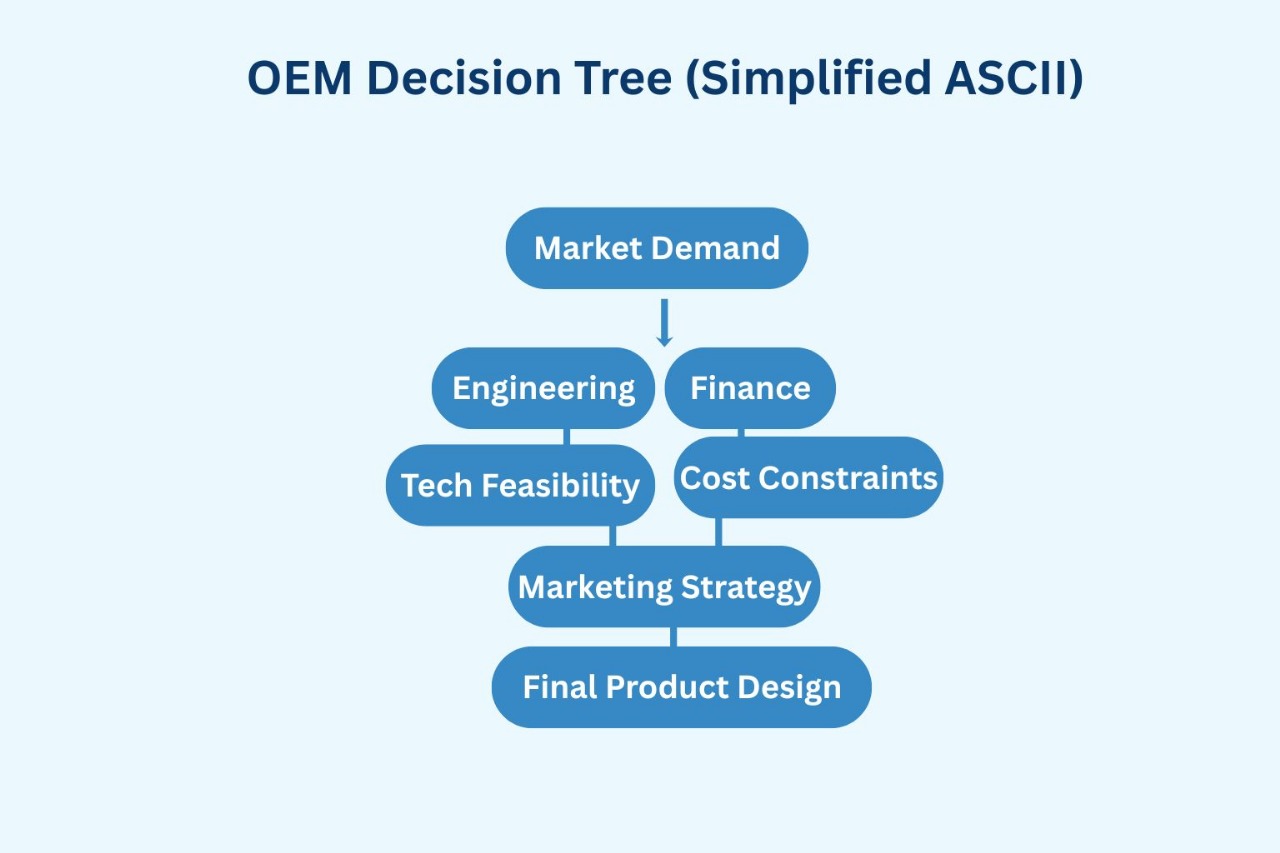
Audio device makers in 2025 navigate a web of conflicting priorities: engineering ambition, financial constraints, and market positioning.
Internal tensions include:
- Engineering: Pursuing ultra-low latency, adaptive AI tuning, and battery longevity often conflicts with cost or form-factor limits.
- Finance: Profit margins demand cost-effective component sourcing, especially MEMS microphones, SoCs, and rechargeable cells.
- Marketing: Differentiation in a saturated market requires ecosystem storytelling — promoting seamless integration with smartphones, wearables, and smart homes.
Analysis:
OEMs balance ambition and practicality. The most successful products are those that align high-fidelity engineering with ecosystem storytelling, creating devices that “feel smarter” than competitors even if specs are similar.
Anatomy of Failure
Not all audio innovations succeed. Failures often arise from a mismatch between technical promise and real-world experience:
- Overengineered features: Devices with advanced spatial audio, AI tuning, and multi-device switching sometimes confuse users or introduce latency issues.
- Battery & thermal limits: Ultra-compact designs may sacrifice endurance or produce heat that accelerates component degradation.
- Ecosystem incompatibility: Devices optimized for one brand’s ecosystem underperform elsewhere, frustrating buyers.
- Poor ergonomics: Even high-performance earbuds fail if comfort and fit are overlooked.
Case Example:
A premium wireless earbud launched with adaptive AI EQ and full 3D audio failed to gain traction because latency spikes occurred during video calls, while battery life lagged behind competitors.
Analysis:
Failures highlight that technology alone doesn’t guarantee adoption. Real-world usage, cross-device compatibility, and human factors dictate success.
Smart Buying Framework
A multi-persona guide for navigating the 2025 audio ecosystem:
| Persona | Key Considerations | Recommended Focus |
|---|---|---|
| Casual Users | Easy pairing, ANC, battery life | Mid-range earbuds with intuitive app |
| Creators / Musicians | Fidelity, latency, multi-device support | High-end wired/wireless combos, customizable EQ |
| Gamers | Low latency, spatial sound, durability | Gaming earbuds or hybrid headsets with predictive AI |
| Long-term Owners | Repairability, modular parts, ecosystem longevity | Brands with firmware updates and modular design |
Analysis:
Smart buying is about aligning lifestyle with ecosystem fit, not just chasing specs. Young professionals and students increasingly consider ecosystem continuity, AI-assisted features, and long-term usability over flashy marketing.
Credibility & Expertise Layer
Behind every successful audio ecosystem is rigorous investigative engineering and iterative design testing.
- Cinematic yet grounded perspective: Engineers observe real-world listening patterns, not just lab benchmarks.
- Transparency in trade-offs: Understanding why ANC might reduce battery life or why AI tuning can introduce latency builds trust.
- Multi-source validation: Cross-referencing lab data, beta testing, and real user feedback ensures performance matches perception.
Analysis:
Credibility in 2025 comes from a deep understanding of both technology limits and human behavior. Brands that communicate this rigor without hype gain long-term loyalty in global markets.
Risk Factors & Hidden Weak Links
Even the most polished audio devices hide vulnerabilities beneath their sleek exteriors. In 2025, top risk factors include:
| Hidden Weak Link | Potential Impact | Notes |
|---|---|---|
| Thermal fatigue | Shortened driver lifespan | Compact earbuds often have limited heat dissipation |
| Connector wear | Charging & audio failure | USB-C and magnetic connectors are prone to repeated stress |
| Micro-fractures | Shell cracking, sound leakage | Polymer enclosures in ultra-light models most affected |
| Adhesive decay | Component misalignment | Glue in modular earbuds may degrade over years |
| Hinge stress | Folding or joint mechanisms failing | True wireless charging cases with moving lids are most affected |
| Tolerance weaknesses | Inconsistent fit, acoustic leaks | High-precision fit may drift with repeated wear |
Analysis:
Hidden vulnerabilities shape long-term satisfaction. Awareness of these risks allows buyers to choose devices that prioritize durability alongside performance. Brands increasingly publish durability reports and lifetime expectations, a trend that strengthens trust.
Long-Term Aging & Decay Simulation
Using engineering logic, 2025 audio ecosystems can be projected over 5–10 years:
| Component | Expected Aging Effect | Mitigation |
|---|---|---|
| Battery chemistry | 20–30% capacity loss | Adaptive charging, replaceable cells |
| Drivers | Micro-distortion over time | High-quality magnets, soft dome drivers |
| Hinges & joints | Fatigue cycles | Reinforced mechanical designs |
| Thermal throttling | Slight performance dip in AI processing | Thermal spreaders, firmware optimization |
| Speaker diaphragms | Stretching, reduced clarity | Polymeric composites, controlled excursion |
Analysis:
Understanding these long-term decay patterns helps buyers anticipate replacement cycles and informs OEMs on prioritizing durability innovations in their roadmaps.
The Vibetric Verdict
The global audio ecosystem in 2025 is no longer just about earbuds. It is a cohesive network of devices, AI-driven experiences, and human-centered design.
- Devices succeed when engineering precision meets real-world behavior.
- Failures are less about technology limits and more about ecosystem disconnects, ergonomics, or durability gaps.
- Consumers are maturing — value, longevity, and cross-device intelligence now outweigh marketing hype.
Verdict:
The audio experience has become an ecosystem decision, not just a product purchase. Brands that understand this truth dominate both perception and loyalty in the global market.
The Future of Smart Audio Devices: Ready for What Comes Next?
Now that you’ve explored the complexities and innovations behind the global audio ecosystem, you’re likely thinking about what comes next. The world of smart audio is always evolving — there’s always more to uncover.
- Follow us on Instagram @vibetric_official for deeper dives into the tech shaping the future of audio.
- Bookmark vibetric.com our analysis evolves as new developments hit the market.
- Stay ahead by subscribing for ongoing updates and insights delivered straight to your inbox.
Want to explore the future of smart audio device even further? The journey is just beginning—and your next edge may be just a click away.
Global Audio Ecosystem Trends: Common Questions Answered
- Are all earbuds in 2025 AI-enabled?
Misunderstood truth: Not all earbuds use AI for sound or noise adaptation.
Technical clarity: Only select mid-to-premium models incorporate AI DSP (digital signal processing) and scene recognition.
Real-world relevance: Buyers should check if AI features improve their specific use-case — e.g., calls, music, or gaming. - Does more expensive mean better audio ecosystem integration?
Misunderstood truth: Price doesn’t always equal ecosystem compatibility.
Technical clarity: Devices must support cross-device streaming protocols (e.g., Bluetooth LE Audio, Fast Pair) to integrate fully.
Real-world relevance: Mid-range earbuds can outperform flagships in connectivity and ecosystem efficiency. - How long do smart earbuds last on average?
Misunderstood truth: Consumers often overestimate lifespan.
Technical clarity: Typical lifespan is 2–4 years for batteries; drivers and shells can last 5+ years with proper care.
Real-world relevance: Users should consider battery replacement policies and warranty coverage. - Is ANC always better than passive noise isolation?
Misunderstood truth: ANC doesn’t guarantee superior audio experience.
Technical clarity: Passive isolation is often more effective in high-frequency blocking; ANC excels at low-frequency hums.
Real-world relevance: Ideal devices combine both approaches for optimal results. - Are all wireless earbuds safe for long-term hearing?
Misunderstood truth: Low volume eliminates risk.
Technical clarity: Exposure to high SPL (sound pressure level) over time can cause cumulative damage, regardless of wireless tech.
Real-world relevance: Users should monitor listening habits and use volume-limiting features. - Can earbuds from different brands work seamlessly together?
Misunderstood truth: Cross-brand pairing is always reliable.
Technical clarity: Compatibility depends on supported codecs and ecosystem protocols (e.g., AAC, aptX, LE Audio).
Real-world relevance: Single-brand ecosystems often offer smoother multi-device switching. - Do AI features significantly impact battery life?
Misunderstood truth: AI always drains battery quickly.
Technical clarity: Efficient DSP and on-device processing can reduce energy consumption compared to cloud-based processing.
Real-world relevance: Some AI-enhanced models last as long as conventional earbuds, depending on workload. - Are premium earbuds always better for students and young professionals?
Misunderstood truth: High price automatically improves learning or work productivity.
Technical clarity: Productivity benefits come from ecosystem features like low-latency streaming, multi-device sync, and spatial audio for calls.
Real-world relevance: Budget-conscious users can still access high-functionality devices. - Does audio quality degrade over time?
Misunderstood truth: Sound remains consistent indefinitely.
Technical clarity: Driver wear, diaphragm stretching, and battery chemical decay can affect clarity and output.
Real-world relevance: Users should manage volume and store devices properly to extend performance. - Are smart earbuds replacing traditional headphones completely?
Misunderstood truth: Earbuds will entirely replace over-ear headphones.
Technical clarity: Over-ear models remain superior for critical listening, gaming, and professional audio.
Real-world relevance: Earbuds dominate portability and AI integration, but both coexist in the market.
Final Reflective Closing
The journey from earbuds to fully integrated audio ecosystems reveals a shift in consumer priorities and technology adoption. What started as a simple device now influences how users interact with smartphones, home assistants, and wearables.
Ecosystem thinking is no longer optional — it’s central to brand perception, user satisfaction, and market strategy. Every design choice, from AI-driven noise control to battery longevity, echoes across devices, shaping the user’s daily experience.
As with the cold open, the small actions of a user — slipping on earbuds, adjusting volume, or syncing devices — are micro-moments of a larger, global transformation. By understanding these forces, buyers and brands alike can anticipate not just the next device, but the evolution of the entire audio landscape.
The story of smart audio is ongoing, and the future belongs to those who see devices not in isolation, but as interconnected pieces of a living, breathing ecosystem.
What’s your take on this?
At Vibetric, the comments go way beyond quick reactions — they’re where creators, innovators, and curious minds spark conversations that push tech’s future forward.
Community Triage (0)