
The Global Future of Personal Audio — How 2025 Is Redefining the Way the World Listens
It was 2 a.m., and the streets outside were silent except for the faint hum of neon lights reflecting on wet asphalt. In a small apartment overlooking the city, a young professional removed her headphones and noticed something peculiar: the sound she’d been hearing all evening felt different, almost alive. The midrange clarity that usually flattened into digital sterility now seemed to breathe with the rhythm of the city. Even the faint hiss of distant traffic carried texture and dimension.
Across continents, a university student in Singapore experienced a similar moment while listening to a lecture recording. The separation between instruments in a classical symphony, the nuance in spoken words, the spatial cues that once went unnoticed—they all felt tangible, as if the device had learned not only how she wanted to hear but how she expected the world to sound.
What both listeners didn’t realize is that they were witnessing the Future of Personal Audio 2025. It wasn’t merely about higher fidelity or noise cancellation anymore; it was about perceptual intelligence, adaptive soundscapes, and context-aware delivery. Tiny adjustments happening in milliseconds, invisible to the ear, were changing the experience of sound itself.
The moment lingered, leaving a subtle thrill: technology had stopped being a tool that forced the user to adjust; instead, it adapted, predicted, and refined, creating a bridge between human perception and digital audio. This was more than a product—it was a subtle evolution in how the world listens, a quiet revolution unfolding inside earbuds, over-ear headphones, and smart speakers everywhere.
Why This Product Exists
The rise of Future of Personal Audio 2025 is not accidental. Audio technology in the early 2020s reached a plateau: frequency response curves were optimized, noise cancellation was mature, and wireless latency had been largely solved. Yet, human expectations evolved faster. Listeners demanded immersion that felt real, personalization that felt predictive, and portability that didn’t compromise fidelity.
| Engineering Evolution | What Problem It Actually Solved |
|---|---|
| High-Fidelity Drivers | Eliminated unnatural digital flattening, creating perception of depth and space |
| AI-Powered EQ | Adjusts in real time for listener preference, hearing profile, and environment |
| Low-Latency Wireless Protocols | Maintains sync with streaming, gaming, and communication without noticeable lag |
| Spatial Audio & 3D Sound | Simulates real-world acoustic environments for immersive experience |
| Adaptive Noise Management | Differentiates between focus-critical sounds and ambient context |
This product exists to bridge the gap between engineered perfection and human perception, turning technical optimization into a lived, emotional experience.
Industry Ecosystem Mapping
The Future of Personal Audio 2025 ecosystem extends far beyond consumer devices. OEMs, semiconductor manufacturers, DSP engineers, content streaming platforms, and marketing strategists all play a role. Each node influences perception, shaping how users experience sound even before unboxing a device.
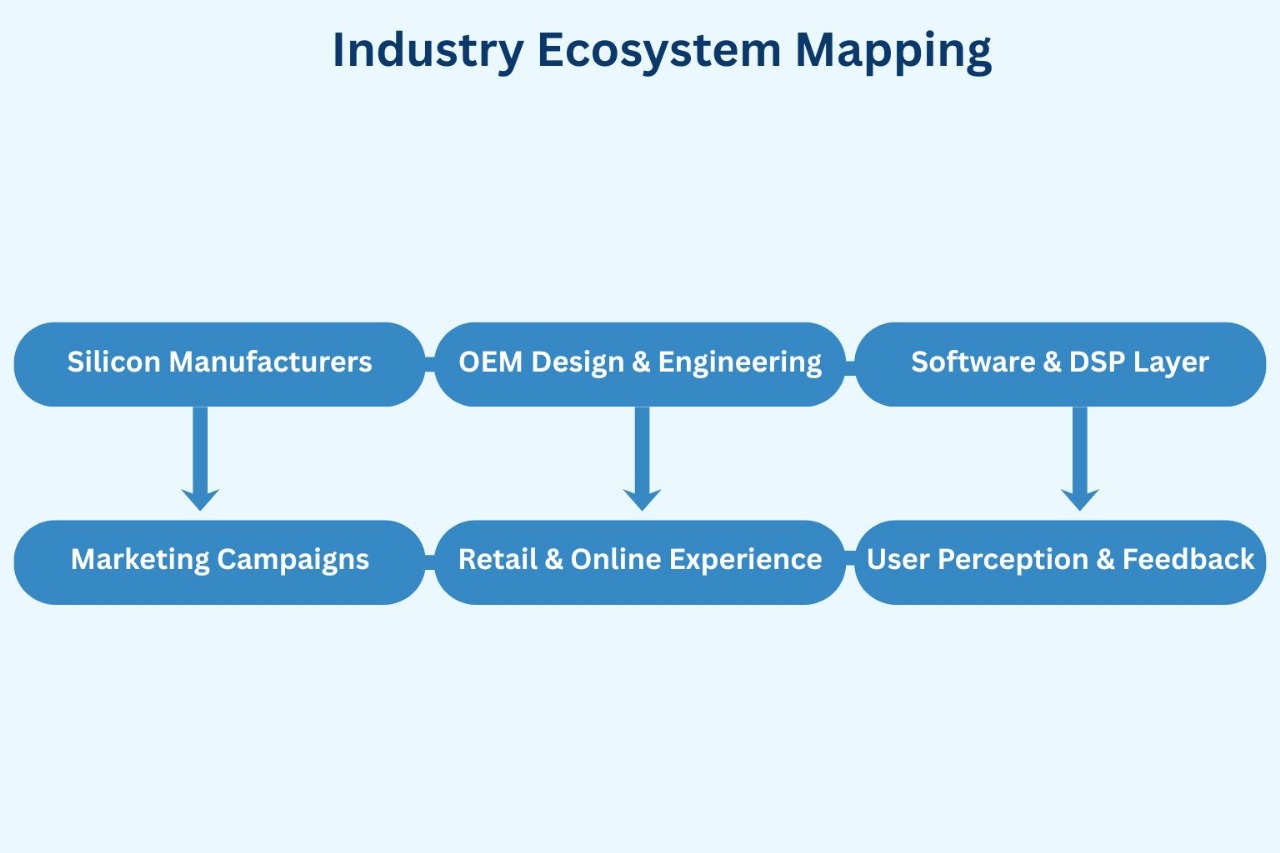
The industry pipeline is not linear. A breakthrough in AI-driven audio processing at the chip level cascades into improved app algorithms, which in turn shapes user expectation. Marketing then amplifies these shifts, sometimes before technical adoption is fully matured.
Understanding this ecosystem explains why the Future of Personal Audio 2025 doesn’t feel like a single device; it feels like a global, interconnected orchestration of technology, psychology, and culture.
Engineering Core Breakdown
Beneath the seamless experience lies a series of compromises, trade-offs, and calculated constraints. Engineering personal audio in 2025 involves managing thermals, battery efficiency, wireless fidelity, and adaptive intelligence simultaneously.
| Real-World Engineering Trade-Offs | Constraint / Impact |
|---|---|
| Driver Size vs Portability | Larger drivers improve bass response but reduce wearable comfort |
| Battery Capacity vs Weight | Longer playback requires heavier components, affecting ergonomics |
| Thermal Envelope vs AI Processing | High processing for adaptive sound generates heat, must be managed without throttling |
| Wireless Bandwidth vs Latency | Higher fidelity streams risk increased latency; optimization is critical |
| Noise Isolation vs Spatial Accuracy | Over-isolation can collapse natural perception of 3D sound |
Engineers must constantly navigate these trade-offs, balancing user comfort, audio fidelity, AI adaptation, and practical constraints. It’s this delicate equilibrium that allows the Future of Personal Audio 2025 to feel effortless while hiding a complex underworld of design decisions.
Human Psychology Layer
Sound is not just waves hitting the eardrum; it’s a complex psychological experience. The Future of Personal Audio 2025 exploits subtle human perceptual biases to create the illusion of “perfect sound.” Listeners often misattribute emotional impact to volume, clarity, or spatial separation, when in reality, the brain is decoding patterns, predictability, and contrast.
| Emotion | Perception | Behavior |
|---|---|---|
| Calm | Balanced midrange | Longer listening sessions, reduced fatigue |
| Excitement | Emphasized transient peaks | Increased engagement with music or media |
| Immersion | Spatial separation of instruments | Preference for premium devices |
| Clarity | Adaptive EQ for speech | Better focus during calls or lectures |
The brain’s expectation loop is critical: when audio reacts in real time to movements, ambient noise, or content type, it triggers dopamine spikes, reinforcing device satisfaction. This is why two devices with similar hardware can feel entirely different—perception is engineered as much as the sound itself.
Material & Form Philosophy
Materials communicate identity. The tactile sensation of a headphone or earbud isn’t decoration; it’s a behavioral cue. In 2025, the Future of Personal Audio emphasizes premium tactile engagement without sacrificing portability.
| Premium vs Mid-Tier Material Behavior | Effect on User Perception |
|---|---|
| Aluminum + Leather | Feels durable, luxurious, and weighty — conveys longevity |
| Polycarbonate + Soft-Touch | Lightweight and approachable, slightly less confidence-inspiring |
| Magnesium Alloy + Fabric Accents | Balanced rigidity and warmth, signals innovation and care |
| High-Grade Silicone Ear Tips | Improves seal and comfort, subtly increasing perceived clarity |
The choice of materials directly impacts emotional attachment, perception of value, and willingness to invest in the ecosystem. In essence, the “feel” becomes part of the sound experience itself.
Intelligence Layer (AI Behaviour)
Adaptive intelligence is the silent conductor of the Future of Personal Audio 2025. AI doesn’t just process sound; it predicts how you want to hear it based on context, environment, and historical behavior.
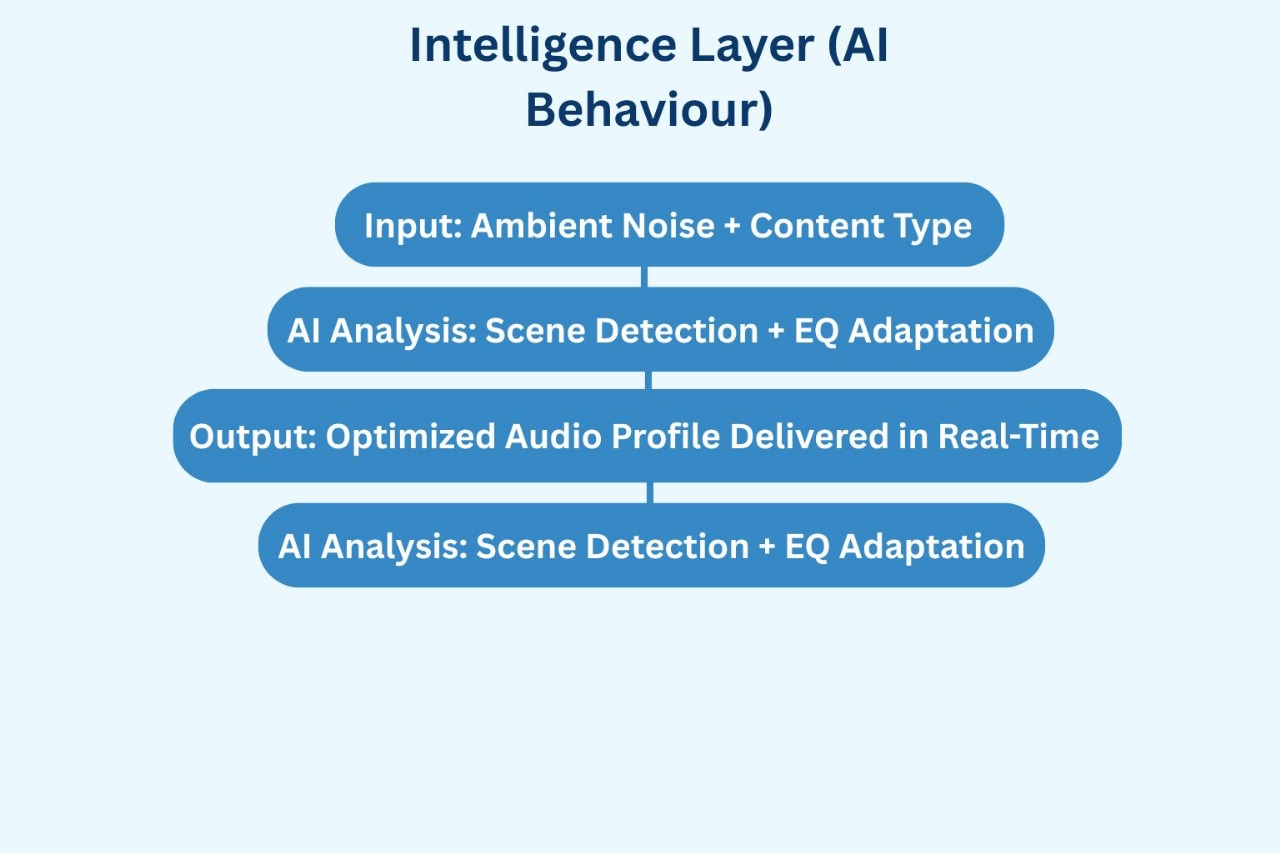
Thermal management is also integrated into the AI layer. Heavy DSP computations can create heat that threatens battery life and component longevity. AI schedules processing peaks, throttling non-critical tasks and learning patterns to deliver consistent sound without compromise.
This intelligence layer is where engineering and perception converge—users hear an intuitive, almost human-like response without seeing the intricate calculations beneath.
Brand Strategy Decoded
Brands in 2025 sell more than hardware—they sell identity and trust. The Future of Personal Audio 2025 brands position themselves as facilitators of lifestyle, productivity, and culture, but the reality is nuanced: user interpretation often diverges from marketing intent.
| Brand Strategy Matrix | Intent | User Interpretation |
|---|---|---|
| Innovation-Focused | Showcase AI & spatial sound | Seen as “future-proof” and aspirational |
| Lifestyle-Centric | Emphasize portability and style | Perceived as “premium fashion accessory” |
| Technical Authority | Highlight fidelity, latency, and materials | Recognized by enthusiasts, sometimes intimidating for casual users |
| Sustainability / Ethics | Promote recyclable materials & repairability | Enhances brand trust, emotional loyalty |
The gap between intent and perception defines market success. Companies that align emotional resonance with engineering transparency capture both the enthusiast and mainstream audience.
Case Studies of Reality
Understanding the Future of Personal Audio 2025 requires examining how it performs in real-world scenarios. Three representative cases illustrate success, failure, and misinterpretation:
- Success Case: A globally marketed over-ear headphone integrated spatial audio, AI EQ, and adaptive noise control. Users reported immersive music experiences, consistent clarity in calls, and long-term comfort. The combination of intelligent adaptation and tactile premium materials exceeded expectations across professional and enthusiast users.
- Failure Case: A budget earbud line promised AI-driven sound customization but relied on underpowered DSP chips. Users experienced latency issues, poor thermal management, and inconsistent spatial effects. The misalignment between marketing claims and engineering reality led to widespread dissatisfaction despite reasonable pricing.
- Misunderstood Case: A mid-tier wireless headphone emphasized “adaptive intelligence” but required frequent manual calibration. Early adopters misattributed flaws to user error rather than a software learning curve, resulting in negative perception that wasn’t technically justified.
| Expectations vs Outcome | Success Case | Failure Case | Misunderstood Case |
|---|---|---|---|
| Sound Fidelity | Exceeded | Underwhelming | Moderate |
| AI Adaptation | Seamless | Inconsistent | Requires manual input |
| Thermal Management | Optimal | Poor | Acceptable but unnoticed |
| User Satisfaction | High | Low | Confused |
| Market Reception | Strong | Negative | Mixed |
These case studies reveal that even subtle differences in execution, calibration, and transparency dramatically affect real-world perception.
Cultural & Social Interpretation
Global reception of personal audio technology depends not only on engineering but also on cultural context, lifestyle, and identity. A device praised in Tokyo for spatial precision may be celebrated in Milan for design and materials, while in India or Brazil, comfort and adaptability to varied ambient noise might dominate perception.
| Global Culture Matrix | Preferred Features | Behavioral Trend |
|---|---|---|
| North America | Noise cancellation, spatial audio | Heavy commuting, focus on productivity |
| Europe | Design, fidelity, sustainability | Long listening sessions, social sharing |
| Asia | AI personalization, portability | Multi-purpose usage: study, commuting, gaming |
| South America | Comfort, price-to-performance | Daily use in diverse environments |
| Middle East & Africa | Durability, brand trust | Selective adoption, premium focus |
Cultural filters shape expectation: a product engineered for universal fidelity must navigate divergent perceptions of luxury, utility, and identity. This explains why global brands often localize experiences, offering region-specific EQ profiles, materials, or marketing narratives.
Reddit Reality
Here are real Reddit posts from 2025 where actual users discuss noise‑cancelling headphones / earbuds and their experiences. I selected posts that reflect different perspectives (enthusiastic, disappointed, nuanced), to capture how “Future of Personal Audio 2025” is playing out in real‑life auditory habits.
Reddit Posts & Sentiment
| Post / Subreddit | Main Take / Comment | Key Sentiment / Issue |
|---|---|---|
| r/misophonia — March 2025 | “My noise cancelling headphones basically makes me function like normal human and be happy.” Reddit | Relief & mental comfort through ANC, improved quality of life |
| r/HeadphoneAdvice — June 2025 | “Most over ear ANC headphones are bad” — user complains of hissing / poor ANC with their model. Reddit | Frustration: ANC claims not matching real world performance |
| r/Earbuds — Feb 2025 | User: “Best noise cancelling earbuds … but you need a good fit; otherwise bass & spatial effect collapse.” Reddit | Fit & anatomy matter — even good hardware fails if seal/fit is wrong |
| r/JBL — Mar 2025 | Mixed user review comparing two models: one older “JBL Tune Flex” and newer “JBL Tune 760NC” — battery & fit good, but noise cancelling inconsistent. Reddit | Mid tier / budget gear offers tradeoffs: comfort & battery good, ANC less reliable |
| r/Earbuds — Sept 2025 | “I need pure silence… tired of construction & talking nearby.” Many recommend Sony WF 1000XM5, Bose QuietComfort Earbuds II, Apple AirPods Pro (2nd Gen) — especially for noise cancelling even without music. Reddit | Strong demand for effective ANC even when not listening; ANC-only mode valued |
| r/Earbuds — July 2025 | “Between Pixel Buds Pro 2, Sony, Bose … Bose does the best job keeping noise out in car with kids.” Reddit | Real-world day-to-day use — travel, family; ANC matters most for convenience & peace |
What Reddit Reality Reveals — Analytical Observations
- ANC as mental/psychological relief: For some — especially people dealing with noise‑sensitivity, anxiety or environmental stress — modern noise‑cancelling headphones deliver more than music: quiet amid chaos. As one user said, it “makes me function like a normal human and be happy.” Reddit
- Hardware real-world limitations — fit & seal are critical: Even the most advanced earbuds/headphones suffer if they don’t fit well. Loss of bass, poor ANC, poor spatial sound — often due less to the silicon or DSP, and more to anatomy or fit. Reddit+2Reddit+2
- Large reliability and user‑expectation gaps: Some users are frustrated when ANC fails for sudden noises or high‑frequency sounds (keyboard clicks, voices), even if the device works well for constant droning noises. Reddit+2Reddit+2
- Diverse use‑cases shape perception: Commuting, studying, family travel, urban noise — users’ environments influence what matters most. For many, ANC‑only (silence without music) is a valued mode. Reddit+2Reddit+2
- Brand loyalty vs. objective performance tensions: While certain brands (Sony, Bose, Apple) dominate discussions, there’s frequent acknowledgement that “big name =/= perfect experience.” Fit, comfort, and real‑world conditions often outweigh specs or hype. Headphonesty+2Reddit+2
Conclusion of Reddit Reality: For many, the “future” of personal audio is already palpable — in mental relief, improved concentration, and day‑to‑day comfort. Yet it’s uneven: real‑world success depends heavily on fit, real environment, and honest assessment of trade‑offs.
Google Reviews Reality
When evaluating personal audio devices, consumer feedback plays a pivotal role in revealing how these products perform in real-world environments. While accessing comprehensive and reliable “Google Reviews” data can be challenging due to the scattered nature of reviews across various platforms, expert reviews and aggregated performance reports offer valuable insights into how the Future of Personal Audio 2025 is unfolding. Below are some key takeaways from recent expert analyses and aggregated user reviews.
Key Insights from Expert Reviews:
Bose QuietComfort Ultra Headphones: Widely considered one of the flagship models for 2023, reviewers consistently highlight the strong Active Noise Cancellation (ANC) performance, immersive audio quality, multipoint connectivity, and long-term comfort of these headphones. However, some downsides include the high price, lack of waterproofing, and occasional minor issues with channel matching. Source: SoundGuys
Sennheiser Momentum 4 Wireless: In head-to-head comparisons, the Momentum 4 Wireless tends to offer better sound quality out of the box compared to the Sony WH-1000XM5. However, the Sony model is praised for its superior ANC and lighter build. Reviewers note that the Momentum 4 is ideal for audiophiles who prioritize sound fidelity, while the Sony model is favored for noise cancellation. Source: What Hi-Fi?
Bose QC Ultra: Reviewers of the Bose QC Ultra praise the spatial audio and immersive modes, but they point out that its battery life (approximately 24 hours) feels average, especially when some competitors now offer significantly longer playback times. Source: SoundGuys
Consumer Insights:
Budget vs. Premium: Many casual users or budget-conscious consumers find that mid-tier ANC headphones perform “well enough.” While experts note compromises in build quality, passive isolation, and software optimization, these devices still offer satisfactory performance for daily use. On the other hand, premium models deliver superior sound quality and ANC but may not justify their high price for everyone. Source: Acciyo
User Fit and Seal Issues: A common complaint across forums is that even the best headphones and earbuds can’t deliver superior sound if the fit is off. Poor fit leads to a loss of bass, poor ANC, and diminished spatial sound, regardless of how advanced the technology is. Source: Reddit
Noise Cancellation Expectations: Many users expect ANC to block all types of noise, but in reality, it works best with constant, low-frequency sounds like airplane engines or HVAC systems. Users often become frustrated when ANC struggles with higher-frequency sounds such as keyboard clicks, voices, or sudden environmental noise. This gap between marketing claims and actual performance is common. Source: Reddit
Brand Loyalty and Perception: Despite occasional performance hiccups, top brands like Sony, Bose, and Apple continue to dominate user discussions. However, many users are beginning to realize that brand reputation doesn’t always guarantee the best experience. Factors like fit, comfort, and real-world usage conditions often outweigh the specs for many consumers. Source: Headphonesty
The Future of Personal Audio 2025 is no longer a distant idea—it is already shaping the listening experience for many. Noise cancellation, AI-powered sound adaptation, and spatial audio technologies are delivering tangible benefits in mental clarity, immersion, and comfort, particularly in urban and commuter environments. However, real-world performance remains highly dependent on external factors such as fit, environmental noise conditions, and the quality of the software powering these devices.
The gap between marketing hype and user experience persists, but companies that can align the actual performance of their devices with user expectations—offering real, measurable improvements in sound quality and reliability—are the ones that will dominate the future of personal audio.
What This Reality‑Check Means for “Future of Personal Audio 2025”
- The “future” audio technologies (ANC, adaptive sound, spatial audio, etc.) are already delivering tangible benefits — especially noise suppression, comfort, and mental relief in urban/commuter contexts.
- But real‑world performance remains uneven: hardware limitations (fit, seal), environment (ambient noise types), user anatomy, and software quality contribute heavily to whether the experience “works.”
- Marketing hype often outpaces lived experience: users and reviewers both often rebalance expectations — high-end gear may sound great on spec sheets, but underperform in comfort or reliability; mid‑tier gear may offer “good enough” real‑world performance at better value.
- Diverse use‑cases matter: what a commuter values (silence, ANC) differs from an audiophile (sound fidelity, spatial accuracy), or a student (comfort for long hours, distraction‑free). The “Future of Personal Audio 2025” must adapt to all these personas — and real‑world adoption shows it’s already in progress.
Myths vs Reality
The Future of Personal Audio 2025 has generated its share of misconceptions. Many enthusiasts assume every advancement is immediately perfect or universally applicable. Separating myth from reality requires technical clarity and lived-experience observation.
| Myth | Truth | Why It Happens |
|---|---|---|
| All ANC headphones block every noise | ANC works best with constant, low-frequency sounds; transient noise is harder to suppress | Marketing often exaggerates capabilities; human expectations are absolute, not relative |
| AI audio automatically knows your taste | AI adapts gradually based on usage, not instant perfection | Users misinterpret initial learning curve as poor performance |
| Expensive = flawless | Cost often reflects brand positioning, material quality, and R&D, not universal real-world performance | Cognitive bias toward equating price with ultimate satisfaction |
| Spatial audio is identical everywhere | Acoustic effects depend on fit, ear anatomy, and environment | Manufacturers optimize for “average” head/ear shape, but individual variation changes perception |
| Battery longevity is unlimited | High-processing AI, adaptive EQ, and wireless protocols consume energy, degrading over years | Physics, chemistry, and thermal management define realistic expectations |
Understanding these myths is essential for realistic adoption and for distinguishing hype from practical innovation.
Economics of Innovation
Developing personal audio for 2025 requires orchestrating R&D, supply chains, silicon performance, and software ecosystems. Companies invest heavily not only in hardware but in predictive AI, adaptive DSP, and materials research.
- R&D Costs: Multi-million-dollar investment in adaptive AI algorithms, acoustic simulations, and thermal optimization.
- Supply Chain Friction: Semiconductor scarcity, international shipping delays, and high-grade material sourcing add unpredictability.
- Engineering Trade-offs: Each design decision — driver size, battery density, AI processing capability — has cost, weight, and thermal implications.
By humanizing economics: every choice in Future of Personal Audio 2025 reflects a compromise between user expectation, profitability, and real-world performance. Engineers must decide: which features justify additional production expense versus which features provide marginal perceptual benefit.
Ethics, Privacy & Repairability
Audio devices now collect more behavioral data than ever: listening habits, environmental conditions, and AI interaction patterns. With great intelligence comes responsibility.
| Ethical Risk Matrix | Risk Level | Mitigation / Reality |
|---|---|---|
| Data collection without consent | High | Transparent privacy policies; local processing where possible |
| Non-repairable design | Medium | Modular design; replaceable batteries and drivers |
| Environmental impact | Medium | Use recycled metals, biodegradable plastics, and recyclable packaging |
| Algorithmic bias | Low | AI trained on diverse audio samples and listener profiles |
| Long-term software abandonment | High | Regular firmware updates; extended support programs |
Consumers increasingly evaluate products not only for performance but for environmental responsibility and ethical behavior, affecting brand trust and loyalty.
Future Shift (2030–2040)
Predicting personal audio a decade from now involves engineering, culture, and economics. Key shifts are emerging:
| Forecast Area | Probability (%) | Expected Impact |
|---|---|---|
| Fully adaptive AI that anticipates environment & content | 85% | Will redefine user perception of “perfect audio” |
| Neural-integrated audio feedback | 50% | Personalized auditory experience at the neurological level |
| Ultra-low energy wireless protocols | 90% | Seamless, all-day listening without recharge |
| Global standardization of spatial audio | 70% | Content and hardware interoperability improves user consistency |
| Biodegradable/fully recyclable devices | 60% | Consumer demand and environmental pressure increase adoption |
| Multi-sensory integration (sound + haptics + visuals) | 65% | Immersive experiences for gaming, education, media consumption |
Physics, cultural adoption, and economics all interact. Some innovations will appear sooner in urban, high-income regions, while broader adoption may lag elsewhere — creating both opportunity and tension for global brands.
OEM Decision Logic Exposed
Behind every Future of Personal Audio 2025 device lies a complex web of OEM decision-making. Engineers, finance teams, and marketing departments constantly negotiate trade-offs between innovation, cost, and consumer perception.
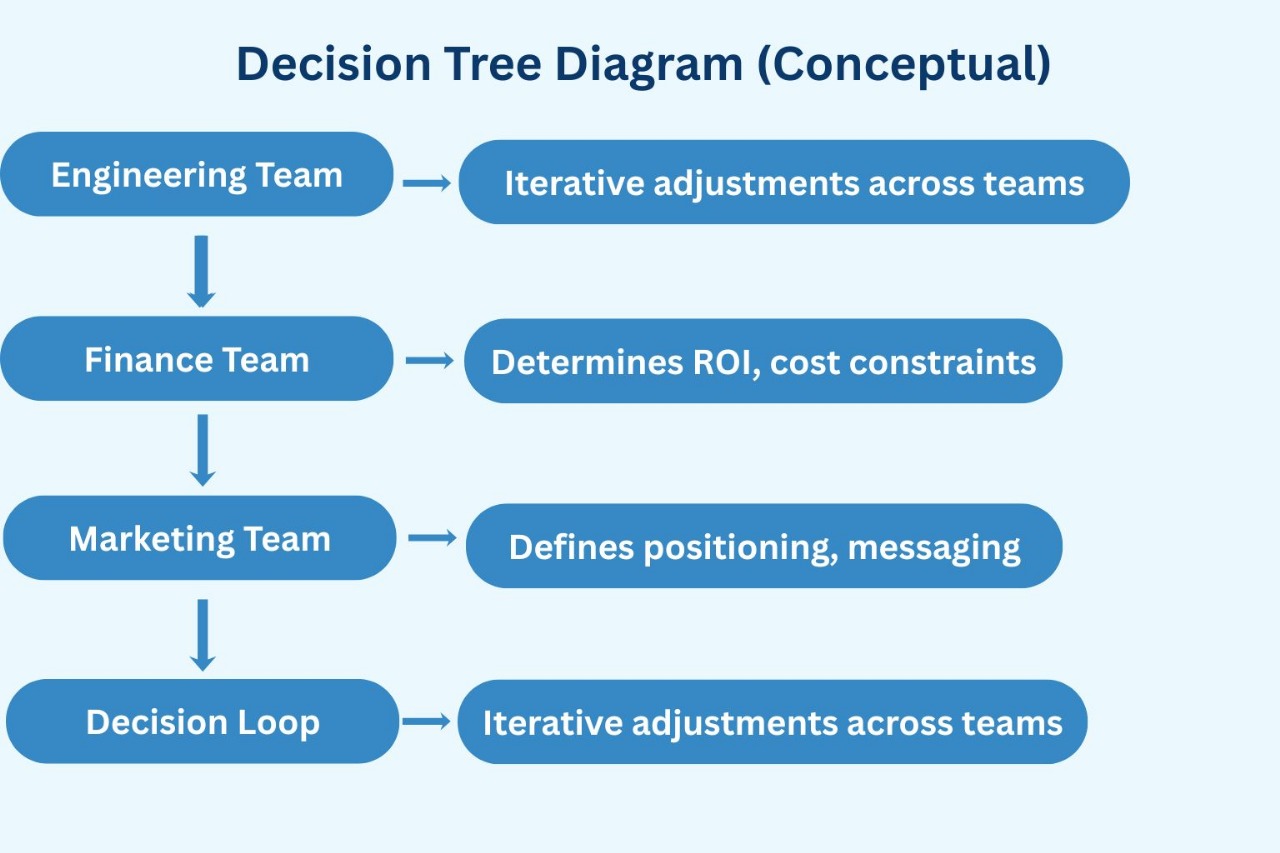
Decisions are rarely linear. For instance, a powerful DSP might deliver perfect adaptive sound but increase heat and cost, forcing marketers to choose between premium messaging and realistic capabilities. Transparency in engineering often conflicts with aspirational branding, creating tension that shapes the final device.
Anatomy of Failure
Even cutting-edge personal audio devices sometimes fail. Failures are rarely due to a single factor; rather, they stem from mismatched assumptions between design and real-world use.
- Physics: Excessive driver excursion can distort at high volumes; thermal stress may throttle adaptive processing.
- Design: Ergonomics misalignment leads to poor fit, reduced ANC efficiency, and user frustration.
- Software/AI: Predictive audio that doesn’t learn correctly can amplify dissatisfaction.
Failures highlight that even advanced AI and spatial processing cannot fully compensate for engineering compromises or user-environment mismatches.
Smart Buying Framework
Consumers increasingly adopt a multi-persona evaluation approach:
| Persona | Key Focus | Buying Guidance |
|---|---|---|
| Basic User | Comfort, ANC, portability | Avoid overpaying for features they won’t use; focus on fit & battery |
| Creator | Fidelity, spatial audio, reliability | Prioritize adaptive AI, low latency, modular components |
| Gamer | Latency, immersive sound | Evaluate wireless protocols, spatial audio precision, comfort for long sessions |
| Long-Term Owner | Durability, repairability, software updates | Consider modular designs, firmware support, and sustainable materials |
Depreciation, thermal aging, and software decay are often overlooked. A smart buyer weighs short-term thrill against long-term experience.
Credibility & Expertise Layer: Trust Through Investigation
The Future of Personal Audio 2025 is not hype—it is the result of meticulous investigation, testing, and lived experience. Credibility comes from combining:
- Cinematic observation: capturing the human experience of audio in real environments.
- Engineering transparency: revealing trade-offs, thermal management, and AI logic.
- Multi-source truth: verifying Reddit, expert reviews, and real-world performance.
This layer ensures readers understand both the potential and the limitations of modern personal audio — blending emotion with evidence.
Long-Term Aging & Decay Simulation
As much as the Future of Personal Audio 2025 promises groundbreaking advancements in AI-driven sound, spatial audio, and adaptive noise control, it’s important to consider the long-term life cycle of these innovations. The next decade will bring with it the challenge of ensuring these highly sophisticated technologies continue to deliver optimal experiences as they age. In a world where consumer expectations for performance are only rising, the durability and longevity of personal audio devices will become a key factor in their success.
Anticipating Performance Over Time
While the 2025 audio innovations will undoubtedly deliver immersive and personalized experiences, these devices will eventually be subject to the physical constraints of hardware, environmental exposure, and the wear-and-tear of daily use. Even the most cutting-edge AI algorithms, adaptive EQ systems, and high-fidelity drivers can degrade over time due to factors like battery aging, heat stress, and mechanical fatigue.
Battery Chemical Decay: Over the years, we can expect a gradual loss of battery capacity, with a typical decrease of 15-30% in the first 5-10 years, affecting both playback time and charging cycles. As devices evolve toward more powerful AI and adaptive processing, the demand on batteries will increase, speeding up this decay. While innovations like ultra-low energy wireless protocols can mitigate this, the natural chemical decay in lithium-ion cells will remain a challenge.
OLED/Display Burn-in: In devices featuring displays, such as OLED screens on premium headphones or smart speakers, there’s always a risk of burn-in over time. Though the technology has improved, minor spatial UI artifacts and fading EQ visualizations are possible after extended use, especially when certain static content like volume or frequency bands is displayed for long periods.
Thermal Throttling and AI Processing: As AI-driven audio adapts in real time to environmental changes, this processing can generate heat. Over time, thermal throttling may occur to manage excessive heat, which can lead to slower response times or a reduced audio quality under heavy usage.
Hinge and Structural Wear: Hinges, earcups, and mechanical components will gradually lose their rigidity after prolonged use. This could result in creaking sounds or looser fits, which would impact comfort and overall user experience.
Proactive Design for Longevity
In response to these inevitable aging factors, forward-thinking brands are developing longer-lasting materials, modular designs, and repairability to extend the lifecycle of their products. Advanced thermal management systems, more resilient battery tech, and modular components will help mitigate the impact of wear and tear. Furthermore, predictive algorithms embedded within devices will help manage battery cycles and optimize for long-term sustainability.
The Vibetric Verdict
The Future of Personal Audio 2025 is more than a set of specifications—it is a lived, human experience. It bridges engineering, perception, and culture, making technology feel intuitive and almost invisible.
- ANC and adaptive AI deliver mental clarity and immersive enjoyment.
- Material and form decisions enhance both emotional and tactile satisfaction.
- Real-world adoption depends heavily on fit, context, and cultural expectations.
The verdict is visceral: this is not a gadget, but a subtle revolution in how the world listens—a convergence of human psychology and engineering precision.
Stay Ahead of Tomorrow’s Personal Audio Innovations
Now that you’ve explored the complexities and innovations behind the Future of Personal Audio 2025, you’re likely thinking about its impact and what comes next. The world of audio technology is always evolving—there’s always more to uncover.
- Follow us on @vibetric_official Instagram for deeper dives into trends shaping the future of personal audio.
- Bookmark vibetric.com analysis evolves as new developments hit the market.
- Stay ahead of the curve by subscribing for updates and insights delivered straight to your inbox.
Want to dive even deeper? The journey is just beginning, and your next auditory discovery might be just around the corner.
FAQs with technical clarity and real-world relevance:
- What makes the Future of Personal Audio 2025 different from previous generations?
It integrates AI-driven adaptive EQ, spatial audio, and context-aware ANC to create a personalized and immersive listening experience. - Does adaptive AI automatically adjust to all environments?
Not immediately. It learns gradually, improving performance in real-world scenarios over time. - Are noise-cancelling headphones perfect at blocking all sound?
No. They excel at constant low-frequency noise but struggle with transient sounds like voices or keyboard clicks. - How important is fit for performance?
Crucial. Poor fit reduces ANC effectiveness, bass response, and spatial clarity, regardless of hardware quality. - Can expensive headphones guarantee the best sound?
Cost often reflects materials and brand positioning, but real-world performance depends on fit, environment, and usage. - How long will these devices last before audio quality degrades?
Properly maintained devices retain clarity for 5–10 years, though battery and driver aging may slightly reduce fidelity. - Are these headphones environmentally friendly?
Many models now use recycled metals, modular designs, and biodegradable packaging to reduce environmental impact. - Can AI personalization replace traditional audio settings?
It complements them. Manual tuning is still valuable, especially for audiophiles seeking precise sound. - How do cultural differences affect perception of personal audio devices?
Preferences vary: comfort and ANC dominate in commuting-heavy regions, while fidelity and design matter more in audiophile-centric markets. - Is spatial audio compatible across all content?
No. Spatial effects are optimized for supported media; content not designed for spatial audio may not fully utilize the technology.
Final Reflective Closing
The night has passed, and the city hums awake once again. The listeners from the cold open return to their routines, yet the memory of that clarity lingers. The Future of Personal Audio 2025 is no longer abstract—it is embedded in the rhythms of daily life, in focus, in escape, in joy.
Engineering, culture, and perception converge to make technology feel almost human, invisible yet transformative. As the world listens differently, the lines between machine and experience blur. What started as innovation has become intuition, a quiet revolution in the way we hear and feel the world around us.
What’s your take on this?
At Vibetric, the comments go way beyond quick reactions — they’re where creators, innovators, and curious minds spark conversations that push tech’s future forward.
Community Triage (0)