How Controller Design Shapes Player Skill
Controller design in gaming might be the silent power behind your skill. Your performance doesn’t just depend on practice — it’s shaped by the very device in your hands.
In 2025, as competitive gaming gets sharper than ever, one truth stands out: a well-crafted controller design can elevate your gameplay as much as strategy or reflex speed.
⚙️ The Design Behind Every Move
Every button press, thumbstick flick, or trigger pull goes through a design decision — from tension and stick height to grip curvature and button travel distance.
A controller isn’t a neutral tool; it’s a translator between your thoughts and in-game actions.
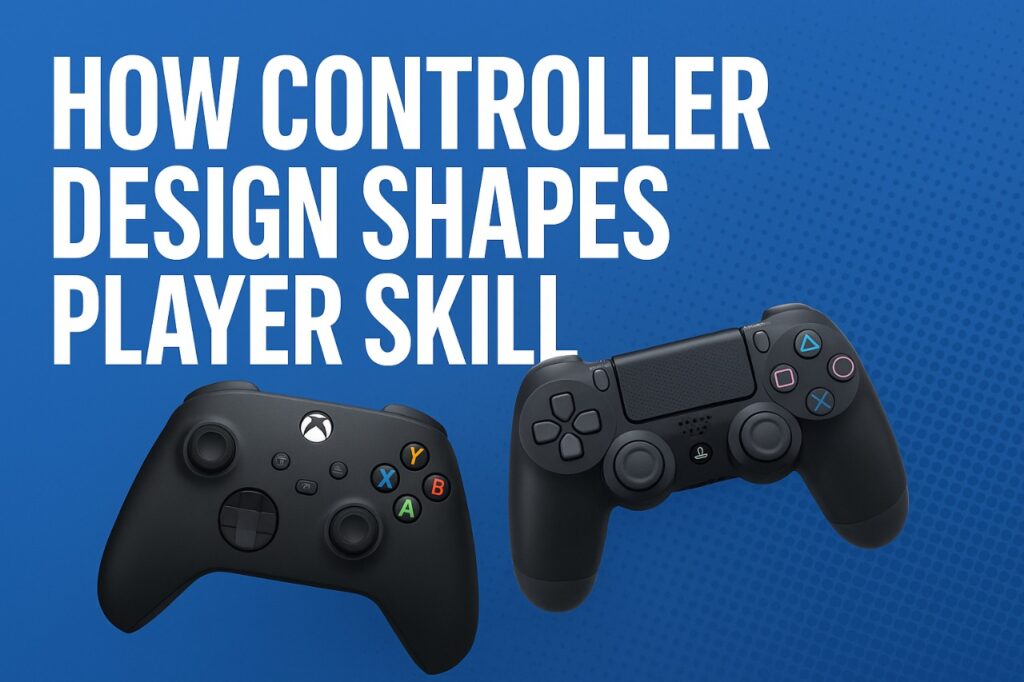
Consider the difference between Xbox and PlayStation controllers. The offset thumbsticks of Xbox favour precision aiming, making it a go-to for shooter fans, while PlayStation’s symmetrical design provides balanced comfort for fighting and platform games.
Even subtle design details — like trigger curvature or vibration feedback — can alter reaction timing and muscle control.
Research in human-computer interaction supports this: our motor skills adapt to hardware layout. In other words, what we call “player skill” is partly controller training. Over time, your hands memorize specific travel paths and actuation pressures. Change that, and your accuracy resets.
🎮 Real Players, Real Patterns
Across gaming communities, the debate over controllers never dies — because the difference is tangible.
Players on Reddit and esports forums often share how switching setups throws off performance:
“I moved from DualShock to Xbox, and my KD dropped for weeks — it felt like relearning how to move.”
These experiences highlight something deeper. When you switch to a new design, you’re not just adjusting to comfort; you’re retraining your hands to speak a slightly different input language.
That’s why controller design in gaming has evolved beyond simple ergonomics — it’s now about input behaviour shaping. The hardware determines how you move, aim, and even how your brain interprets timing.
💡 Why It Matters in 2025
In 2025, controller design has become one of the most critical (and competitive) aspects of hardware innovation.
With the expansion of mobile gaming, handheld PCs, and cloud gaming, the controller is no longer just an accessory — it’s the bridge between human reflex and digital precision.
The rise of customizable controllers like the DualSense Edge, Xbox Elite Series 2, and Razer Wolverine proves the trend. Gamers can now fine-tune thumbstick tension, adjust trigger sensitivity, or remap buttons to suit personal playstyles.
For professional esports players, these micro-adjustments mean milliseconds — and milliseconds decide victory.
Even casual gamers feel the impact. A well-balanced controller reduces fatigue, improves reaction consistency, and helps players build confidence faster. It’s not just a comfort feature anymore — it’s a performance enhancer.
As AI begins influencing adaptive control schemes, gaming controllers 2025 might even learn your style and subtly adjust resistance or vibration to guide your accuracy in real time. The line between “hardware” and “coach” is starting to blur.
🧩 Key Takeaways
- Controller design directly shapes reflexes, accuracy, and comfort.
Ergonomic layouts speed up adaptation and minimize fatigue. - Muscle memory built on one layout can limit cross-platform performance.
- Customizable controllers let players mold hardware to their style.
In modern esports, - Hardware fluency is as important as mechanical skill.
💬 Vibetric Verdict
Vibetric Verdict: Skill isn’t just practice — it’s partnership.
Your controller is more than plastic and circuits; it’s an extension of your reflexes. The right design doesn’t just respond to your input — it teaches your hands how to move, react, and master.
In the era of adaptive gaming hardware, understanding controller design is understanding performance itself.
🔗 Stay in the Loop
Follow @vibetric_official for daily truth checks and deep dives into how design, performance, and innovation really connect.
No hype. No bias. Just facts — the Vibetric way.
💬 What’s your take on this?
The comment section at Vibetric isn’t just for reactions — it’s where creators, thinkers, and curious minds exchange ideas that shape how we see tech’s future.