
Bose Ultra Open Earbuds Review (2025): The Surprisingly Comfortable Way to Listen
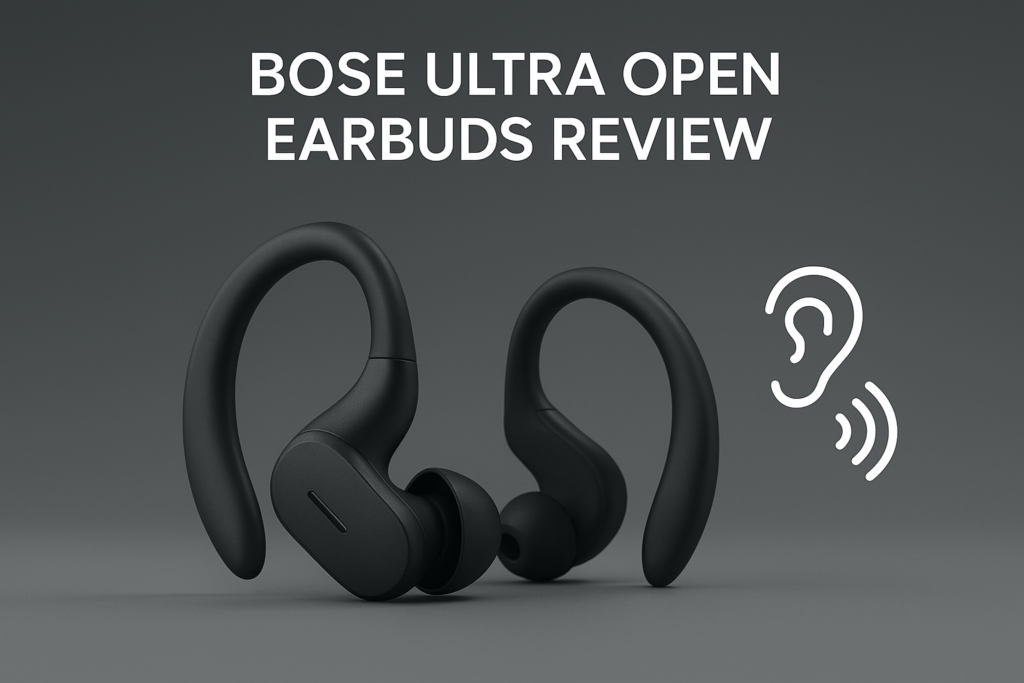
Most earbuds ask your ears to compromise—either endure the pressure of silicone tips, tolerate heat from over-ear pads, or accept the ache of long sessions. The search for something that simply disappears on your ears has been surprisingly difficult. Then the Bose Ultra Open Earbuds landed, promising comfort so effortless it challenges the way we think about personal audio. You put them on expecting a gimmick… but something unexpected happens.
A New Kind of Listening Freedom
On a cool morning walk, the air feels crisp and sound seems brighter. You slip on the Bose Ultra Open Earbuds, and instead of the usual “sealed-off” feeling, the world remains open. You hear distant footsteps, leaf rustling, and the low hum of the street—yet your music rides above it with clarity that shouldn’t be possible in an open design. It feels less like wearing earbuds and more like a sound bubble that follows your motion.
For years, open-ear audio attempted this balance but stumbled in bass response, comfort, or stability. The Ultra Open version marks Bose’s most decisive attempt to fix these long-standing issues with engineering, not marketing.
The Real Problem Bose Set Out to Solve
Everyone knows open-ear designs let in too much ambient noise and usually sound thin. What’s less obvious is the problem behind the problem: most open-ear models direct sound inefficiently, bleeding energy into the air and losing body in the process. That’s why listeners assume open-ear comfort must come at the cost of immersive audio.
The Bose Ultra Open Earbuds flip that expectation. Instead of relying on bone conduction or simple outward-facing speakers, Bose engineered a miniature directional system that behaves more like a focused audio beam than a loose broadcast. The result: comfort without sacrificing presence, and openness without losing engagement.
Why the Bose Ultra Open Earbuds Work So Well
Misconception Reset: Open-Ear = Weak Sound?
For years, the market conditioned us to believe that open-ear equals compromise. If you wanted bass, seal your ears. If you wanted awareness, accept lower fidelity. The Bose Ultra Open Earbuds challenge that binary by showing how targeted acoustics and well-shaped housings can deliver richer sound than expected while leaving the ear canal unobstructed. The surprise isn’t just the audio quality—it’s how natural it feels.
Engineering That Makes Comfort the Point, Not the Bonus
The defining breakthrough lies in Bose’s OpenAudio architecture, pairing a compact transducer with precision-angled vents. The earbuds sit around the ear rather than inside it, using a soft, flexible clasp that distributes pressure along your outer ear structure. There’s no suction, no heat buildup, and no sliding during motion.
A quick micro-table explains the experience:
| Engineering Element | Purpose | Impact |
|---|---|---|
| Directional Acoustic Beam | Focuses sound toward the ear canal | Richer mid-bass + improved clarity |
| Ear-Hugging Flexible Band | Weight distribution + stability | Zero pressure hot-spots |
| OpenAir Vent Path | Preserves ambient sound | High situational awareness |
| Dual-Diaphragm Micro-Driver | Expands low-end response | Warm, full-bodied sound |
| Adaptive EQ Layer | Real-time frequency balancing | Consistent volume and tone |
Why Bose Committed to Open-Ear Design Now
This shift isn’t random. Three consumer behaviors converged:
- Safety-conscious listening during runs, cycling, and commuting.
- A push toward all-day wearables that don’t fatigue ears.
- The expectation of seamless blending with real-world tasks (multitasking, meetings, ambient awareness).
The Bose Ultra Open Earbuds sit directly at that intersection—a lifestyle-first device engineered for blended digital-physical environments.
What This Means for the Future of Audio
Open-ear audio is entering a long-tail growth phase. With AI-driven adaptive sound, spatial awareness mapping, and upcoming gesture-integrated wearables, the category is positioned to evolve rapidly. Bose’s early leadership with the Bose Ultra Open Earbuds suggests a future where earbuds behave more like invisible companions than traditional audio gear. Expect lighter frames, smarter tuning, and deeper AR utility within 2–3 years.
How the Bose Ultra Open Earbuds Perform in Real-World Scenarios
Scenario 1 — Running in Busy Urban Streets
A runner reports feeling safer weaving through traffic since the earbuds don’t isolate critical sounds. The directional design keeps voice audio clear even with street noise, and the secure ear-hugging band prevents shifting during sudden head movement.
Scenario 2 — Working From Home
During long Zoom calls, pressure-free wear becomes the hero. No ear fatigue. No heat. Microphone clarity is surprisingly crisp for an open model, making daylong usage effortless without the usual “compression” feeling.
Scenario 3 — Casual Commuting
Train announcements remain audible, yet the earbuds deliver enough punch to enjoy a podcast. Unlike bone conduction, the Bose Ultra Open Earbuds handle low frequencies well, providing a warm listening environment even without sealing.
Scenario 4 — Outdoor Social Activities
Whether gardening, walking the dog, or cooking outside, you get the sensation of “background music that follows you,” without blocking conversations or environmental cues.
Quick Snapshot Table
| Scenario | Experience Strength | Awareness Level | Comfort Rating | Best Feature |
|---|---|---|---|---|
| Running | High stability | Very High | Excellent | Secure outer-ear clasp |
| Video Calls | Clear voice | Medium | Exceptional | Natural-feeling wear |
| Commuting | Good clarity | High | Strong | Mid-bass warmth |
| Social Time | Seamless blending | High | Excellent | Ambient-friendly sound |
| Cycling | Good situational sound | Very High | Great | No canal blockage |
| Desk Work | Relaxed feel | Medium | Excellent | Fatigue-free fit |
The Acoustic Science Behind Bose’s Approach
The physics are straightforward: sound loses energy with distance and dispersal, and open-ear earbuds traditionally let that happen. Bose compensates with:
- Precision driver placement to reduce spill
- Tuned reflections inside the housing to regain bass
- Adaptive frequency balancing that maintains clarity during movement
- Tight beam projection to minimize leakage
Rather than force isolation, Bose optimizes the path sound takes.
How This Impacts the Human Listening Experience
The shift is subtle but powerful. With the Bose Ultra Open Earbuds:
- Your ears never feel “blocked,” reducing fatigue.
- Your brain doesn’t struggle to blend outside noise with sealed-in audio.
- You stay connected to your environment, lowering cognitive load.
- Background sound feels natural rather than artificially isolated.
This makes long-term listening feel less like wearing a device and more like living inside a lightly amplified personal soundscape.
Buyer Guide: Who the Bose Ultra Open Earbuds Are Best For
Everyday Listeners
Ideal for walks, desk work, chores, and casual use. No pressure, no heat, no discomfort.
Creators & Professionals
Great for conference calls, editing reference audio, or long sessions requiring situational awareness.
Fitness Users
A stable design that stays put without sealing in sweat or blocking traffic sounds.
Future-Proof Buyers
If you want where wearable audio is headed—not where it’s been—this category is worth entering.
Pros & Cons Table
| Category | Pros | Cons |
|---|---|---|
| Sound Quality | Warm, focused, surprisingly full | Not for heavy bass lovers |
| Comfort | Pressure-free, all-day wear | May feel unusual at first |
| Awareness | Excellent for outdoor use | Poor isolation in loud areas |
| Design | Sleek, stable, ergonomic | Cannot fold or collapse |
| Use Cases | Multi-scenario versatility | Not ideal for airplanes |
The Counter-Perspective: Who Should Skip These
Some listeners want escape, not awareness. If your priority is deep immersion, thumping bass, or blocking out noisy environments like planes or packed cafés, the open-ear model won’t deliver that. The Bose Ultra Open Earbuds are designed for inclusion in the environment—not exclusion.
Reddit / Real User Reality
Conversations around the Bose Ultra Open Earbuds highlight a consistent pattern: comfort praise, curiosity about sound physics, and debates about noise isolation expectations.
| User Type | Feedback Summary | Relevance |
|---|---|---|
| Runners | Loves safety & comfort | High |
| Cyclists | Appreciates awareness | High |
| Audiophiles | Wants more isolation | Medium |
| Remote Workers | Praises multi-hour comfort | High |
| Tech Reviewers | Acknowledge sound innovation | High |
| Commuters | Mixed: clarity good, noise bleed varies | Medium |
| Students | Great for libraries if volume kept low | Medium |
| Casual Listeners | Enjoy “invisible” feel | High |
Across threads, the most repeated sentiment: “It feels weirdly natural… like sound is just floating near your ear.”
Criticism focuses primarily on environments that demand isolation.
Where Open-Ear Audio Is Heading
Expect the next wave of Bose Ultra Open Earbuds to integrate:
- AI adaptive environmental mixing
- Directional noise-reduction mics
- Smarter spatial beam shaping
- Ultralight composite materials
- Multi-device fluid handoff
The category is moving toward ambient-aware sound bubbles, not sealed listening chambers.
Closing Narrative: Comfort That Redefines Listening
Think back to that morning walk—quiet air, soft light, and music that complements the world rather than hiding it. The Bose Ultra Open Earbuds embody that feeling. They don’t demand that you shut anything out. Instead, they expand the way audio fits into your daily rhythm. Comfort becomes the medium; sound becomes the companion. And you become part of your environment instead of retreating from it.
Vibetric Ending
This is audio that supports your life instead of interrupting it—exactly the kind of thoughtful design we champion at Vibetric.
Ready for the Next Big Leap in Audio?
- Follow vibetric_official on Instagram for emerging audio technology insights.
- Bookmark Vibetric.com we update analyses as new open-ear innovations appear.
- Subscribe for future breakdowns and expert evaluations of next-gen listening gear.
Common Questions People Ask About the Bose Ultra Open Earbuds
- Do the Bose Ultra Open Earbuds leak sound?
Minimal leakage at moderate volumes thanks to directional drivers. - Can you use them for calls?
Yes—microphones perform well for open-ear form factors. - Are they good for running?
Excellent stability, high awareness, and no sweat accumulation. - Do they replace noise-cancelling earbuds?
No. They are designed for openness, not isolation. - How’s the bass?
Warm and present for an open-ear model, but not sub-heavy. - Can they be worn with glasses?
Yes. The outer-ear clasp avoids typical pressure points. - Are they safe for cycling?
Safer than sealed earbuds because they maintain road awareness. - Are they good for airplane travel?
Not ideal—lack of isolation makes them less suited for loud cabins. - Do they get uncomfortable with long use?
They are specifically engineered for all-day comfort. - Will they work with future Bose wearable features?
Their design suggests strong compatibility with upcoming ambient-sound and AR ecosystems.
What’s your take on this?
At Vibetric, the comments go way beyond quick reactions — they’re where creators, innovators, and curious minds spark conversations that push tech’s future forward.

Galaxy S26 Ultra Privacy Display: 5 Brutal Real-World Truths Nobody Tells You
Galaxy S26 Ultra Privacy Display: 5 Brutal Real-World Truths Nobody Tells You There’s a specific anxiety that comes with using a phone