
Why So Many New Phones Feel Identical
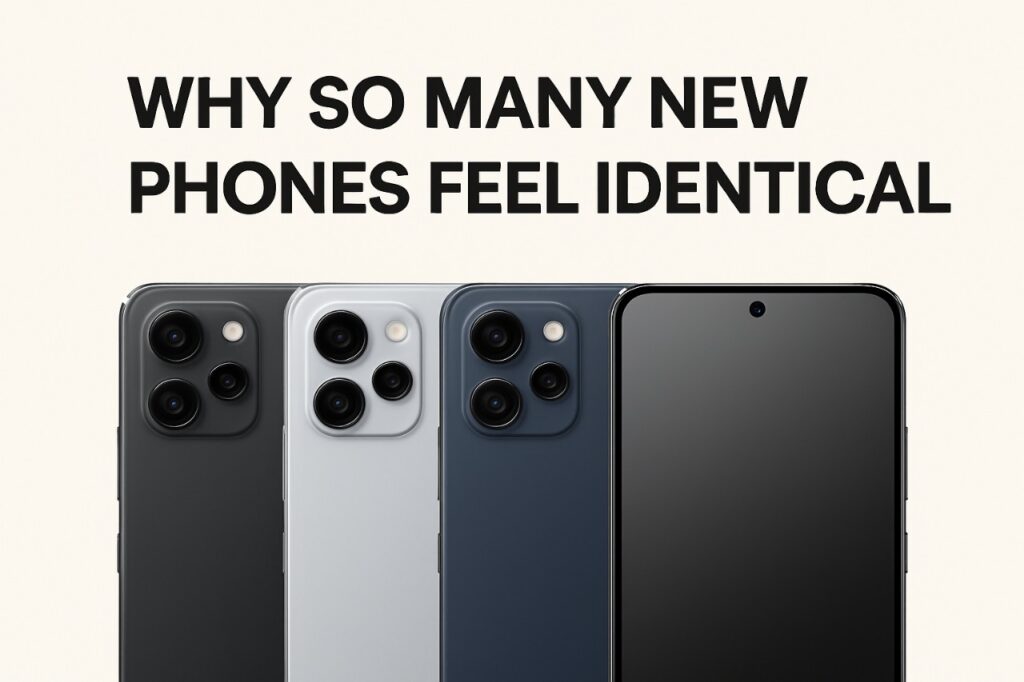
For years, smartphone launches felt exciting — new shapes, new ideas, new identities. But in 2025, something strange happened: almost every phone started looking, feeling, and functioning the same.
Same flat edges.
Same triple-camera layout.
Same glossy marketing language.
Same “AI-powered everything.”
What once felt like innovation now feels like repetition. And it’s not your imagination — the industry has, in many ways, merged into one giant template.
This blog explains why new phones feel identical, the hidden forces shaping this sameness, and why the future of phones might not be as predictable as it seems.
⚙️ Core Insight (Depth + Clarity)
The similarity isn’t accidental — it’s engineered into the industry.
Brands have converged on the same design and feature set because of three unavoidable forces:
1. Mature Hardware
There’s very little room left for radical physical innovation.
The rectangle-with-a-screen format has reached near-perfect efficiency. Thinner bezels, better materials, smoother curves — these refinements are incremental, not transformative.
When hardware stabilizes, design creativity naturally shrinks.
2. Supplier Dependence
Most brands buy from the same ecosystem:
- Sony & Samsung for camera sensors
- BOE, Samsung, LG for OLED displays
- Qualcomm / MediaTek / Apple for chipsets
When everyone sources from the same pool, the end product feels similar — even if the brands are different.
3. Risk-Averse Marketing
Safe designs guarantee sales. Unique designs rarely do.
Every time a company tried something bold — modular phones, curved displays, periscope pop-ups — the market rejected it or the tech failed long-term. Brands now prefer the formula that sells over the design that risks.
So when every company uses the same suppliers, competes in the same price categories, and follows the same consumer trend reports, the result is what explains why new phones feel identical.
📊Bite-Sized Data Table
| Factor (2025) | Real Impact | How It Causes Sameness |
|---|---|---|
| Shared suppliers | High | Same camera sensors, same displays |
| Design trends | Medium | Brands copy what sells |
| AI marketing | High | Every brand pushes “AI features” |
| User expectations | High | Compact, flat, safe designs preferred |
| Cost cutting | Medium | Fewer unique hardware components |
🔍 Micro Analysis
1. The Real-World Effect
Pick up any 2025 mid-range or flagship phone, and the differences are microscopic:
- a slightly different camera bump
- a new colour finish
- a marginally thinner bezel
But the experience? Almost identical.
Why? Because brands are optimizing for the same priorities:
- Efficiency
- Thinness
- battery life
- minimal overheating
- wide appeal
Radical ideas — curved screens, modular phones, slider mechanisms, pop-up cameras — have mostly disappeared. Not because they failed technologically, but because they failed economically:
- higher production costs
- lower durability
- poor repairability
- low consumer demand
So the market optimized itself into practicality over personality. The result: Phones no longer try to stand out — they try to not make mistakes.
2. The Hidden Truth
Brands avoid risk because one wrong design can cost millions.
Research shows that:
- flat sides
- matte backs
- minimal camera bumps
- centred punch-hole displays
…sell the best across global markets. Even if one brand tweaks a design, the others mimic it within months.
But there’s a deeper shift explaining why new phones feel identical: AI is replacing hardware differentiation. Phones compete more on:
- computational photography
- real-time AI editing
- on-device generative features
- predictive battery optimization
- adaptive display tuning
Software layers now matter more than unique hardware. As AI becomes the main selling point, hardware naturally becomes more uniform — because all brands need a stable platform for their software to shine.
🌍 Culture Angle
There was a time when your phone reflected your personality:
curved edges, bold colours, gradient finishes, quirky designs.
Today, users are more practical — they prioritise:
- battery life
- sustained performance
- thermal stability
- reliable cameras
- software longevity
- durability
Form has taken a back seat to function.
The shift is cultural: people prefer devices that blend in, not stand out. Neutral tones, sharp lines, clean backs — these choices match modern minimalist lifestyles.
When consumers value consistency over uniqueness, brands follow the money. And the cycle reinforces itself: the more uniform phones become, the more users expect that uniformity.
🧠 Quick Vibetric Takeaways
- Phone design has reached maturity → less room for bold experiments.
- Brands share the same suppliers → hardware naturally becomes uniform.
- Market research pushes companies toward safe, identical designs.
- AI has replaced hardware as the main differentiator.
- Real-world experience matters more to users than aesthetic uniqueness.
- “Sameness” is not laziness — it’s a market-driven optimization.
- The future differences will be inside the software, not the casing.
💬 Vibetric Verdict
Vibetric Verdict: Phones today aren’t identical because brands lack creativity — they’re identical because the market demands efficiency, reliability, and familiarity.
The real differentiation is shifting:
Not in the camera bump.
Not in the screen curve.
Not in the colours.
But in how the phone thinks — its AI capabilities, computational processing, and responsiveness under load.
As on-device AI improves, expect even more similarity on the outside… but far bigger differences in how phones behave, adapt, and personalize themselves.
The future of smartphones won’t be defined by shapes — but by intelligence.
🔗 Stay in the Loop
We don’t sell hype — we explain it.
- Follow @vibetric_official for grounded insights on smartphone trends, real-world testing, and deep-tech analysis.
- Bookmark vibetric.com to stay ahead of the tech curve.
- No hype. No bias. Just facts — the Vibetric way.
💬 What’s your take on this?
The comment section at Vibetric isn’t just for reactions — it’s where creators, thinkers, and curious minds exchange ideas that shape how we see tech’s future.
Minimalist Tech Design Trends 2026 — Why Clean, Powerful Devices Are Winning
Minimalist Tech Design Trends 2026 — Why Clean, Powerful Devices Are Winning For years, consumer technology competed on excess — more cameras,

AI Infrastructure in 2026: The Critical Shift Reshaping Modern Technology
AI Infrastructure in 2026: The Critical Shift Reshaping Modern Technology For years, artificial intelligence was presented as decoration. Product launches highlighted AI-enhanced